Encyclopedia Anachronistica

Standard
Armor
Asia
Chinese
Body Art
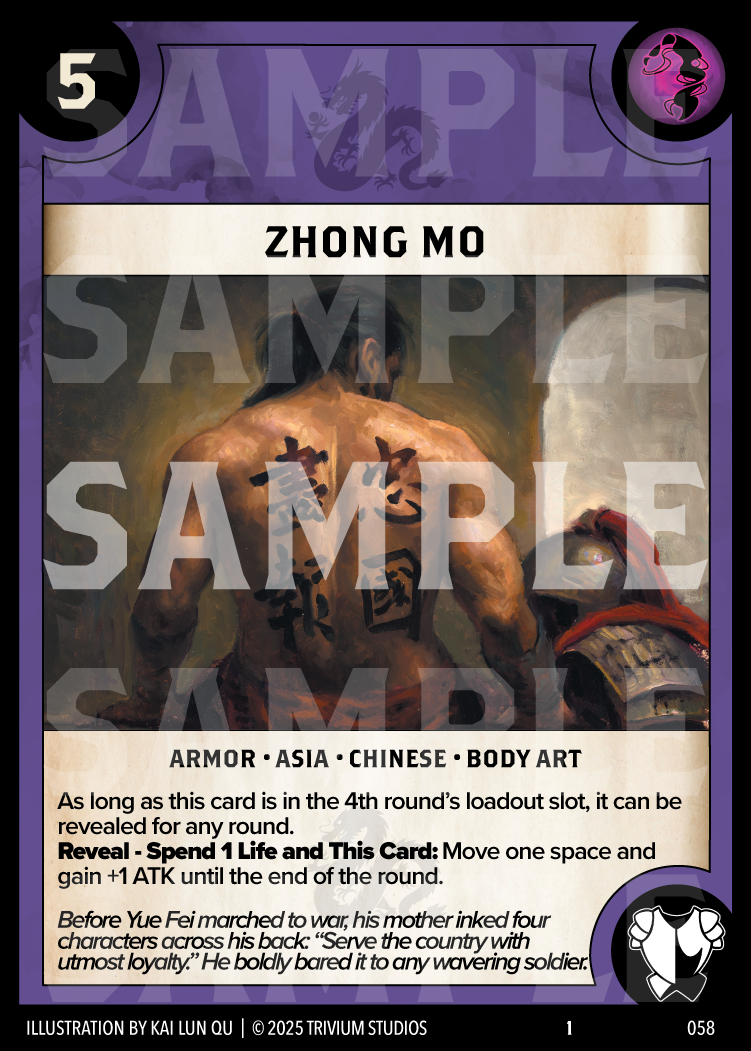
As long as this card is in the 4th round's loadout slot, it can be revealed for any round. Reveal - Spend 1 Life and This Card: Move one space and gain +1 ATK until the end of the round.
Before Yue Fei marched to war, his mother inked four characters across his back: "Serve the country with utmost loyalty." He boldly bared it to any wavering soldier.
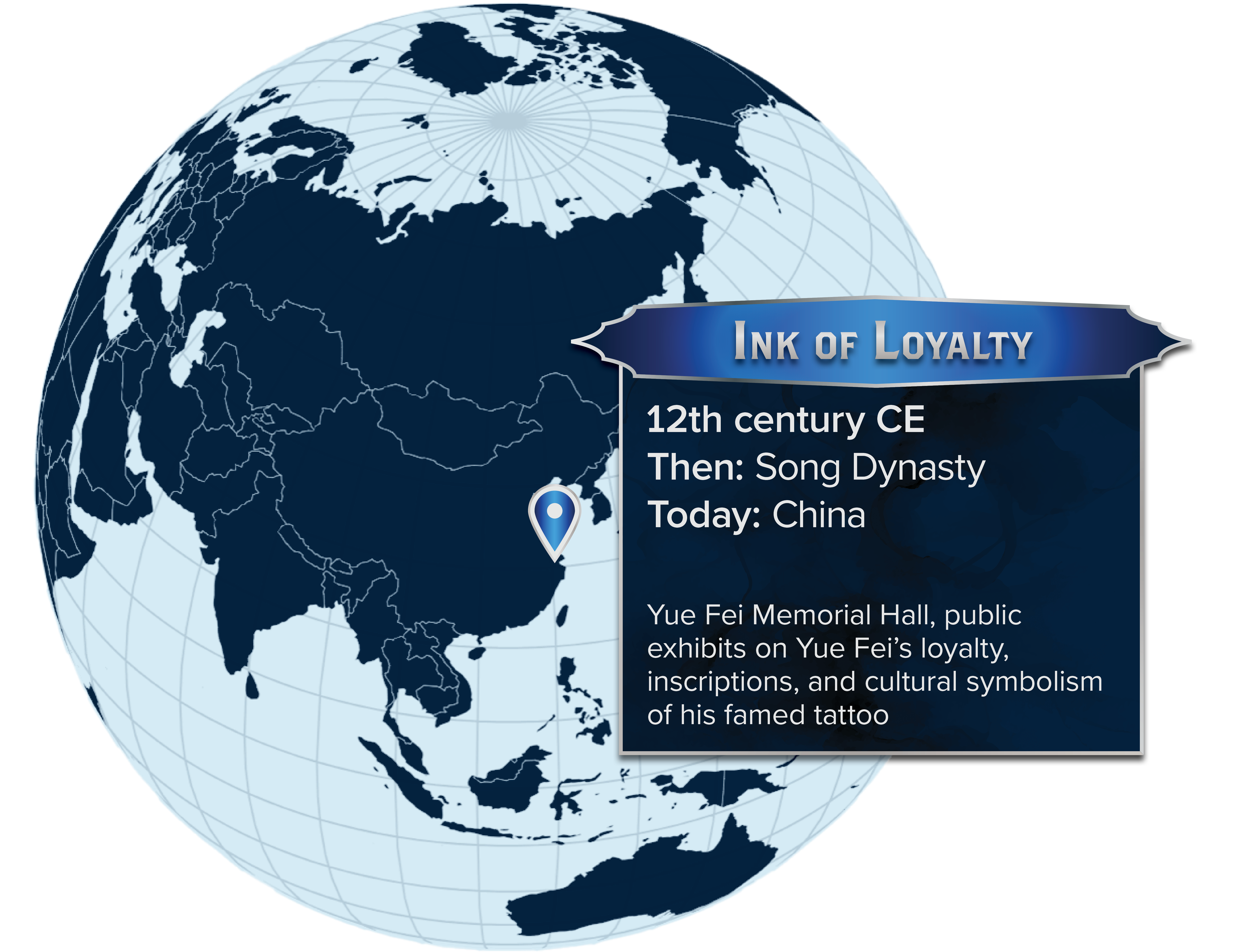
“Ink of Loyalty” refers to the famous tattoo said to have been inscribed on Yue Fei’s back: “Jin Zhong Bao Guo” (尽忠报国), meaning “Serve the country with utmost loyalty.” Although the earliest textual references to the ink appear in later dynastic sources rather than contemporary Song records, the tattoo became one of the most enduring symbols of Yue Fei’s legacy. It encapsulates the Confucian ideal of absolute devotion to one’s sovereign and homeland, a theme that resonated deeply in periods of foreign invasion and internal turmoil.
The popular story describes Yue Fei’s mother tattooing the phrase onto his back before he left to join the army, ensuring that he would never forget his duty. While the official History of Song records the ink as a testament of his own resolve revealed during an interrogation, it was later Ming-era novels that introduced his mother as the calligrapher—weaving together the two most important Chinese virtues: filial piety and state loyalty. Whether literal or allegorical, the tale reflects the moral expectations placed on military leaders during the Southern Song’s struggle against the Jin. Interestingly, at memorial sites like the Yue Fei Temple, the character for "Country" (国) is often missing a final stroke, a deliberate calligraphic choice symbolizing that the nation was "incomplete" while the north remained under Jurchen occupation.
In cultural memory, the tattoo became a moral anchor. Ming and Qing operas, novels, and woodblock prints depict Yue Fei revealing the characters before battle, inspiring troops and shaming traitors. The tattoo also appears in martial arts lore, where it symbolizes the unity of body, will, and moral purpose. Even in modern times, the phrase is invoked in patriotic contexts, often associated with sacrifice and national integrity.
From a historical perspective, the tattoo reflects broader Song-era anxieties about loyalty and the fragility of the state. Yue Fei’s eventual execution under suspicious political circumstances only amplified the tattoo’s meaning, transforming it into a critique of court corruption. Today, the Ink of Loyalty remains one of the most recognizable moral symbols in Chinese history—a reminder of the tension between personal virtue and political reality.