Encyclopedia Anachronistica


Chrono
Weapon
Asia
Chinese
Sword
When this green or yellow Champion attacks with this weapon, overlay both the weapon and Champion base attack grids to determine the attack roll result.
Crafted by master swordsmith Ou Yezi, the Yuchang ("Fish Intestines") Sword was famed for its compact form, razor edge, and use in the assassination of King Liao.
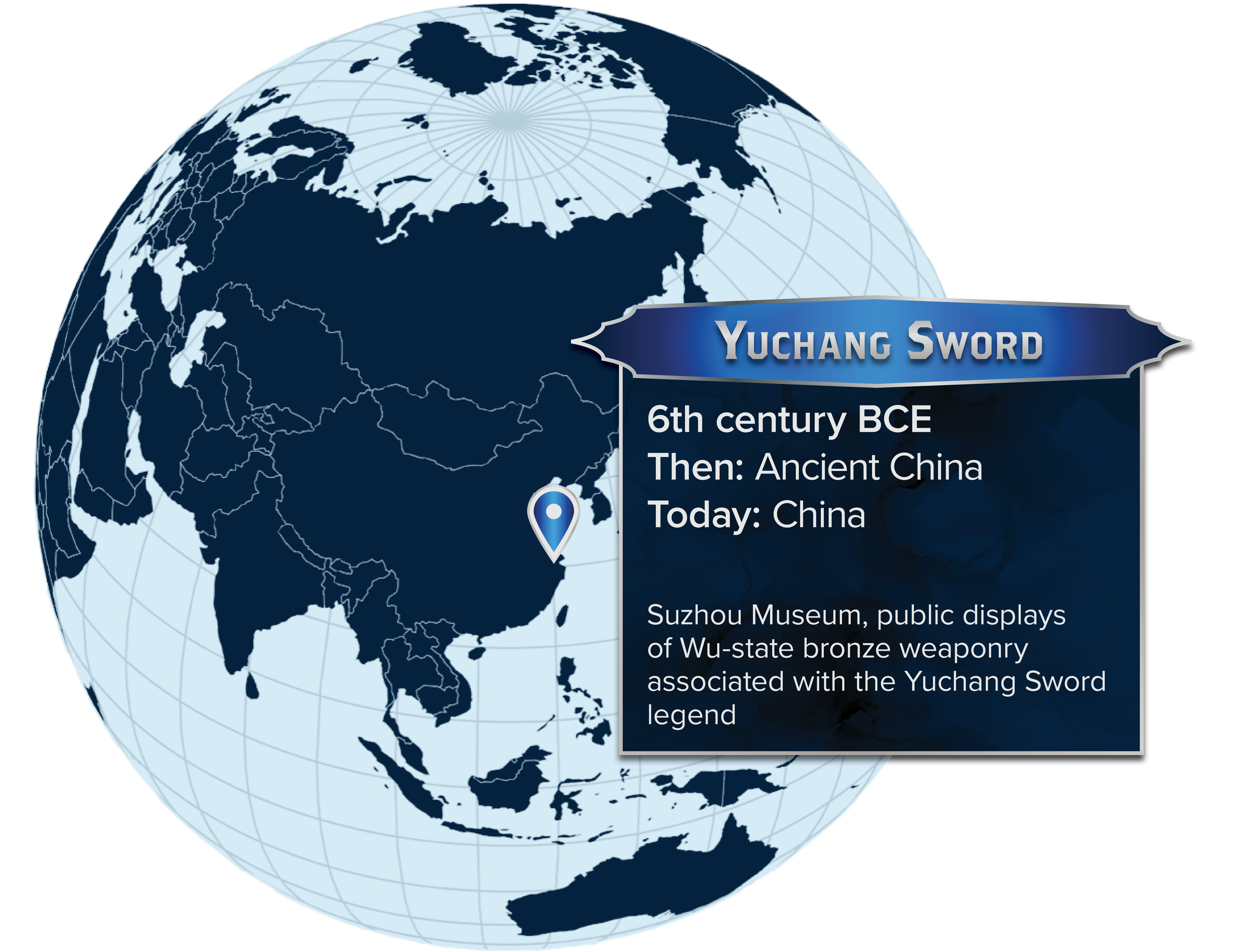
In the high-stakes world of the Spring and Autumn period (ca. 770–476 BCE), power often shifted not on the battlefield, but at the tip of a hidden blade. The Yǔ Chāng Jiàn, or "Fish-Intestine Sword," is the most famous of these covert weapons. Forged by the legendary Yue swordsmith Ou Yezi—a man said to infuse his steel with elemental forces—this blade was never intended for a soldier’s scabbard. Instead, it was designed to be small, narrow, and incredibly sharp: a masterwork created specifically for the art of assassination.
The sword’s bizarre name is rooted in the most famous political hit in Chinese history. According to tradition, the assassin Zhuan Zhu was hired by Prince Guang to eliminate King Liao of Wu. To bypass the king’s heavy security at a private banquet, Zhuan Zhu hid the slender blade inside the belly of a large, steamed fish. When the dish was presented to the king, the assassin drew the hidden sword and struck, killing the king and changing the course of the Wu state forever. This legendary act cemented the Yǔ Chāng Jiàn as a symbol of precision, lethal resolve, and the dangerous intimacy of political violence.
While the sword itself belongs to the realm of myth rather than archaeology, its story reflects the very real tensions of ancient China. During this era, rival states like Wu and Yue were locked in a cycle of vengeance and "shadow warfare," where professional assassins were often as important as generals. These stories were recorded in foundational texts like the Records of the Grand Historian (Shiji), ensuring that the Fish-Intestine Sword would be remembered as one of the "Ten Famous Swords" of Chinese culture—a literary group that celebrates the moral and symbolic weight of legendary steel.
Today, the Yǔ Chāng Jiàn remains a staple of Chinese cultural memory, appearing in everything from classical opera to modern martial arts films. Though no physical blade from Ou Yezi’s forge has ever been found, the legend of the fish-hidden sword endures. It serves as a reminder that in the history of power, a small, well-timed blade can be just as impactful as an entire army.