Encyclopedia Anachronistica


Chrono
Special
Asia
Chinese
Realm
Kingdoms 1 of 3: Up to three Kingdoms cards may be used this game. Reveal: Rotate each Champion to face north. Gain +1 ATK until the end of the round.
Founded by Cao Pi after ending the Han, Wei, strongest of the Three Kingdoms, held rich northern China, including the Central Plains and Yellow River basin.
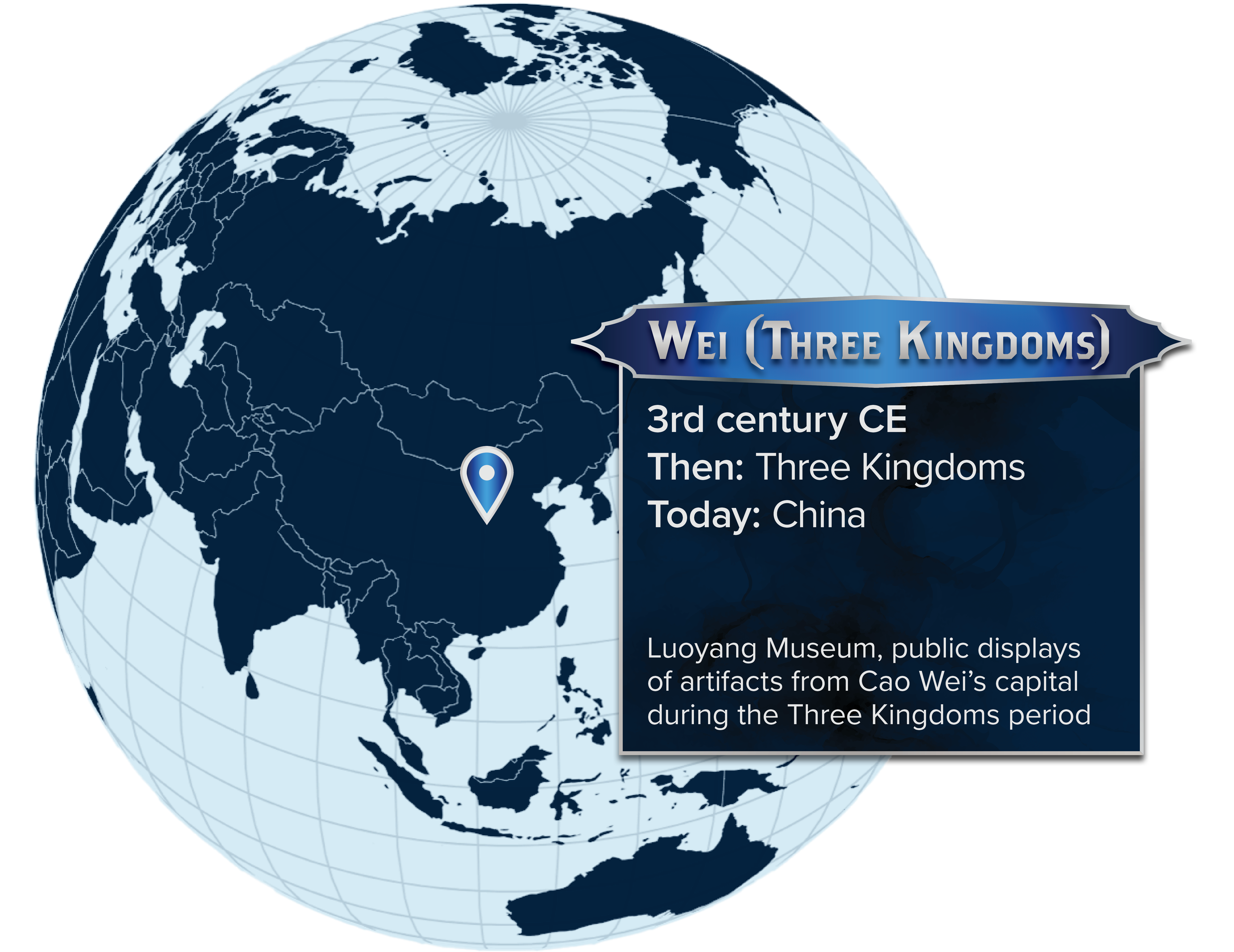
Following the collapse of the Han dynasty, the State of Wei emerged as the powerhouse of the Three Kingdoms era. Dominating the fertile Yellow River heartland, Wei held the keys to China’s political and economic core. Its rise was fueled by the visionary—and often ruthless—leadership of Cao Cao, whose administrative reforms and military innovations turned a fractured landscape into a disciplined, centralized state that outmatched its rivals in both scale and efficiency.
Wei’s dominance was built on a foundation of "Strategic Realism." Through the tuntian system, Cao Cao settled soldiers and refugees on state-managed farms, creating a self-sustaining cycle of food production and frontier defense. When his son, Cao Pi, formally declared the Wei dynasty in 220 CE, he inherited a professionalized bureaucracy and a massive pool of manpower. These resources allowed Wei’s armies to repeatedly blunt the famous northern expeditions of Shu’s Zhuge Liang and check the naval power of Wu to the south.
Beyond the battlefield, Wei was a vibrant intellectual hub. It was home to the Seven Sages of the Bamboo Grove and other scholars who explored new frontiers in poetry, metaphysics, and music. The court debates of this era shaped Chinese political thought for centuries, balancing the need for firm legal authority with the refined cultural ideals of the displaced Han elite. Though the kingdom never achieved the ultimate goal of full unification, its institutional strength provided the blueprint for the Jin dynasty that eventually followed.
Today, Wei is remembered as the realm of strategic brilliance and institutional weight. Its leaders remain some of the most debated figures in history: brilliant poets and administrators who were also capable of chilling pragmatism. As the kingdom that came closest to restoring imperial order, Wei stands as a testament to the idea that administrative discipline and economic stability are the true engines of power.