Encyclopedia Anachronistica

Standard
Inspiration
Europe
Roman
Ideology
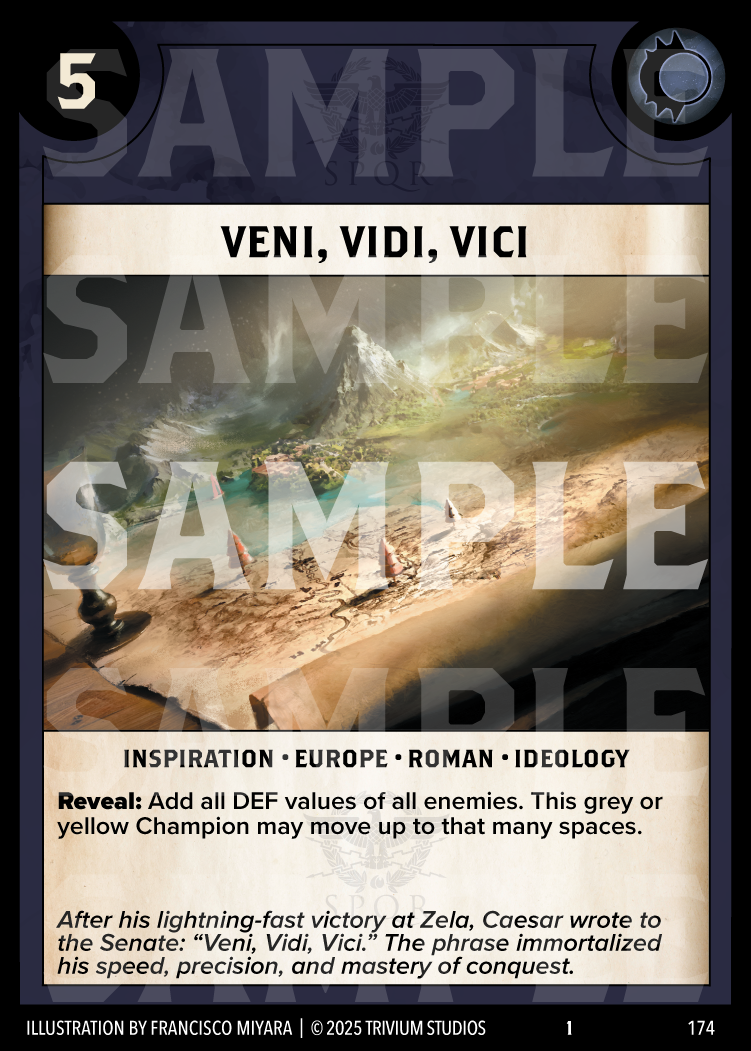
Reveal: Add all DEF values of all enemies. This grey or yellow Champion may move up to that many spaces.
After his lightning-fast victory at Zela, Caesar wrote to the Senate: "Veni, Vidi, Vici." The phrase immortalized his speed, precision, and mastery of conquest.

In the year 47 BCE, Julius Caesar sent a message back to Rome that would become the most famous "status update" in human history: Veni, vidi, vici. Translated as "I came, I saw, I conquered," these three words were a report on his victory at the Battle of Zela in modern-day Türkiye. Caesar had just faced King Pharnaces II, an ambitious ruler who thought he could capitalize on Rome’s internal chaos to carve out an empire of his own. He was wrong. Caesar crushed the king’s forces in a lightning-fast campaign that lasted only five days, ending the final battle in a matter of hours.
While many people imagine Caesar shouting these words from the back of a horse or during a grand speech, they actually began as a written letter to the Roman Senate. At the time, Rome was exhausted by civil war and political infighting. Caesar knew that he didn't just need to win battles; he needed to win the "PR war." By boiling an entire military campaign down to three rhythmic, punchy words, he was sending a clear signal to his political rivals that he was moving faster and more decisively than anyone else. It wasn't just a boast; it was a warning that the man who could conquer an entire kingdom in a week was not someone to be trifled with at home.
The brilliance of the phrase lies in its "tricolon" structure—a series of three parallel words that create a sense of inevitable momentum. Ancient historians like Plutarch and Suetonius were so impressed by the brevity of the message that they recorded it for posterity, noting that Caesar even had the words displayed on a banner during his triumphal parade in Rome.
In the modern world, we are surrounded by the descendants of Caesar’s three-word masterpiece. From the punchy slogans of billion-dollar brands to the viral "mic drop" moments on social media, we still live in an era where the shortest message often carries the most weight. Caesar was essentially the first master of the "soundbite." He understood that while a long, detailed report might prove your intelligence, a three-word summary proves your power. In a world of endless information, his ability to cut through the noise is a tactic still used by world leaders and marketing experts today to command attention and project an image of effortless control.
The phrase also serves as a timeless reminder of the "humblebrag" taken to an extreme. By making his massive military achievement sound as simple as running an errand, Caesar set the gold standard for projecting confidence. Today, when we see a successful entrepreneur or athlete summarize a decade of hard work with a single, cool sentence, they are channeling that same Roman swagger. Veni, vidi, vici survives because it captures a universal human desire: the wish to face a complex, overwhelming challenge and make the solution look easy. It teaches students that history isn't just about what you do, but about how you frame your story for the world to see.