Encyclopedia Anachronistica

Standard
Special
Middle East
Persian
Tactic
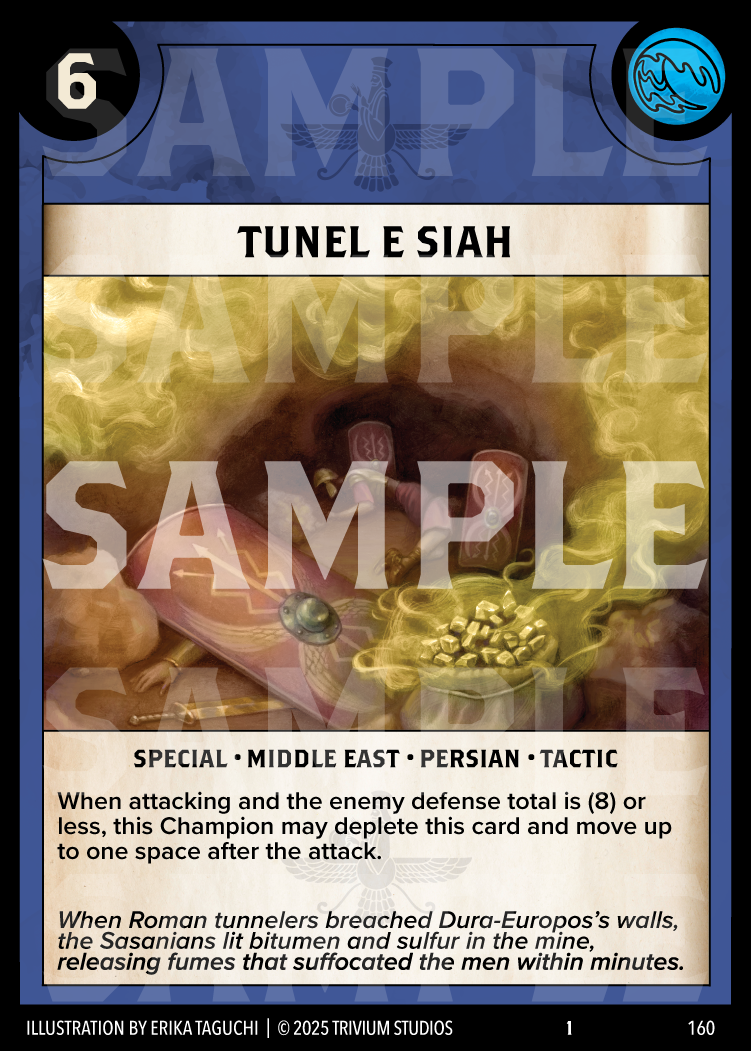
When attacking and the enemy defense total is (8) or less, this Champion may deplete this card and move up to one space after the attack.
When Roman tunnelers breached Dura-Europos's walls, the Sasanians lit bitumen and sulfur in the mine, releasing fumes that suffocated the men within minutes.

During the siege of Dura-Europos in 256 CE, the war between Shapur I and the Romans descended into the literal dark. Beneath the city’s massive walls, archaeologists discovered a claustrophobic battlefield where Persian miners and Roman counter-miners fought a nightmare war of tunnels. In one of these narrow, hand-carved passages, the remains of twenty Roman soldiers were found stacked in a cramped space. Curiously, their bodies showed no signs of trauma from swords or spears; they looked as though they had simply dropped where they stood.
In 2009, archaeologist Simon James proposed a chilling explanation that changed our understanding of ancient combat: the Sasanians had used chemical warfare. Evidence suggests that as the Romans broke into the Persian tunnel, the Sasanian miners ignited a mixture of bitumen and sulfur crystals. When burned, these materials produce sulfur dioxide—a heavy, choking gas that turns into sulfuric acid upon contact with the moisture in human lungs. In the confined, oxygen-poor environment of the tunnel, the fumes would have acted as a "death cloud," suffocating the Roman defenders in a matter of minutes.
The "Black Tunnel" provides a haunting snapshot of this moment. The walls are still stained with chemical residue, and the pile of bodies suggests the Romans were overcome so quickly they didn’t even have time to retreat. Nearby, the remains of a single Sasanian soldier were found—likely a victim of his own side’s lethal innovation, tasked with stoking the fire until the very end. For Shapur I, the fall of Dura-Europos was a strategic victory, but for military history, it represents one of the earliest and most brutal uses of industrial chemistry as a weapon.
Today, Dura-Europos is considered one of the most important archaeological windows into the Sasanian-Roman conflicts. This event isn’t recorded in the heroic victory inscriptions of Shapur or the panicked histories of Rome; it was preserved only in the silent, blackened earth. It serves as a stark reminder that the ancient world was often far more "modern" in its brutality than we care to imagine, using every tool available—from the mountains’ stones to the earth’s chemicals—to tip the scales of empire.