Encyclopedia Anachronistica

Standard
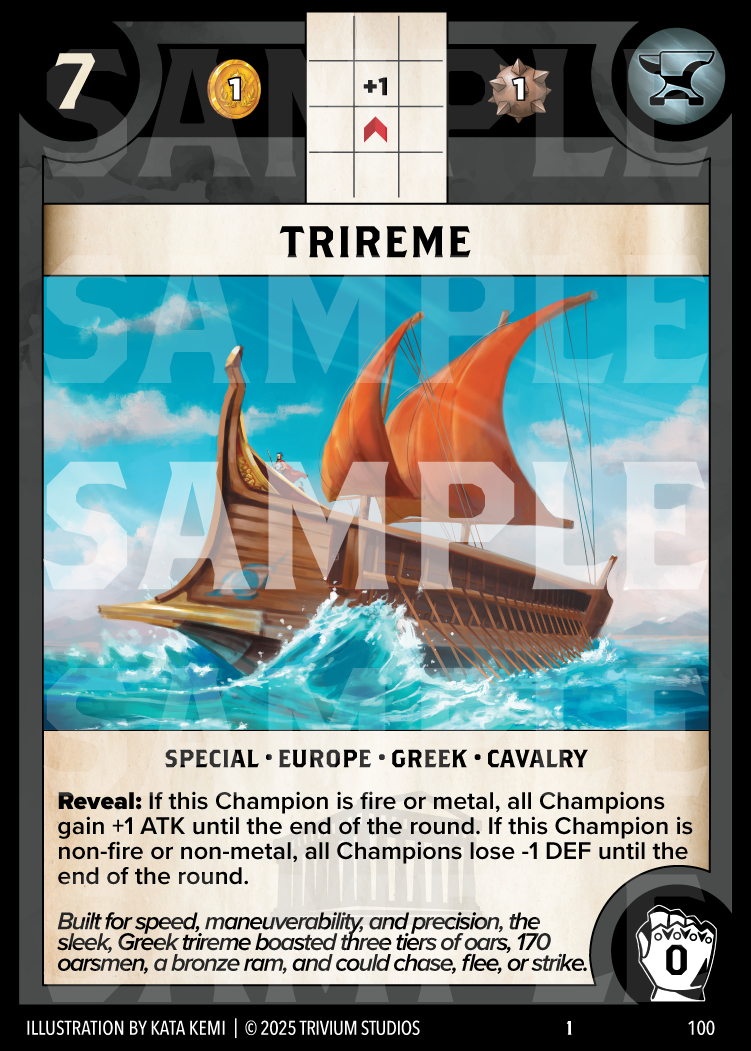
Special
Europe
Greek
Cavalry
Reveal: If this Champion is fire or metal, all Champions gain +1 ATK until the end of the round. If this Champion is non-fire or non-metal, all Champions lose -1 DEF until the end of the round.
Built for speed, maneuverability, and precision, the sleek, Greek trireme boasted three tiers of oars, 170 oarsmen, a bronze ram, and could chase, flee, or strike.
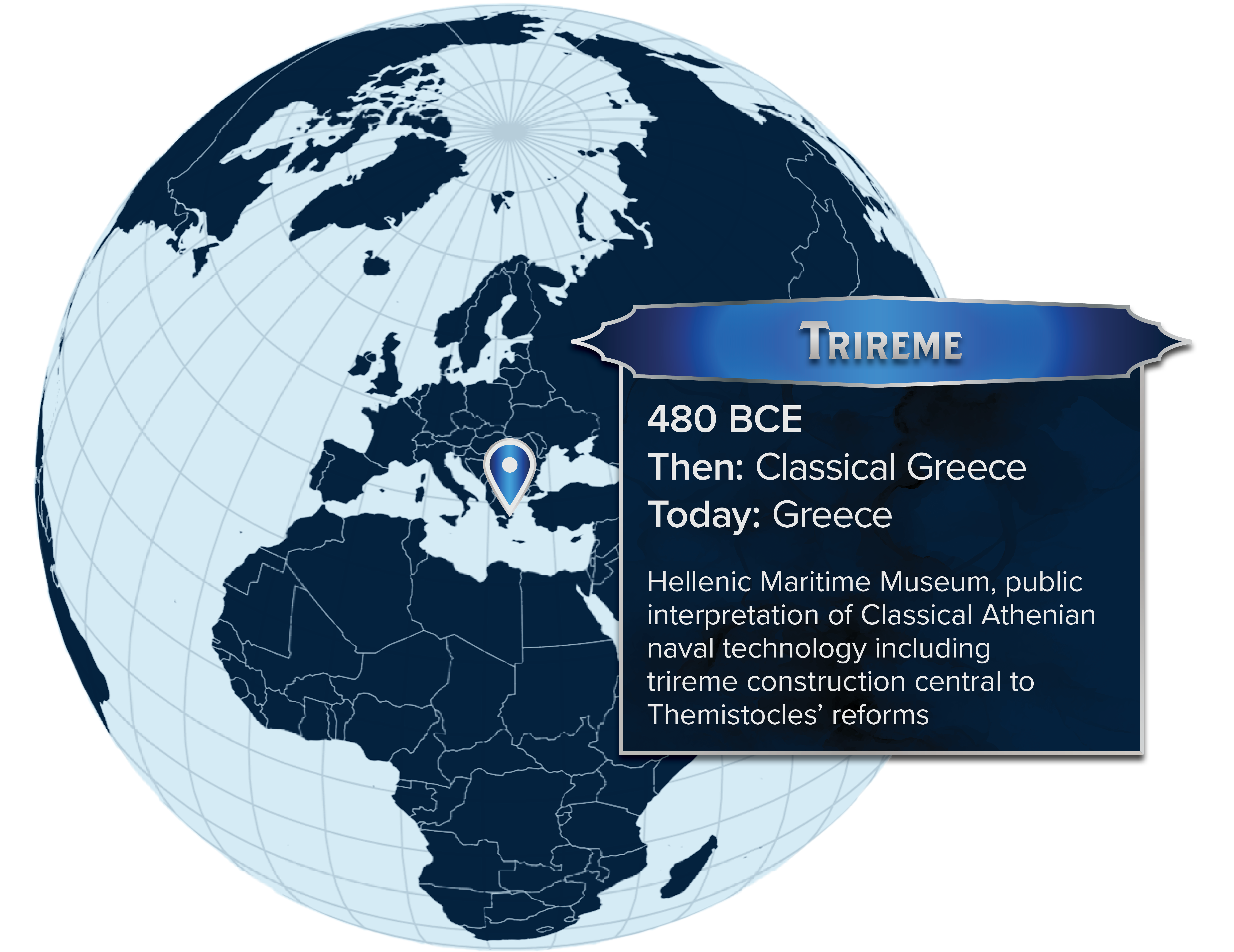
The trireme was the ancient world’s version of a fighter jet: sleek, incredibly fast, and designed for one specific purpose—destruction. This 37-meter (120-foot) wooden warship was the engine that transformed Athens from a small city-state into a global superpower. Its name comes from its most innovative feature: three tiers of rowers stacked on top of each other. By packing 170 rowers into a narrow hull, the trireme achieved a power-to-weight ratio that allowed it to sprint across the water at speeds up to 9 knots (about 10 mph).
The genius behind the Athenian navy was a leader named Themistocles. When a massive vein of silver was discovered in the mines at Laurion, most citizens wanted to split the money. Themistocles, however, convinced them to gamble on the future by building a fleet of 200 triremes. He knew that the Persian Empire was coming, and that the only way to stop a massive land army was to dominate the sea. He didn't just build ships; he built a culture of training. A trireme wasn't just wood and bronze; it was a "living machine" that required perfect rhythm. Rowers followed the beat of a flute player (auletes), moving in such tight synchronization that a single mistake could tangle the oars and stop the ship dead.
The trireme's primary weapon wasn't an arrow or a catapult—it was the ship itself. On the front of every vessel was a massive bronze-sheathed ram. The goal of a trireme captain was to use the ship’s agility to "blade" the enemy’s oars or smash directly into their wooden hull. This strategy was the key to the Battle of Salamis in 480 BCE. Themistocles lured the massive, clunky Persian fleet into the narrow straits of Salamis where they couldn't turn. The smaller, faster Athenian triremes darted in and out, ramming the Persian ships until the water was filled with wreckage.
For a long time, historians weren't sure if the ancient descriptions of these ships were actually possible—could 170 men really pull that much weight? In the 1980s, a team of engineers and historians built the Olympias, a full-scale working reconstruction. They proved that the three-tier system worked brilliantly, but they also discovered how difficult it was. Rowers had almost no space, it was incredibly hot, and they had to trust their lives to the person sitting next to them.
Today, the trireme is a symbol of what happens when technology, teamwork, and a bold vision collide. It didn't just win a war; it protected the birth of democracy. Because the navy required thousands of poor citizens to serve as rowers, these men gained a political voice, forever changing the structure of Athenian society. The trireme proves that a single invention can do more than win a battle—it can change the destiny of a civilization.