Encyclopedia Anachronistica

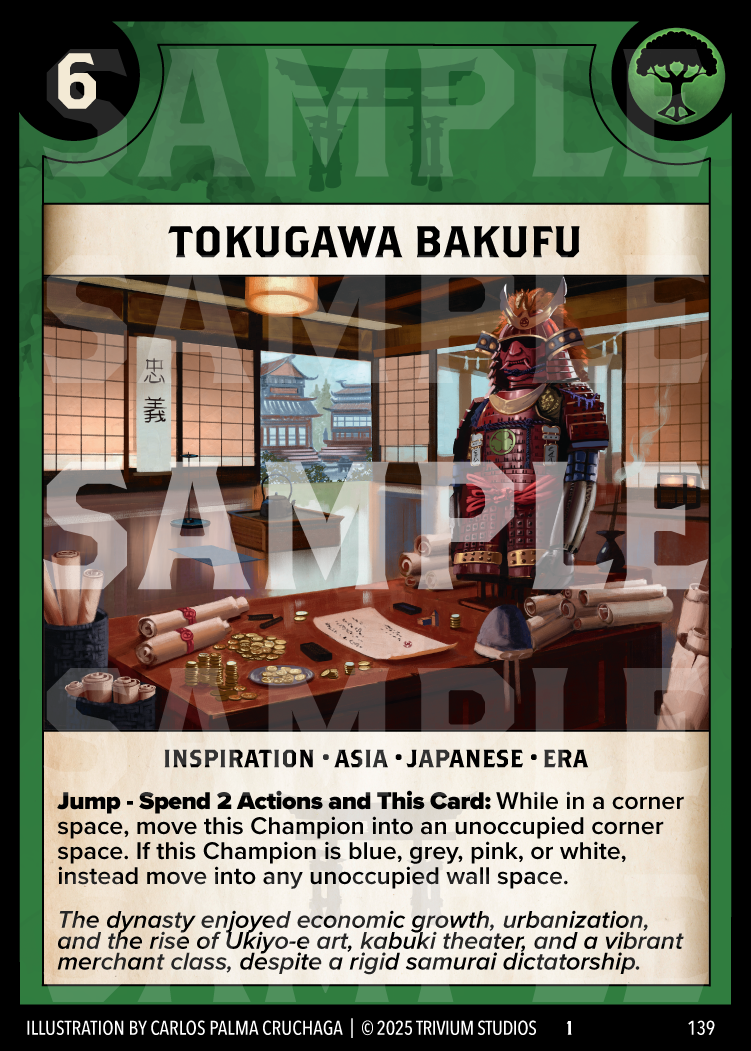
Standard
Inspiration
Asia
Japanese
Era
Jump - Spend 2 Actions and This Card: While in a corner space, move this Champion into an unoccupied corner space. If this Champion is blue, grey, pink, or white, instead move into any unoccupied wall space.
The dynasty enjoyed economic growth, urbanization, and the rise of Ukiyo-e art, kabuki theater, and a vibrant merchant class, despite a rigid samurai dictatorship.
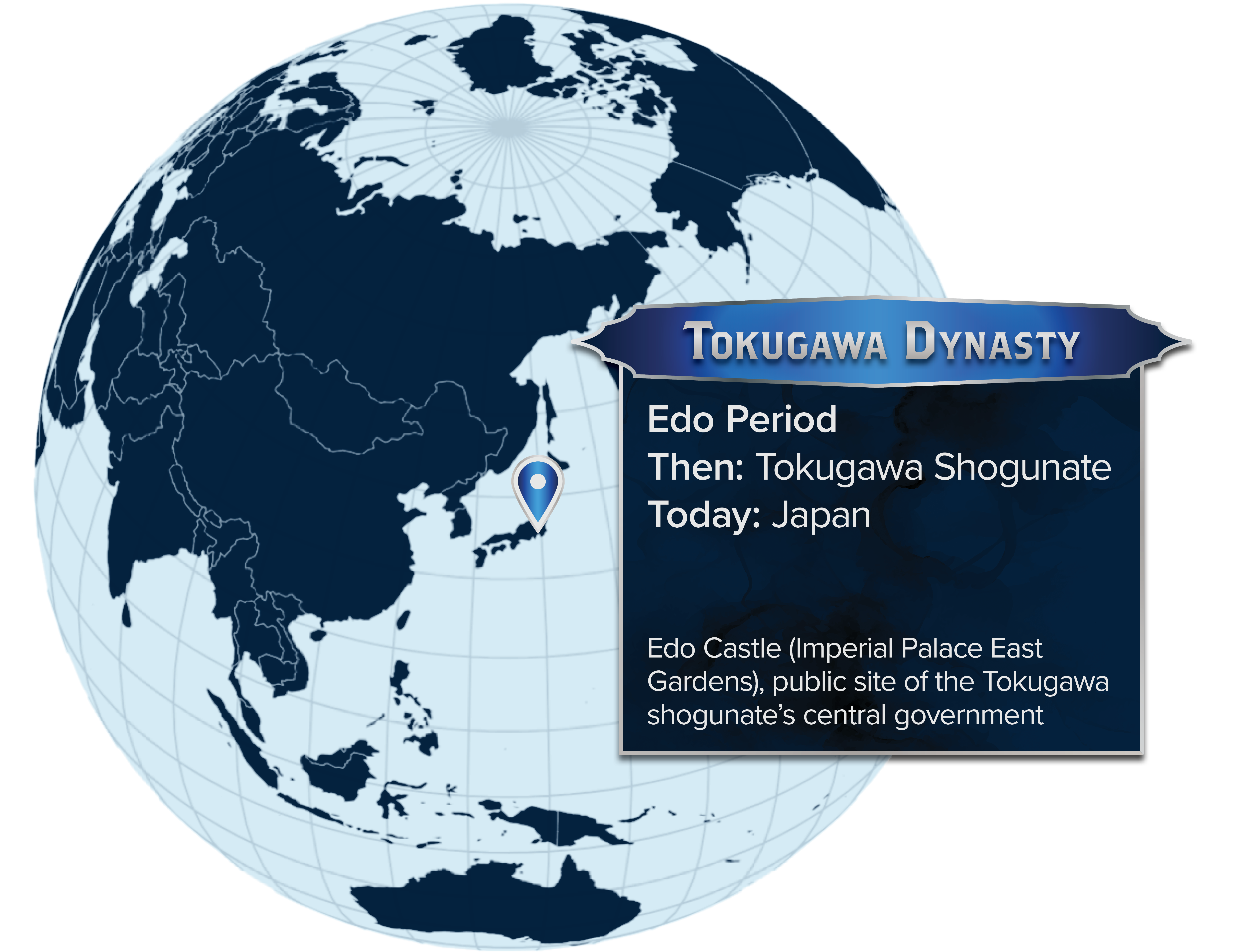
The Tokugawa dynasty didn’t just win a war; it stopped the clock on a century of chaos. After Ieyasu’s decisive victory at the Battle of Sekigahara, he claimed the title of Shogun in 1603 and set up his headquarters in the small fishing village of Edo (modern-day Tokyo). This wasn’t just another change in leadership—it was the birth of the Edo Bakufu, a hereditary military government that would keep the peace in Japan for over 250 years. Ieyasu’s genius was in realizing that while you can win a country with a sword, you can only keep it with a system.
To prevent another civil war, Ieyasu and his heirs built a political "straitjacket" for the rival warlords. They introduced the Sankin-kōtai system, which forced every daimyo to live in Edo every other year. This was a brilliant move: it was so expensive for the lords to maintain two households and travel with their massive entourages that they had no money left over to fund a rebellion. By keeping the lords’ families as permanent "guests" (hostages) in Edo and strictly controlling who could marry who or build a castle, the Tokugawa ensured that no one could ever challenge their authority.
To prevent another civil war, Ieyasu and his heirs built a political "straitjacket" for the rival warlords. They introduced the Sankin-kōtai system, which forced every daimyo to live in Edo every other year. This was a brilliant move: it was so expensive for the lords to maintain two households and travel with their massive entourages that they had no money left over to fund a rebellion. By keeping the lords’ families as permanent "guests" (hostages) in Edo and strictly controlling who could marry who or build a castle, the Tokugawa ensured that no one could ever challenge their authority.
Today, the thumbprints of the Tokugawa dynasty are everywhere in Japan. From the massive stone walls of the Imperial Palace in Tokyo (formerly Edo Castle) to the perfectly preserved "little Edos" like Kawagoe, the era’s stability is still visible. Ieyasu only ruled as Shogun for two years before officially retiring, but the machine he built was so well-oiled that it ran for fifteen generations. He proved that the ultimate victory isn’t destroying your enemies, it’s building a world where they no longer have the reason, or the resources, to fight.