Encyclopedia Anachronistica


Standard
Inspiration
Europe
Greek
Event
React: When this Champion rolls a /1/ on a defense roll, choose one: Gain +1 ATK until the end of the round -or- gain +1 DEF until the end of the round. Double /1/'s, choose both.
Wedging themselves in the only road through the pass, 300 Spartans neutralized the Persian numerical advantage and inflicted massive losses on Xerxes I's invasion.
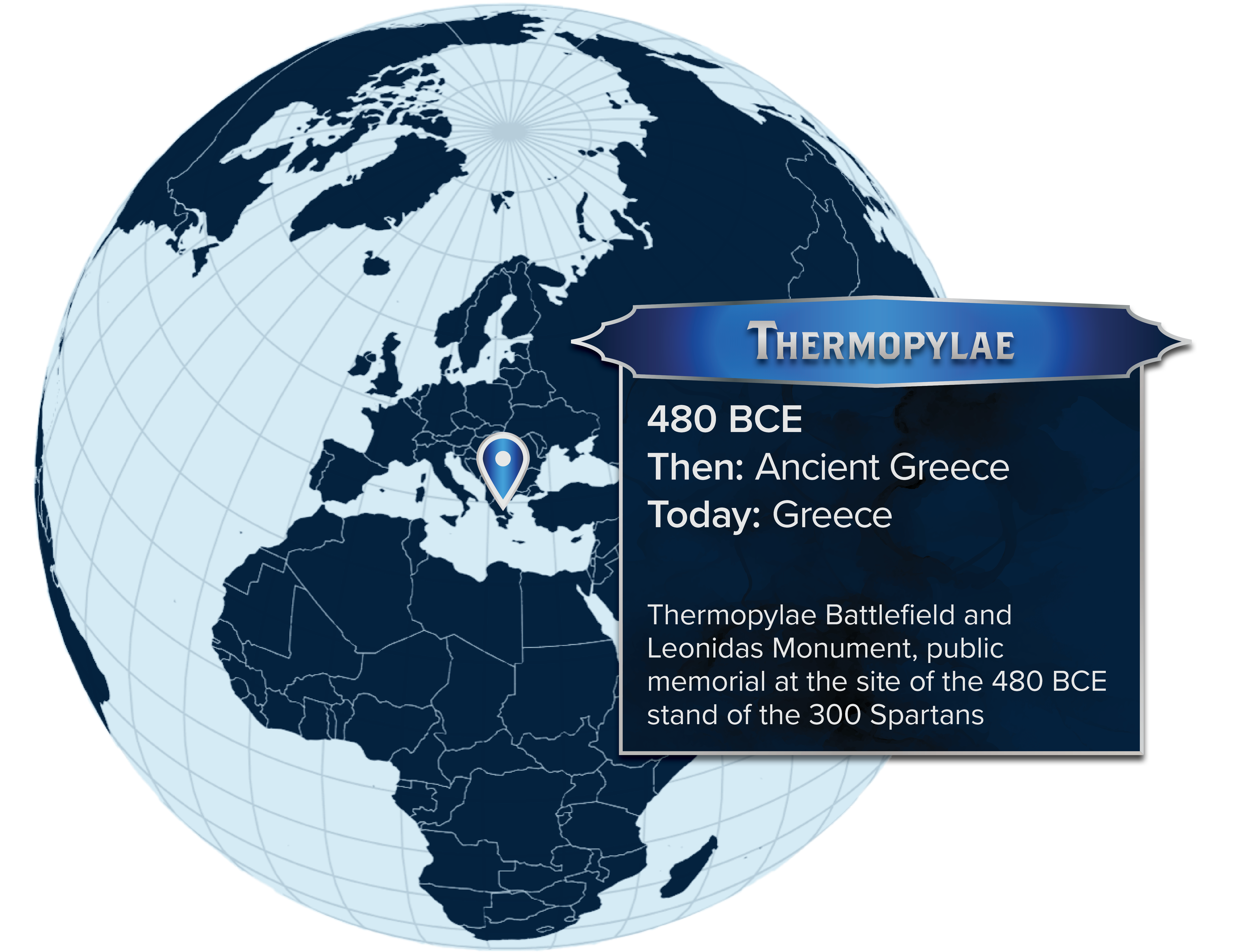
Thermopylae, the “Hot Gates,” was a narrow coastal corridor in central Greece where land, sea, and stone compressed history into a killing ground. In 480 BCE, Leonidas I of Sparta chose this pass to confront the advancing army of Xerxes I, knowing that its geography—sheer mountains to one side, the Malian Gulf to the other—would strip the Persians of their greatest advantage: numbers. At Thermopylae, space itself became a weapon. Whoever held the pass controlled the road into central Greece and the heart of the Greek world beyond.
Our fullest account comes from Herodotus, who describes how Leonidas led roughly 300 Spartans, supported by several thousand allied troops, into a defense that lasted three days. The Greek phalanx, anchored by Spartan discipline and drilled cohesion, turned the narrow roadway into a wall of shields and spearpoints. Persian infantry advanced again and again, only to be thrown back in chaos. Even the elite Immortals failed to break the line. In this confined terrain, training and unity outweighed imperial might.
The battle turned not through force, but betrayal. A local man, Ephialtes, revealed a mountain path that allowed Persian troops to outflank the defenders. Once the encirclement became inevitable, Leonidas acted decisively. He dismissed most of the allied contingents, ordering them to withdraw and carry the warning south. He remained behind with his Spartans, joined by 700 Thespians who refused to leave, and a contingent of Thebans whose role remains debated. Together, they held the pass until they were overwhelmed and killed.
Thermopylae was a tactical defeat, but a strategic and psychological victory. The stand delayed the Persian advance, unified Greek resistance, and became an immediate symbol of resolve against overwhelming odds. Inscriptions, poetry, and later historians transformed the site into a moral landmark as much as a geographic one. Though the coastline has shifted dramatically since antiquity, the hill where the final stand occurred still anchors the story in physical space.
Today, Thermopylae is both an archaeological site and a touchstone of historical memory. Scholars study it for lessons in terrain, defensive warfare, and command decisions under impossible conditions. For broader audiences, it remains a powerful example of leadership and sacrifice—proof that geography, discipline, and determination can briefly halt even the largest empire the ancient world had ever seen and immortalizing the Spartan as unbreakable death.