Encyclopedia Anachronistica


Standard
Special
Middle East
Persian
Tactic
Reveal: Maneuver up to one space into an enemy's base attack grid. Make a base attack.
Artaxerxes I's cunning diplomacy funded Athens against Sparta or Sparta against Athens so that neither was ever strong enough to threaten Persian interests.
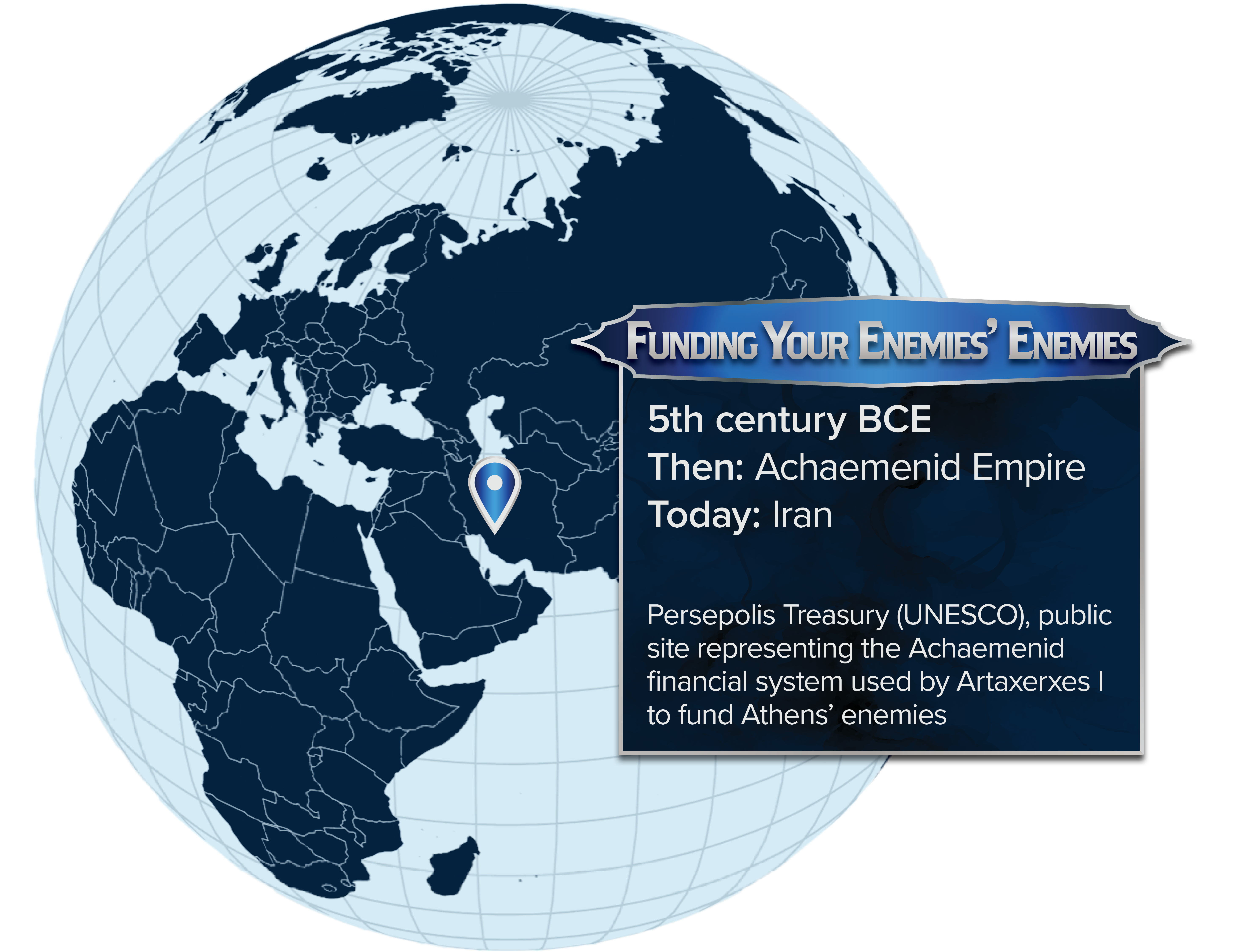
In the long rivalry between Athens and Sparta, Persia played a quiet but decisive role that had nothing to do with spears and everything to do with gold. Artaxerxes I understood a fundamental truth of geopolitics: a united Greece was a threat to Persian interests, but a divided Greece was a manageable neighbor. His strategy was a masterclass in manipulation—he funded whichever side was currently losing, ensuring that neither Athens nor Sparta ever gained enough momentum to look toward the Persian frontier.
During the First Peloponnesian War and the decades of tension that followed, Persian gold flowed into Greek coffers through the hands of satraps in Asia Minor. When Athens threatened Persian influence in the Mediterranean, Artaxerxes funneled resources to Sparta. When Sparta grew too bold, he subtly shifted his support back toward Athens or its allies. This policy of "tamin-e doshmanan"—funding your enemies’ enemies—was a classic example of balance-of-power diplomacy and allowed the Great King to act as the ultimate puppet master of the Aegean. By keeping the Greek city-states locked in a cycle of exhaustion, he protected the empire’s borders without losing a single Persian soldier.
The primary accounts of this strategy come from ancient Greek authors like Thucydides, Diodorus Siculus, and Ctesias, who watched as Persian influence began to overshadow Greek military pride. Together, these authors describe the Daric—the gold coin featuring a Persian archer—as a more effective weapon than any actual soldier. As one famous Greek joke went, the Great King had "ten thousand archers" in his service, referring not to his legendary army, but to the gold coins he used to bribe Greek politicians and disrupt their alliances.
The strategy was brilliant because it transformed military conflict into an economic game. Artaxerxes realized that if he could keep his rivals busy destroying each other, he could maintain control over his western territories with minimal effort. This approach set the blueprint for future Persian diplomacy, where treaties, funded rebellions, and economic leverage became the primary weapons of the state. It proved that sometimes the most effective way to win a war is to make sure your enemies never stop fighting it.
Today, historians view Artaxerxes’ policy as a foundational example of balance-of-power diplomacy. It serves as a reminder that economic power can be just as effective—and often more durable—than military might. Much like the warnings of his early reign, this strategy shows the danger of being so focused on a local rival that you fail to see the larger hand directing the conflict. The legacy of Artaxerxes’ gold illustrates a complex reality of international relations: the most dangerous opponent isn’t always the one across the battlefield, but the one funding the fight from the shadows.