Encyclopedia Anachronistica

Standard
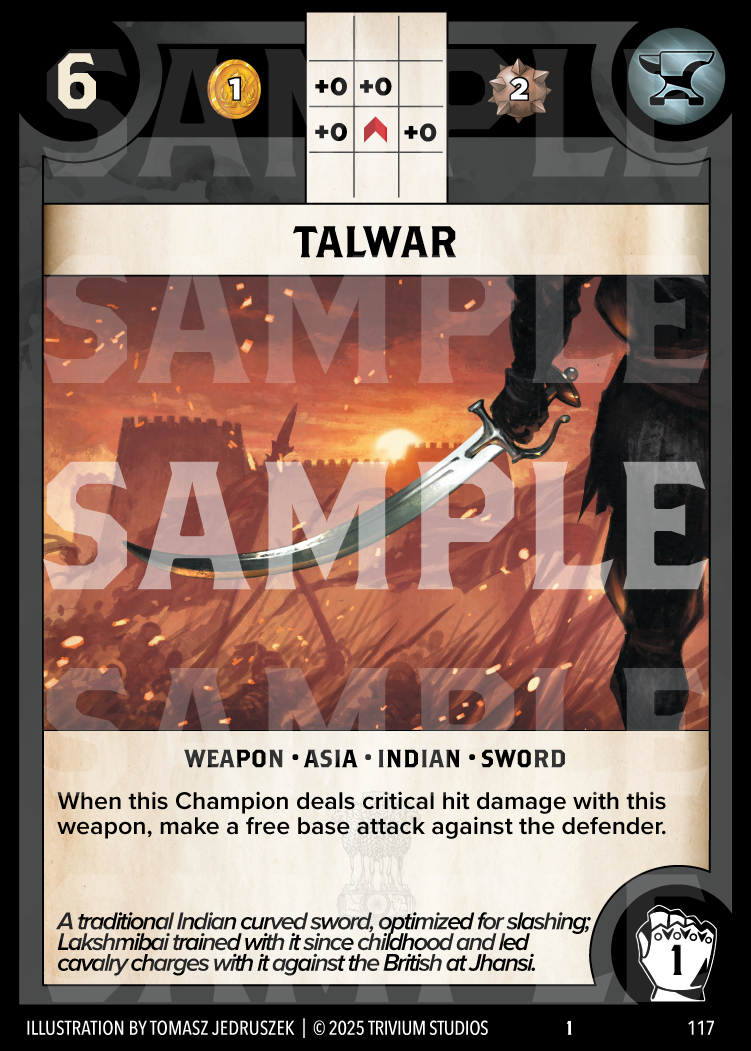
Weapon
Asia
Indian
Sword
When this Champion deals critical hit damage with this weapon, make a free base attack against the defender.
A traditional Indian curved sword, optimized for slashing; Lakshmibai trained with it since childhood and led cavalry charges with it against the British at Jhansi.
A talwar feels less like a weapon and more like justice and vengeance held in the palm. Its curved blade sweeps forward in a single, fluid arc, engineered specifically for the terrifying speed of a cavalry charge. By the mid-19th century, this was the defining sword of North Indian warriors, and Rani Lakshmibai of Jhansi was a master of its steel. During the desperate heat of the 1857 uprising, eyewitnesses described a sight that became legendary: the Rani galloping through thick musket smoke, sometimes wielding a sword in each hand while holding the reins of her horse in her teeth.
The talwar’s design was a perfect match for the "hit-and-run" urban combat Lakshmibai faced. Unlike the straight, heavy swords used in Europe, the talwar’s forward-weighted blade was built to slice through fabric and leather with minimal effort. Its unique hilt featured a disc-shaped pommel that acted like a lock, keeping the hand from slipping during a powerful strike, while a curved knuckle-guard protected the fingers from an opponent’s blade. In the workshops of Jhansi, armorers forged these from high-carbon steel, ensuring that when the Rani led her breakout from the besieged city, her blade wouldn’t snap against the bayonets of the British infantry.
For Lakshmibai, the talwar was more than just a piece of military gear; it was her scepter. It symbolized her refusal to let the British East India Company annex her kingdom. When she led her final, famous charge near Gwalior, it wasn’t a crown she wore into battle, but a soldier’s uniform and a sharp blade. Her sword became an extension of her will, a gleaming defiance against an empire that thought a queen would never fight back. Even in her final moments, she died as a warrior, sword in hand, in the thick of the melee.
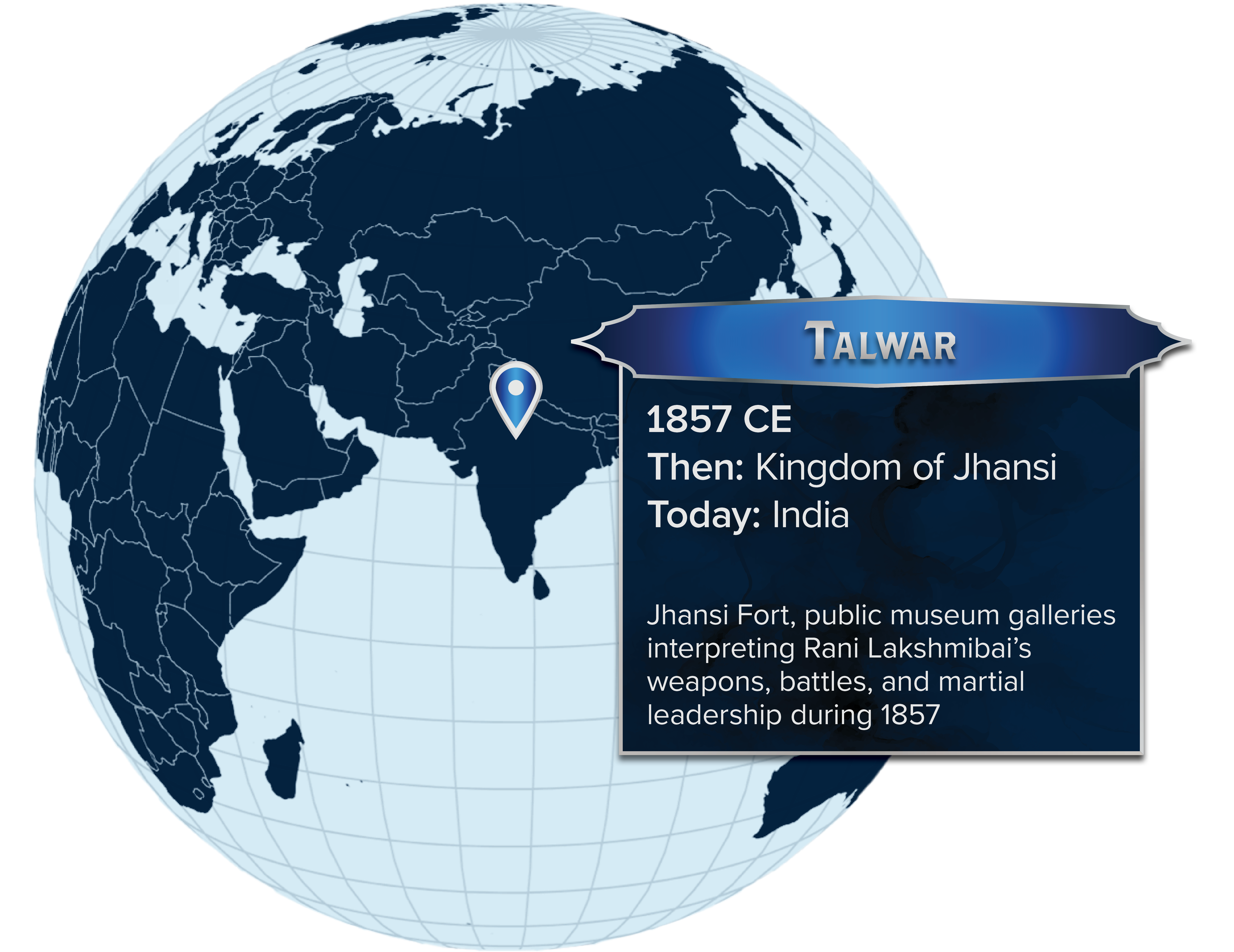
Today, talwars from this era are prized centerpieces in museums across India, their blades still reflecting the sunlight just as they did on the ramparts of Jhansi. They serve as a gritty, physical reminder that the "Rani of Jhansi" wasn’t just a character in a story—she was a real commander who lived and died by the edge of a blade. Seeing a talwar today helps us touch the past, bringing to life the craftsmanship and the sheer courage it took to stand against the most powerful army in the world with nothing but a horse and a few feet of curved steel.