Encyclopedia Anachronistica

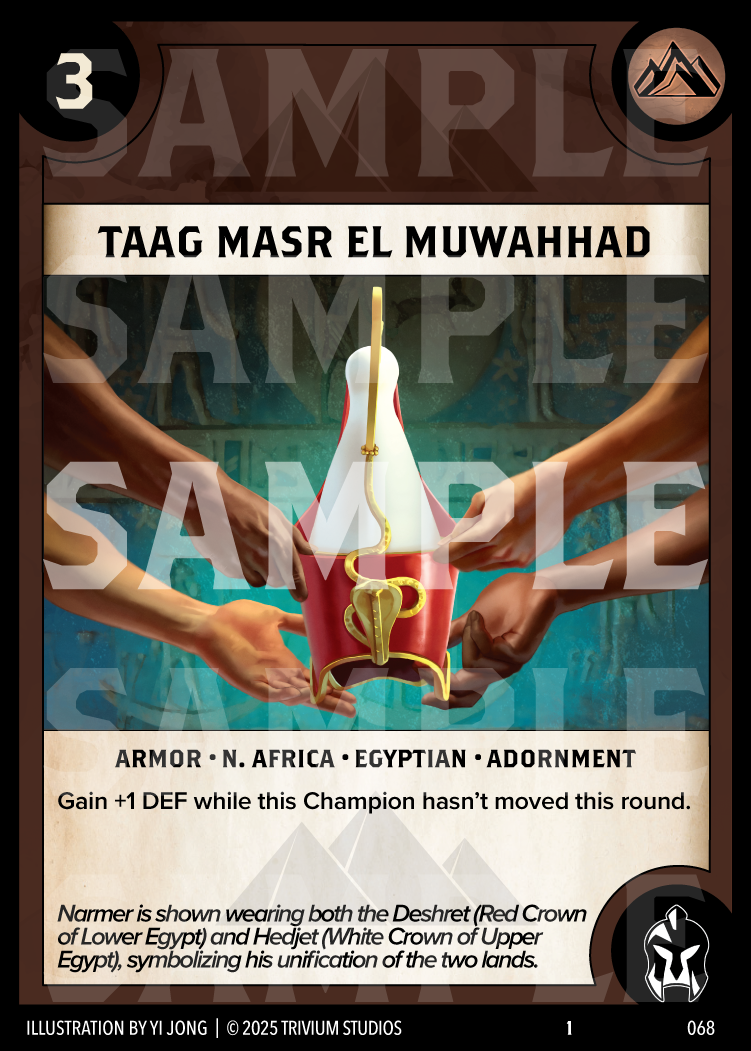
Standard
Armor
N. Africa
Egyptian
Adornment
Gain +1 DEF while this Champion hasn't moved this round.
Narmer is shown wearing both the Deshret (Red Crown of Lower Egypt) and Hedjet (White Crown of Upper Egypt), symbolizing his unification of the two lands.
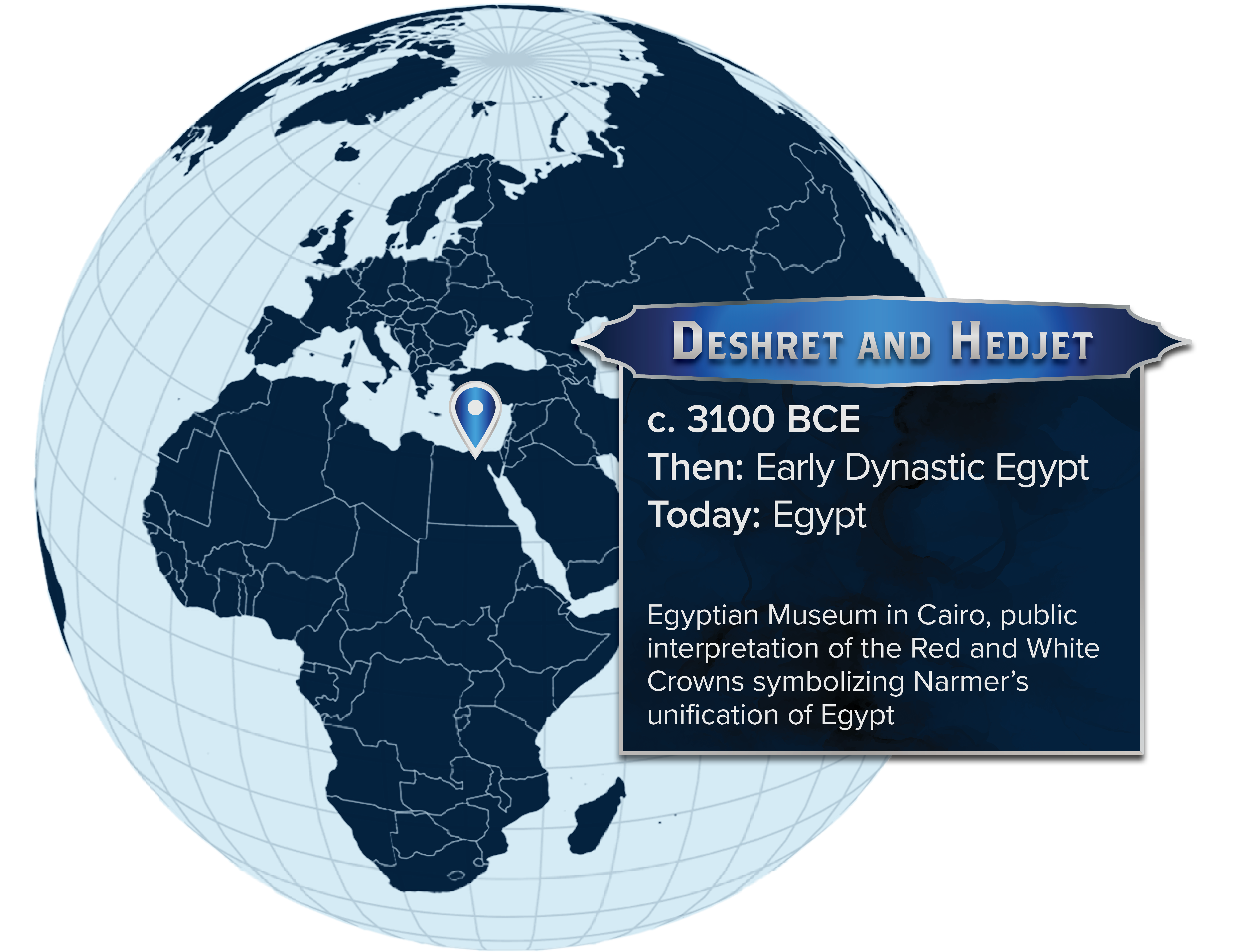
The Red Crown (Deshret) and the White Crown (Hedjet) are the two most powerful "hats" in human history. Long before Egypt was a single country, these crowns belonged to two different worlds. The White Crown, a tall, bulbous headpiece, represented Upper Egypt (the southern desert highlands), while the Red Crown, with its flat top and curly wire, represented Lower Egypt (the northern Nile Delta marshes). For centuries, these crowns were symbols of rivalry—until a leader named Narmer changed the script forever.
Narmer is the first king we see wearing both. On the famous Narmer Palette, he is shown on one side wearing the White Crown and on the other wearing the Red Crown. This wasn't just a costume change; it was a massive political "rebrand." By wearing both, he was telling the world that the "Two Lands" were now one. Eventually, the Egyptians literally stacked them on top of each other to create the Double Crown (Pschent). This wasn't just about territory; it was about balance. The King was now the "Lord of the Two Lands," the only person capable of keeping the peace between the North and the South.
The crowns were so sacred that they were treated like living beings. They were tied to protector goddesses: Wadjet the cobra for the Red Crown and Nekhbet the vulture for the White Crown. Because they were seen as divine, they were likely kept in high-security temple treasuries rather than being buried in tombs. This is why archaeologists have never found a physical crown—they were passed down from king to king for 3,000 years, treated as the eternal spirit of Egypt itself rather than the personal property of one man.
For Narmer, wearing these crowns was a way to say his power was legitimate, not just based on force. Anyone can win a battle, but only a true King has the "right" to wear the sacred regalia of the ancestors. This created a political tradition that lasted longer than the Roman Empire or any modern nation. It established the idea of Ma'at—the cosmic balance—where the King sits at the center of two opposite forces (North and South, Red and White) and keeps them in harmony.
Today, these crowns are the ultimate "visual shorthand" for ancient Egypt. You see them in every museum, textbook, and movie because they perfectly capture the moment a group of scattered tribes became the world's first great state. They remind us that national identity is often built on symbols—and that 5,000 years ago, Narmer used two simple hats to build a foundation that would survive for three millennia.