Encyclopedia Anachronistica

Standard
Inspiration
Europe
Russian
Companion
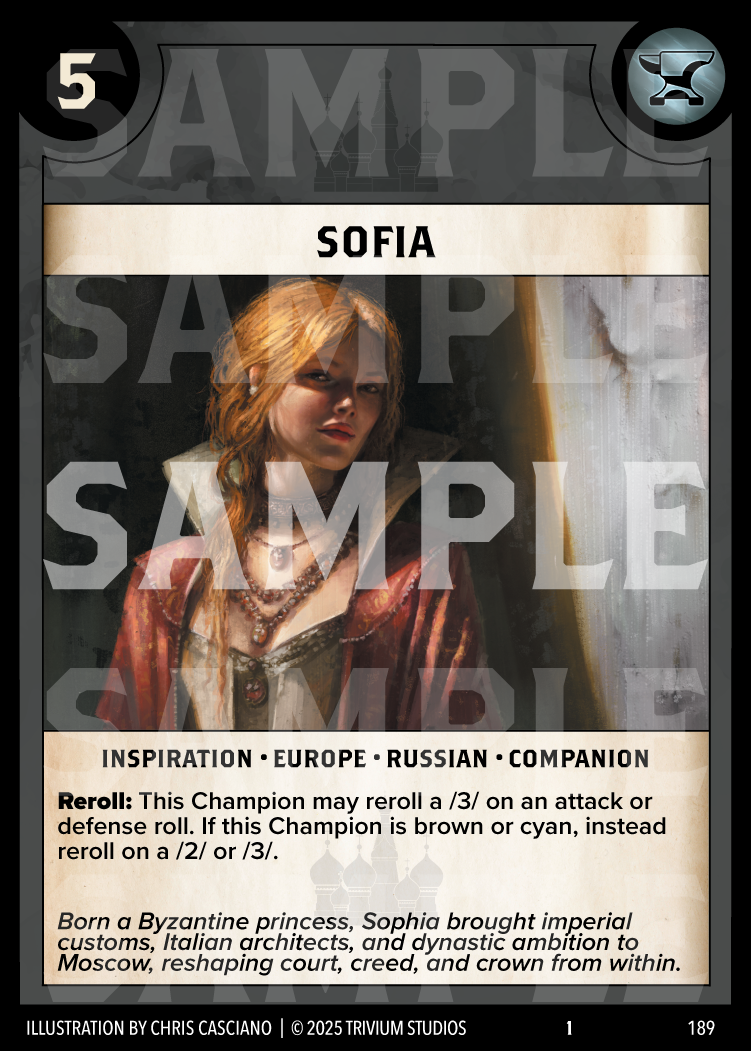
Reroll: This Champion may reroll a /3/ on an attack or defense roll. If this Champion is brown or cyan, instead reroll on a /2/ or /3/.
Born a Byzantine princess, Sophia brought imperial customs, Italian architects, and dynastic ambition to Moscow, reshaping court, creed, and crown from within.

When Sophia Palaiologina arrived in Moscow in 1472, she carried more than just luggage—she carried the ghost of the fallen Byzantine Empire. As the niece of the last Byzantine emperor, she was a living link to ancient Rome. Having grown up in exile after Constantinople fell to the Ottomans, her marriage to Ivan III was actually a high stakes move by the Pope to pull Russia into Western alliances. Instead, Sophia’s arrival transformed Russia into a powerhouse on its own terms.
Sophia’s presence at court immediately changed how Moscow saw itself. She brought with her elaborate Byzantine court rituals and a sense of "imperial dignity" that Muscovy had never seen. Chroniclers describe her as a formidable woman—highly intelligent, politically sharp, and unafraid to go toe-to-toe with the boyars (the powerful nobles) who tried to limit her influence. Under her guidance, Ivan adopted the double-headed eagle as his personal emblem. This symbol of imperial sovereignty, representing a gaze that looked both East and West, soon appeared on Russian seals, banners, and coins, where it remains even today.
Her marriage did more than just decorate the court; it gave Ivan the ultimate political "receipt" to rule a unified Russian state. By linking his family to the legacy of Rome, Sophia helped birth the idea that Moscow was the "Third Rome"—the rightful heir to the leadership of the Orthodox Christian world. This wasn't just a fancy title; it was a powerful ideological foundation for the Russian state that would last for centuries. Legend even suggests she was the one who finally convinced Ivan to stop paying tribute to the Mongols, famously asking if she had married a Great Prince or a servant of the Horde.
Sophia matters today because her influence reshaped the very DNA of Russian political culture. The double-headed eagle she championed is still the central symbol of the Russian Federation. Her story is a perfect example of "soft power"—how a single person, through marriage and culture, can bridge two worlds and create a new imperial identity that survives long after empires have crumbled.