Encyclopedia Anachronistica

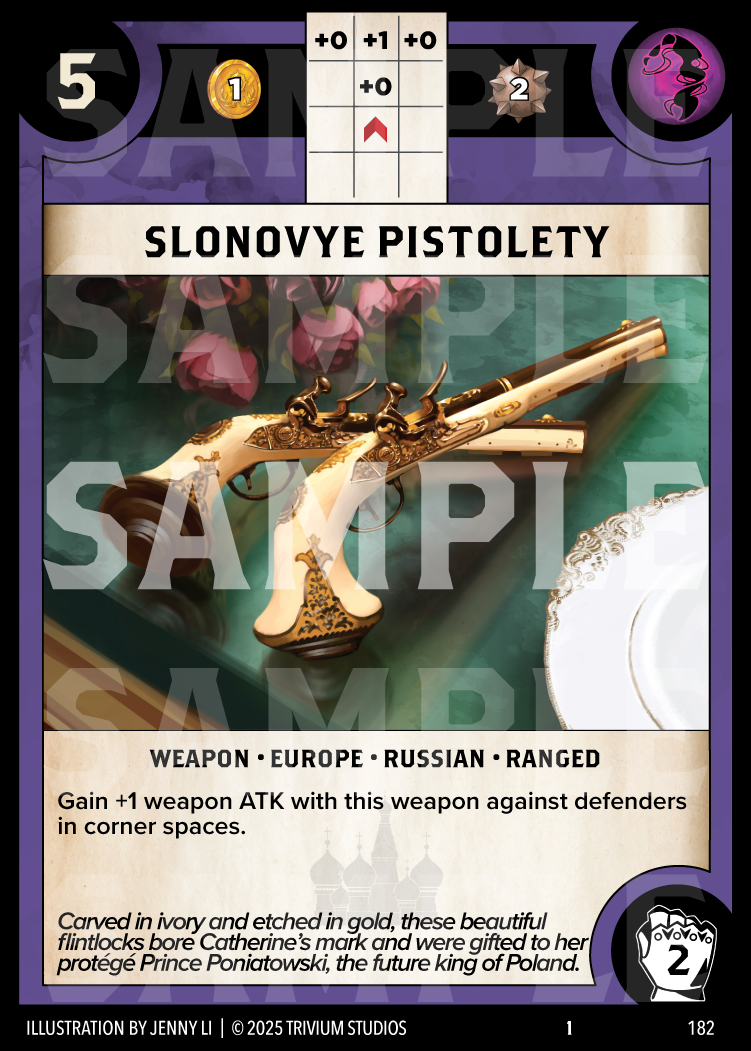
Standard
Weapon
Europe
Russian
Ranged
Gain +1 weapon ATK with this weapon against defenders in corner spaces.
Carved in ivory and etched in gold, these beautiful flintlocks bore Catherine's mark and were gifted to her protege Prince Poniatowski, the future king of Poland.

Imagine the first thing you notice: a blinding flash of white ivory and the sharp glint of polished steel. Catherine the Great’s ivory-mounted flintlock pistols weren’t built for a muddy battlefield; they were "power jewelry." In the 1700s, owning a pair of pistols like these signaled your status the way a custom-made supercar might today: they were expensive, finely engineered, and unmistakably elite. A flintlock pistol worked through a mechanical dance: a hammer snapped a piece of flint against a steel plate, showering sparks into a pan of gunpowder to fire a single lead ball. The process was slow, smoky, and sometimes fickle, but in Catherine’s era, it represented the cutting edge of personal defense.
The ivory grips on her pistols were the ultimate flex of the 18th century. Sourced through vast trade networks that stretched from the frozen north to distant lands, ivory was rare and incredibly difficult to carve. By commissioning these from the Imperial Arms Factory at Tula, Catherine was telling the world that Russia wasn’t just a "wild" frontier, it was a sophisticated empire capable of producing the finest luxury goods on Earth. Catherine herself was a master of branding who understood the political value of looking dangerous. She famously seized the throne in a military coup while wearing a soldier’s uniform, and these ornate pistols fit that image perfectly. While she likely used them for target practice or displayed them during high-stakes diplomatic meetings, they served as a constant reminder that the Empress commanded both the arts and the army.
While historians note that these specific pistols, now preserved in the Metropolitan Museum of Art in New York and attributed to the St. Petersburg armory workshops known for blending European craftsmanship with Russian luxury, were likely meant for "show" rather than "survival," they weren't just toys. In the 18th century, "showing your teeth" through beautiful weaponry was a standard part of international politics. These objects reveal a world where technology, art, and power were inseparable. They transform Catherine from a distant historical name into a living ruler who used every object at her disposal to project a message of absolute authority.