Encyclopedia Anachronistica


Standard
Armor
Middle East
Caliphates
Light
If this Champion has a revealed cavalry card at the start of the turn, deplete this card and move up to one space left or right.
A chain mail curtain suspended from the helmet, the aventail shielded the neck and throat. In later eras, it was detachable, secured by vervelles and a waxed cord.
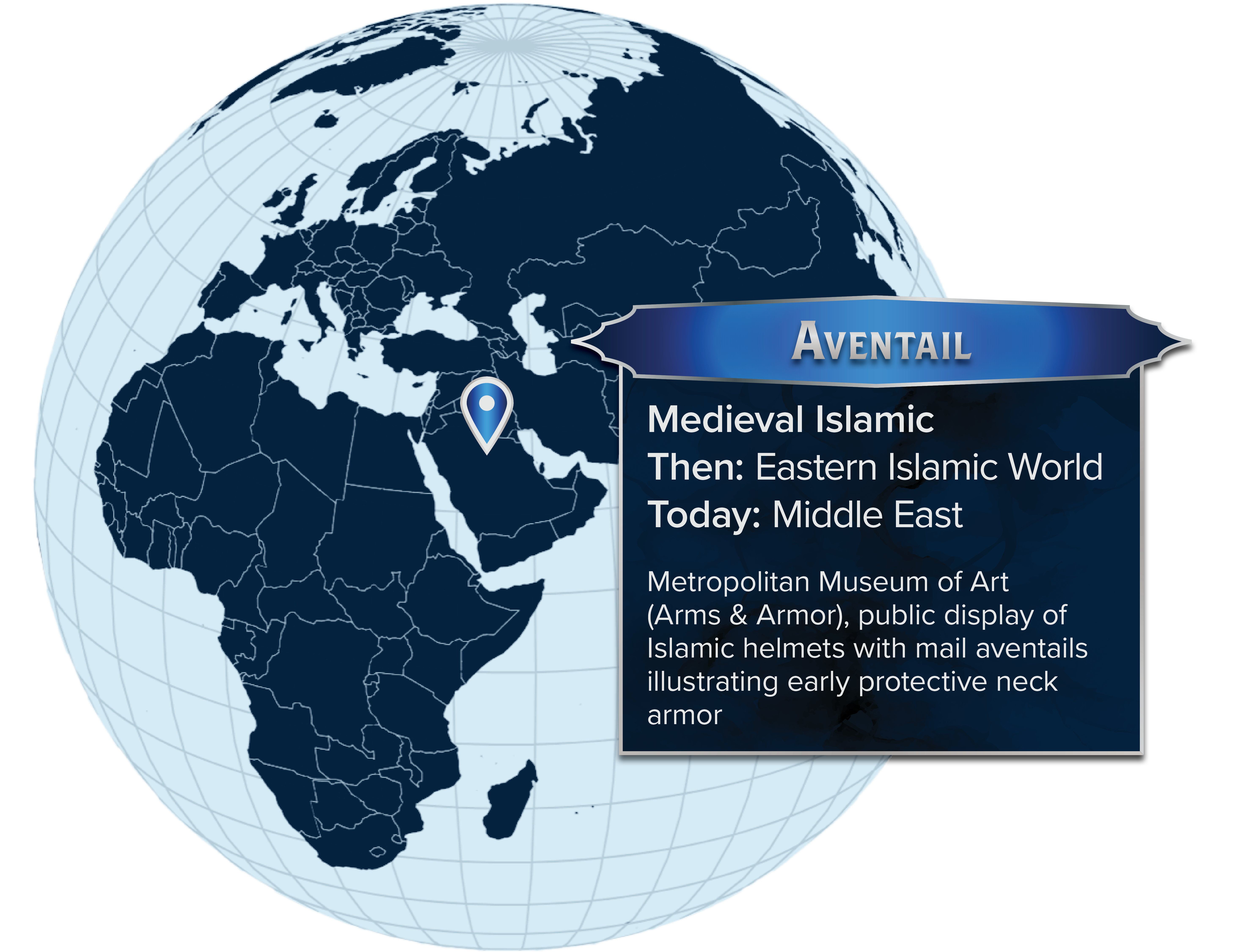
In the 7th century, Arabian warriors relied on gear that balanced speed with survival, and one of the most vital pieces was the aventail—a curtain of interlinked metal rings attached to the base of a helmet. Its job was simple but lifesaving: to shield the neck, jaw, and throat from sword cuts and flying debris while allowing a fighter to whip their head around to spot an incoming attack. For someone like Ali ibn Abi Talib, who was famous for diving into the most intense part of the "scrum" in battle, this kind of protection was essential equipment.
Early historical sources consistently portray Ali as a front-line fighter, often the first to engage the enemy. While these texts don't give us a "gear list" of his specific kit, they make it clear he was a master of close-quarters combat. This makes the aventail a historically accurate part of his loadout. By looking at archaeological finds from the neighboring Sasanian and Byzantine empires, we can see the exact types of mail circulating in the region. Most elite Arabian warriors adopted these styles—rounded iron helmets with aventails woven in dense, protective patterns—because they were durable enough to stop a blade but breathable enough for the desert heat.
As the centuries passed, later Islamic tradition added more "cinematic" flair to Ali’s armor, describing helmets that gleamed with a supernatural light or bore holy markings. While historians classify these stories as legendary—since they don't appear in the earliest 7th-century reports—they show the deep respect later generations had for Ali’s bravery. The real-life history is just as impressive: Ali fought with the standard, sturdy equipment of an elite warrior, relying on his skill and his mail to survive the chaotic reality of medieval warfare.
Today, the aventail gives us a "hands-on" way to imagine the physical reality of the past. When you see a helmet with a surviving mail curtain in a museum, you can see exactly how the rings move and feel the weight the wearer had to carry. It reminds us that historical figures weren't just names on a page; they were people who faced real danger and used real technology to protect themselves. Ali’s aventail—whether we look at it through archaeology or historical memory—reminds us that courage isn't just a grand idea; it’s something lived out in the grit and clatter of the battlefield.