Encyclopedia Anachronistica

Standard
Weapon
Middle East
Persian
Dagger
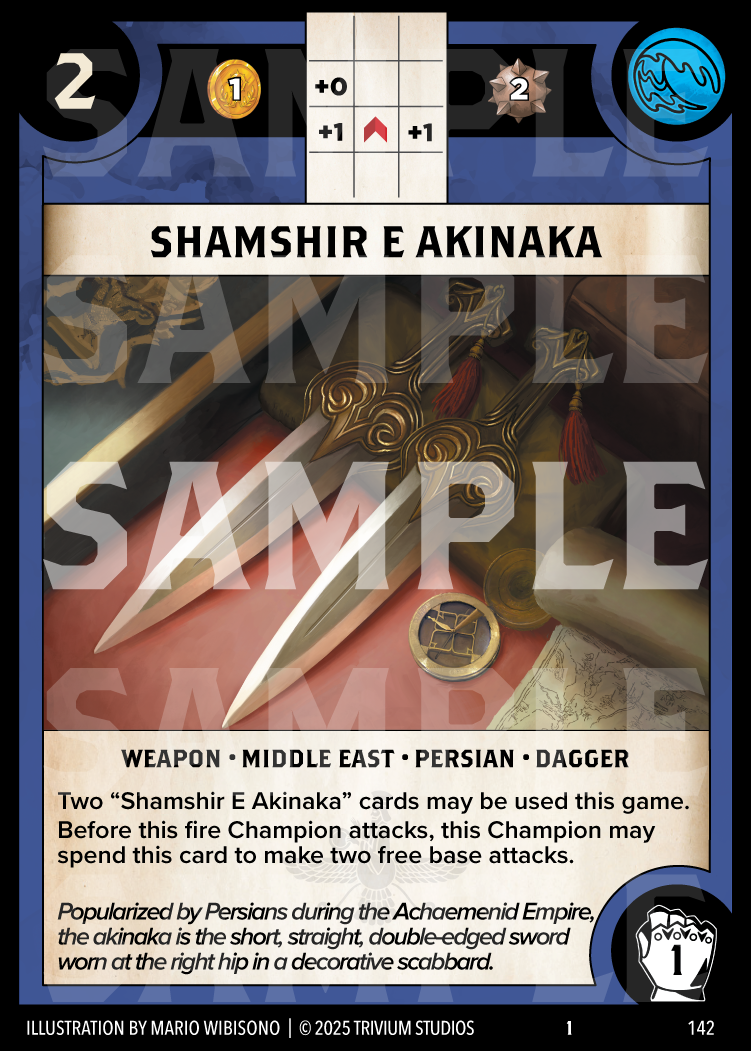
Two "Shamshir E Akinaka" cards may be used this game. Before this fire Champion attacks, this Champion may spend this card to make two free base attacks.
Popularized by Persians during the Achaemenid Empire, the akinaka is the short, straight, double edged sword worn at the right hip in a decorative scabbard.

The akinaka is a compact, double-edged short sword that feels like a piece of living history. With its leaf-shaped blade and a hilt often carved with the heads of lions or eagles, it was a weapon that connected the warriors of the 7th century back to the legendary Achaemenid Empire of Cyrus the Great. By the time of the Sasanian resistance, it had evolved from a primary weapon into the ultimate "Plan B"—the trusted sidearm hanging from the belts of officers and cavalry alike.
In the frantic, high-speed world of mounted combat, the akinaka was a lifesaver. When a cavalry charge turned into a grinding melee, a long sword or a spear became a liability—too heavy and too long to swing in a crowd. The akinaka, however, was built for the "close-shave." A rider could draw it in a heartbeat to deliver a devastating thrust through a gap in an enemy’s armor. Its broad blade was designed to widen a wound, and its solid, one-piece construction meant it wouldn’t snap even when striking bone or bronze.
For a commander like Apranik, who likely operated in the chaotic environment of hit-and-run ambushes, this blade was the definition of reliability. While the heavy Savaran knights might have favored their long, two-handed swords, a guerrilla fighter needed something that was light enough for travel but lethal enough for a surprise encounter. Archaeological finds from Sasanian frontier forts often turn up these shorter blades, proving that when the empire’s borders were under siege, the akinaka was the weapon of choice for those who needed to be fast on their feet (or their hooves).
Today, these short swords are prized pieces in museums from Tehran to Tbilisi. Their surfaces, though pitted by time, still show the sophisticated metallurgy of the ancient Persian world. The akinaka remains a symbol of the "long memory" of Iranian warfare—a weapon that stayed in a warrior’s hand for over a thousand years because, in the heat of battle, a sharp edge and a sturdy grip never go out of style.