Encyclopedia Anachronistica


Standard
Weapon
Europe
Greek
Polearm
After attacking with this weapon, this Champion may rotate.
Invented by Philip II, it revolutionized infantry tactics because its 7-meter length far exceeded the reach of enemy spears and several ranks could attack in unison.
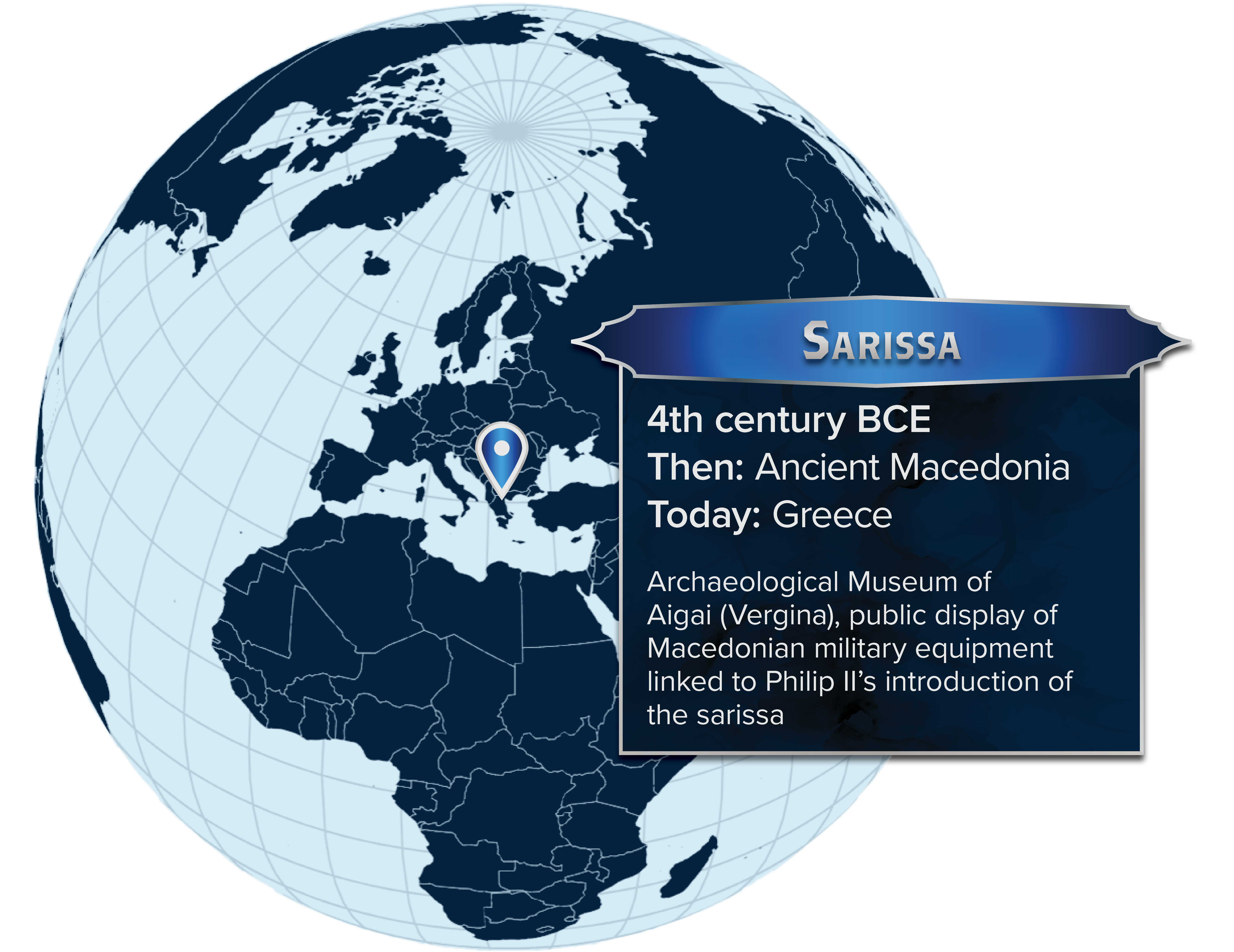
The sarissa was the high-tech breakthrough that transformed the Macedonian army into a battlefield revolution. While traditional Greek spears were about 2.5 meters (8 feet) long, Philip II equipped his men with massive pikes measuring between 4.5 and 6 meters (15 to 20 feet). Fashioned from tough ash wood and tipped with a sharp iron head, this weapon redefined the reach of an infantryman. Because it was so long and heavy, it required a weighted bronze or iron butt spike at the back to balance it, making the sarissa a weapon of collective discipline rather than individual skill.
The true power of the sarissa lay in the "forest of pikes" it created. As the Macedonian phalanx advanced, the first five ranks leveled their weapons horizontally. This meant that an enemy soldier didn't just face one row of spears; they faced a dense thicket of iron points projecting several meters beyond the front line. Ancient accounts describe how this layered defense made frontal charges near-suicidal for both infantry and cavalry. On open ground, the phalanx functioned as a slow-moving wall of death that was almost impossible to penetrate.
This wasn't just theory—it changed history at the Battle of Chaeronea in 338 BCE. The traditional Greek hoplites, used to close-quarters fighting with shorter spears, found themselves helpless as they were stabbed from a distance they couldn't bridge. While no complete wooden sarissa has survived the centuries, archaeology has uncovered the standardized iron pike heads and heavy butt spikes that confirm these weapons were mass-produced for a centrally equipped professional army. These fragments prove that Philip’s genius was in creating a uniform system where every piece of equipment was a strategic asset.
Today, the sarissa is the ultimate example of military innovation. Experimental archaeologists who have reconstructed these 6-meter (20-foot) pikes have shown just how physically demanding they were to use, requiring hours of relentless drill to master. More than just a long spear, the sarissa was the spine of a new kind of warfare—one built on coordination, discipline, and the simple but devastating advantage of outreaching the enemy.