Encyclopedia Anachronistica

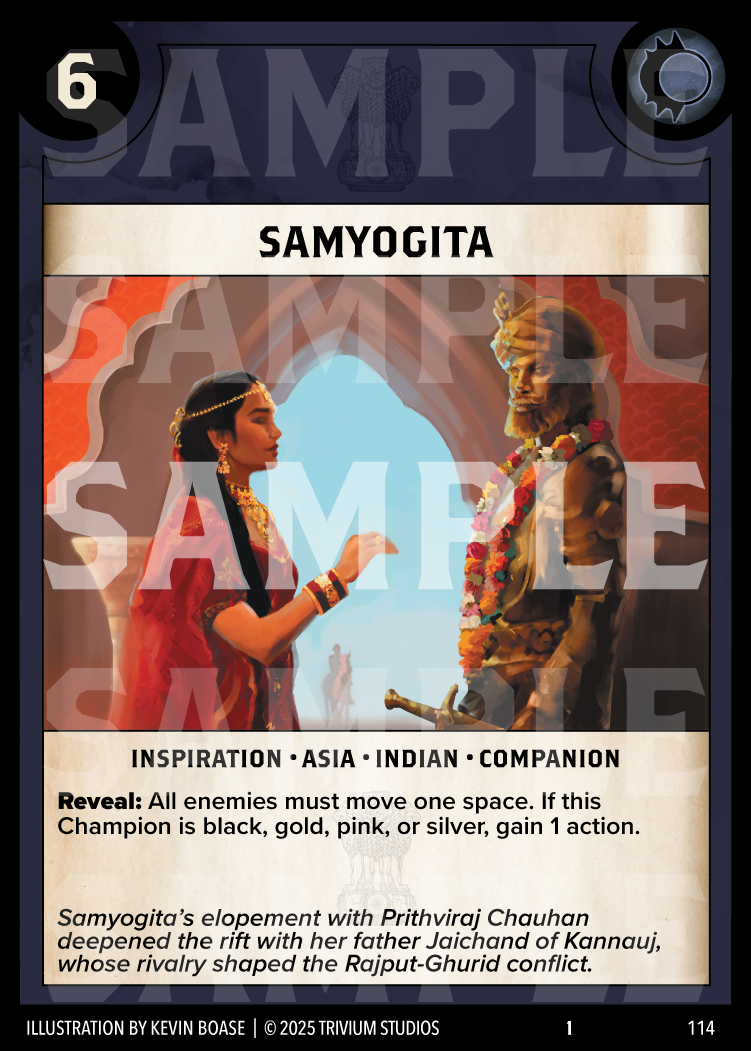
Standard
Inspiration
Asia
Indian
Companion
Reveal: All enemies must move one space. If this Champion is black, gold, pink, or silver, gain 1 action.
Samyogita's elopement with Prithviraj Chauhan deepened the rift with her father Jaichand of Kannauj, whose rivalry shaped the Rajput-Ghurid conflict.

The legend of Samyogita begins with the stroke of a painter’s brush. In the epic Prithviraj Raso, the princess sees a portrait of the young King Prithviraj and falls instantly in love. Her father, Jaichand of Kannauj, is Prithviraj’s bitter rival and attempts to humiliate the King by holding a swayamvara—a royal ceremony where a princess chooses her husband—without inviting him. To add insult to injury, Jaichand places a stone statue of Prithviraj at the door to act as a lowly gatekeeper. But as the legend goes, Samyogita defies her father, walking past every prince in the room to place her floral garland around the neck of the statue. At that exact moment, the real Prithviraj leaps from his hiding place, sweeps her onto his horse, and gallops away through a storm of dust and arrows.
If we look at the historical records from the 12th century, the picture becomes more complicated. Contemporary Persian and Sanskrit chronicles don’t mention Samyogita by name, and this high-stakes elopement appears mainly in later heroic poems. However, the political fire behind the story was very real. The Chauhans of Ajmer and the Gahadavalas of Kannauj were the two most powerful "superpowers" of northern India, and their deep-seated rivalry effectively split the region’s defenses right as Muhammad Ghori’s armies were crossing the frontier. The tale of Samyogita takes this cold political reality—a disastrous feud between two neighboring kings—and transforms it into a gripping story of forbidden love.
Whether Samyogita lived exactly as the poems describe or serves as a symbol of the era, she represents the high-stakes world of medieval marriage. In the 1100s, a wedding wasn’t just a celebration; it was a treaty, a border agreement, and a family alliance all rolled into one. A union between Ajmer and Kannauj could have created a united front that changed the course of Indian history. Through her story, we see the Rajput ideals of viranganas (heroic women) and the belief that love and honor were worth risking an entire kingdom for.
Today, Samyogita’s defiant choice is a staple of Indian theater, cinema, and folklore. Her story matters because it reminds us that history isn’t just a dry list of dates and troop movements; it is a collection of human relationships. She provides a window into the emotional heart of the 12th century, showing us that even in a world of steel and stone, the most powerful forces were often the ones that couldn’t be measured on a map.