Encyclopedia Anachronistica


Standard
Weapon
N. Africa
Egyptian
Bludgeon
This Champion may roll the attack roll before the defender when attacking with this weapon and gains +1 weapon ATK until the end of the round.
Found at Hierakonpolis, the Narmer Macehead shows King Narmer enthroned beneath a canopy, receiving captives and tribute for his conquests and governance.
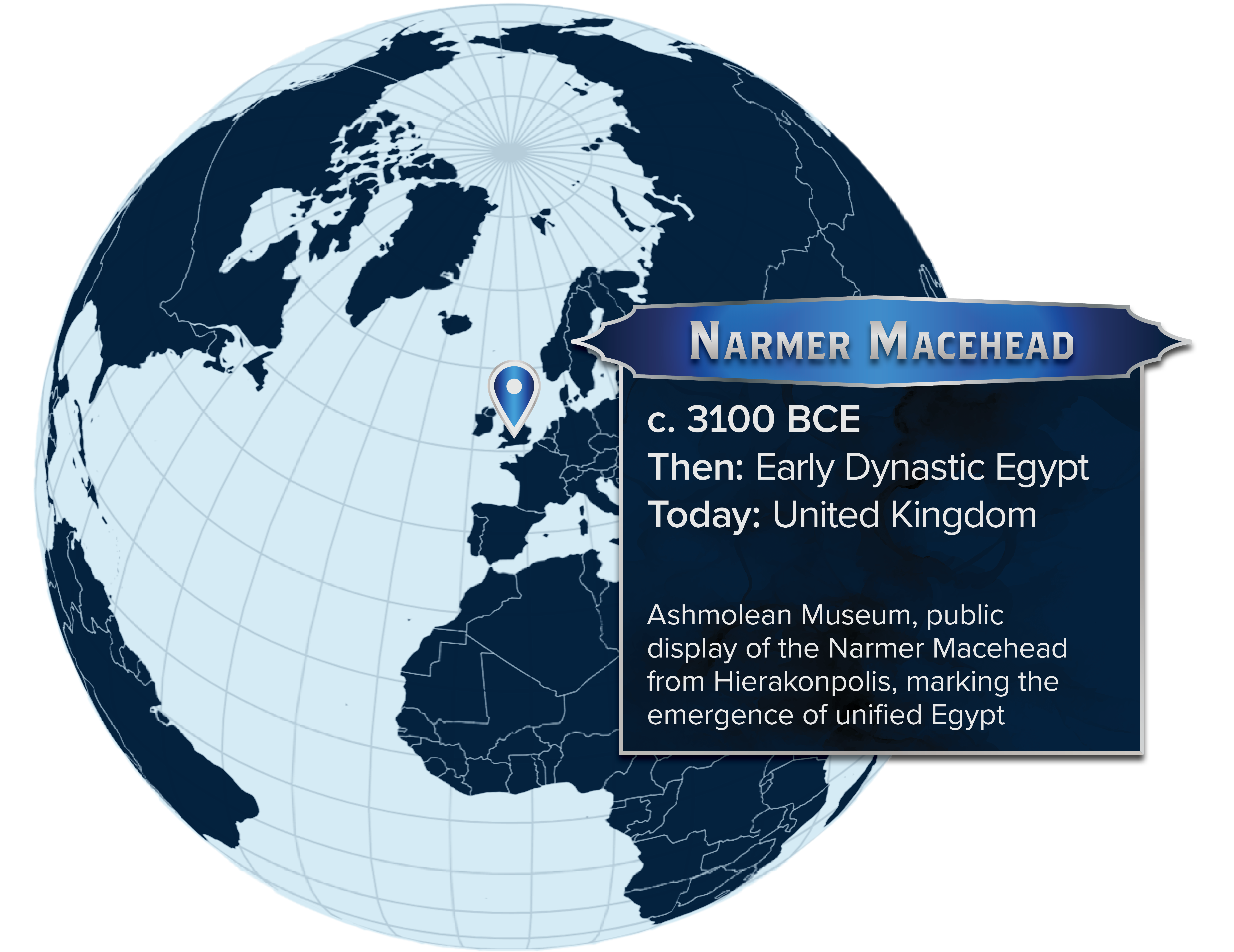
The Narmer Macehead is the world’s oldest "government report" carved into stone. Discovered in 1898 by archaeologist James Quibell, it was found buried in a secret "Main Deposit" at the ancient city of Hierakonpolis. This wasn't a random find; it was uncovered alongside the famous Narmer Palette and the Scorpion Macehead, forming a time capsule of the exact moment Egypt was born as a unified nation. While a mace was originally a blunt weapon used to smash skulls, this limestone version was purely ceremonial—a scepter of power used to show that the King was the ultimate boss.
The carvings on the macehead are a masterclass in "administrative flex." Narmer is shown sitting on a high throne under a decorative canopy, wearing the Red Crown of Lower Egypt. He isn't fighting; he is watching. Below him, the carvings list staggering numbers: 400,000 cattle, 1,422,000 goats, and 120,000 prisoners. Historians believe these numbers might be a bit of royal exaggeration, but the message was clear: Narmer had the power to count, categorize, and control the entire wealth of the Nile Valley. This is one of the first times in history we see a leader displaying the "machinery" of a state—taxation, census-taking, and resource management.
Scholars are still debating what specific event is being celebrated on the stone. It might be a Heb-Sed (a royal jubilee to prove the king was still fit to rule), a wedding to a northern princess, or a victory parade. However, the exact party doesn't matter as much as the choreography. Narmer is shown as the "axis" of the world. Everything—the prisoners, the animals, and the standard-bearers—moves toward him. He is the one who brings "Ma’at" (order) to the chaos of the early tribes. He is moving Egypt from a collection of small villages into a massive, organized empire.
Today, you can see this incredible artifact at the Ashmolean Museum in Oxford. It remains a cornerstone for understanding the "Divine Right of Kings." Before there were books or news broadcasts, the Macehead was how a leader said, "This is order. I am the one who makes it." It serves as a reminder to students that political power has always relied on three things: ceremony, the ability to count your resources, and the clever use of symbols to show you're in charge.