Encyclopedia Anachronistica

Standard
Inspiration
N. Africa
Egyptian
Location
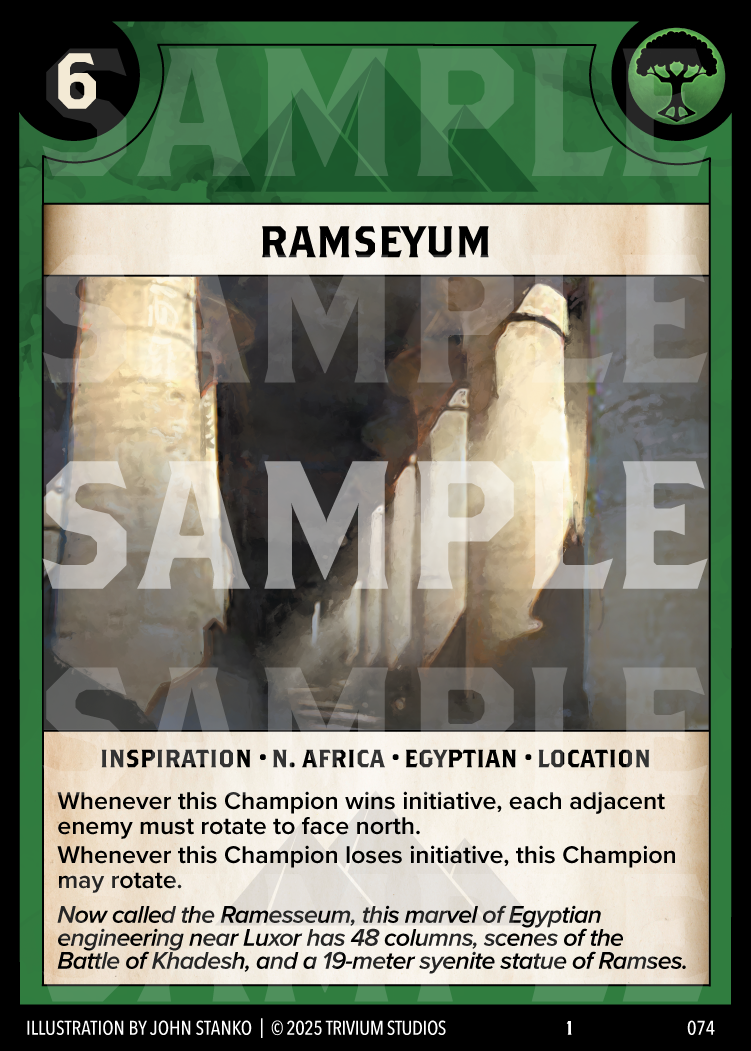
Whenever this Champion wins initiative, each adjacent enemy must rotate to face north. Whenever this Champion loses initiative, this Champion may rotate.
Now called the Ramesseum, this marvel of Egyptian engineering near Luxor has 48 columns, scenes of the Battle of Khadesh, and a 19-meter syenite statue of Ramses.
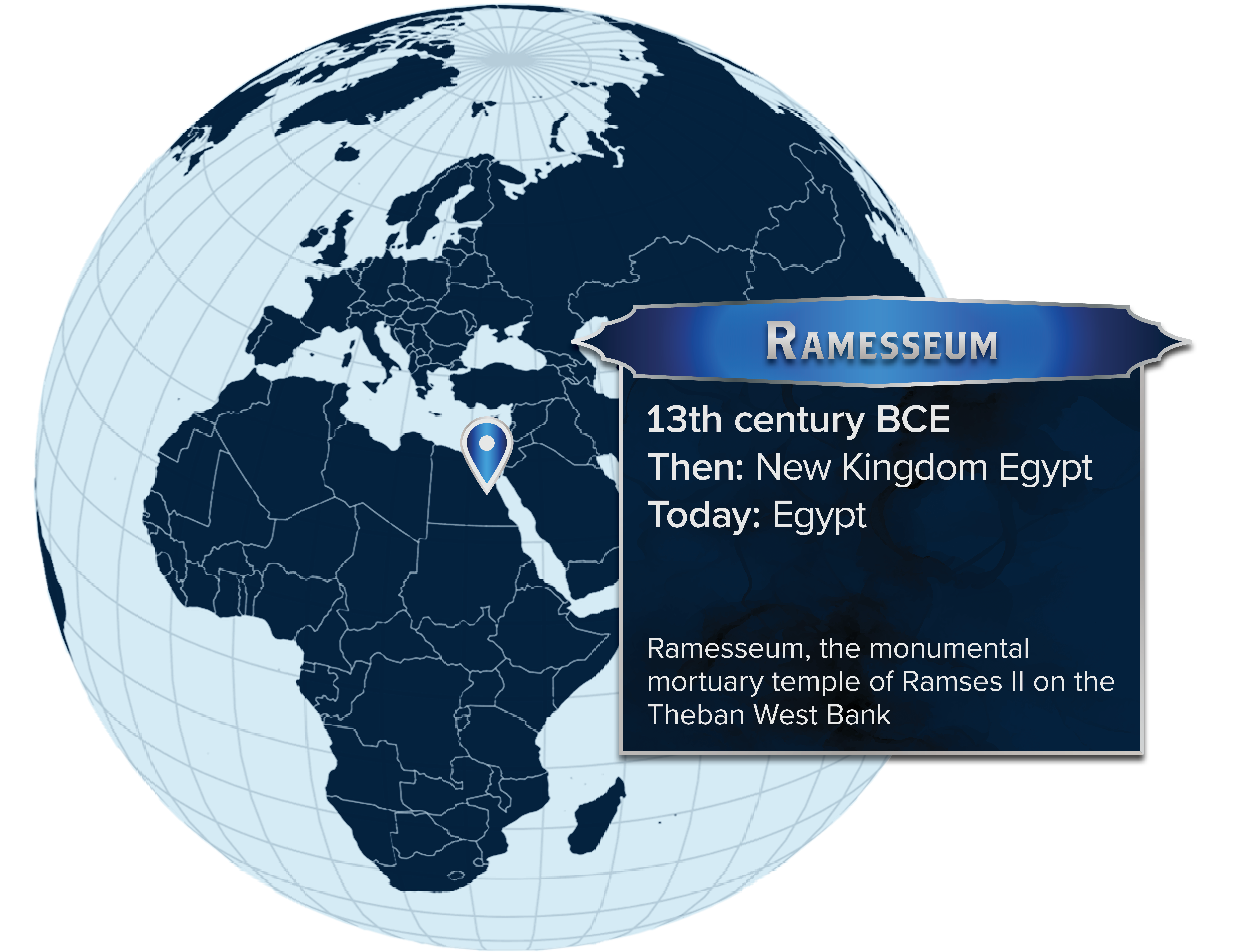
The Ramesseum is the grand memorial temple of Ramesses II, built on the west bank of the Nile at Thebes. It was designed to be more than just a place of worship; it was a "mansion of millions of years" where the king would be remembered and honored forever. Construction began almost as soon as he took the throne and lasted for decades, resulting in a massive complex of pylons, courtyards, and halls that showcased the peak of Egyptian engineering and art during the 19th Dynasty.
The temple is most famous for its giant statues, particularly the seated granite figure of the king. Originally standing about 18 meters (60 feet) tall and weighing nearly 1,000 tons, this colossus was one of the largest single-piece stone sculptures ever made. When Greek travelers like Diodorus Siculus saw the shattered remains of this statue centuries later, they called it "Ozymandias." The walls of the temple are also covered in detailed carvings of the Battle of Kadesh and other military campaigns, serving as a massive stone billboard for the king’s bravery and divine protection.
Beyond its religious and military displays, the Ramesseum was a vital economic hub. Excavations have uncovered a vast network of mud-brick storage magazines and granaries surrounding the stone temple. These warehouses could hold enough grain to support thousands of people, acting as a regional bank and distribution center. This shows that the temple wasn't just for the dead; it was a living institution that managed the wealth, food, and labor of the surrounding area.
Over thousands of years, the site suffered from Nile floods and people taking its stones to build other structures. At one point, part of the temple was even converted into a Christian church. Despite this wear and tear, the Ramesseum remains a cornerstone of the UNESCO World Heritage Site at Thebes. It provides historians with a clear look at how an ancient superpower organized its economy and how a king used architecture to claim a spot among the gods.
Today, the site is a powerful reminder of both human achievement and the passage of time. The sight of the massive, fallen statues lying in the sand has inspired generations of writers and artists to reflect on the nature of power. For students, the Ramesseum serves as a window into a world where religion, government, and economics were all tied together in a single, magnificent stone complex.