Encyclopedia Anachronistica

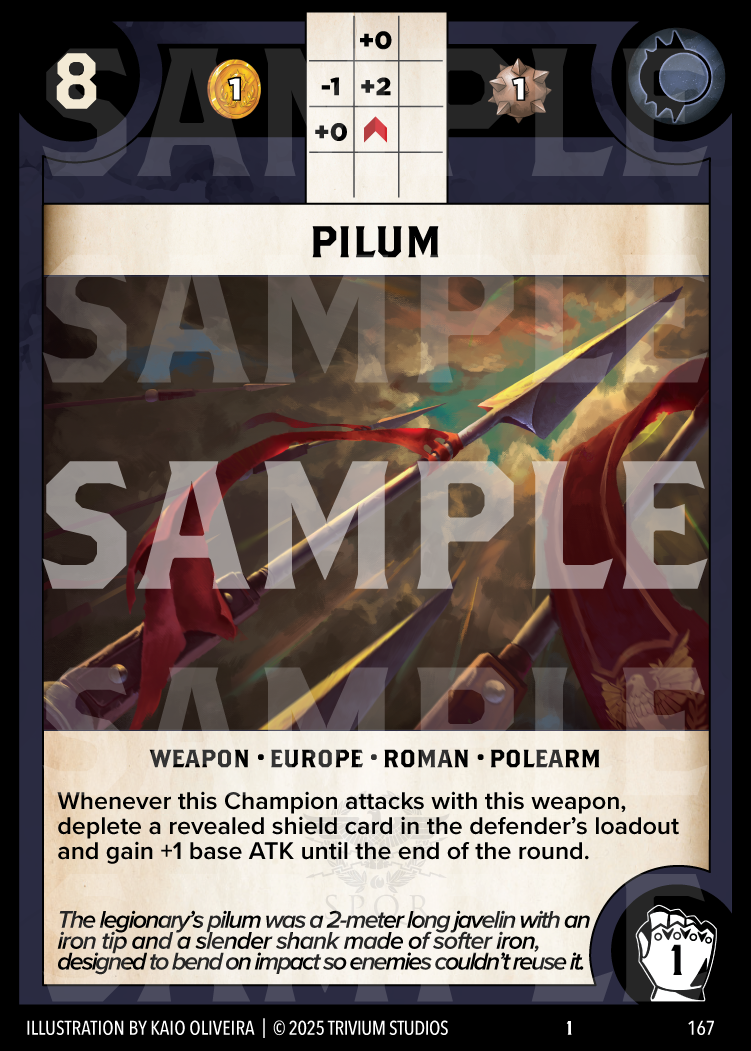
Standard
Weapon
Europe
Roman
Polearm
Whenever this Champion attacks with this weapon, deplete a revealed shield card in the defender's loadout and gain +1 base ATK until the end of the round.
The legionary's pilum was a 2-meter long javelin with an iron tip and a slender shank made of softer iron, designed to bend on impact so enemies couldn't reuse it.

The pilum was more than just a spear; it was a piece of high-tech Roman engineering designed for one specific, devastating purpose: to make an enemy’s defense a death trap. A Roman soldier carried this heavy javelin into the heat of battle, and when he let it fly, it didn't just pierce armor. Because of its unique, thin iron shank, the pilum would bend upon impact. If it hit a shield, it became an immovable, heavy anchor that the enemy couldn't pull out and—crucially—couldn't throw back. Imagine the chaos of a charging army suddenly forced to drop their weighted-down shields just as the Roman legionaries drew their swords and closed the distance.
Octavian’s entire rise to power was paved by the clatter of these javelins. During the meat-grinder civil wars that defined his youth, the pilum was the "opening act" of every major engagement. At the Battle of Philippi, thousands of these spears darkened the sky at once, shattering the formations of the assassins' armies. Even after the dust settled and he became Augustus, he didn't let the weapon go. He knew that his "Pax Romana" was only as strong as the professional soldiers guarding the Rhine and the Danube. The pilum became the standard-issue signature of the most disciplined military machine the world had ever seen.
For a student, the pilum is the perfect symbol of how Rome dominated the Mediterranean through coordination rather than just raw strength. It was the first step in a lethal, three-part rhythm: throw the pilum to strip the enemy of their shields, draw the gladius (short sword) to exploit the gap, and advance as an unbreakable wall of iron. Augustus took this tactical system and turned it into a permanent, professional career for his citizens. He didn't just want brave soldiers; he wanted a standardized force that functioned like a single, massive organism, with the pilum as its stinging front line.
Today, the rusted iron heads of pila found in archaeological digs across Europe still look menacing. They serve as a visceral reminder that the marble temples and sophisticated laws of Augustus’s Rome were protected by a very sharp, very practical reality. While we remember the poets and the politicians, it was the weight of the pilum in the hands of an ordinary soldier that held the empire’s borders for centuries. It remains the ultimate symbol of a civilization that didn't just outfight its enemies—it out-engineered them.