Encyclopedia Anachronistica

Standard
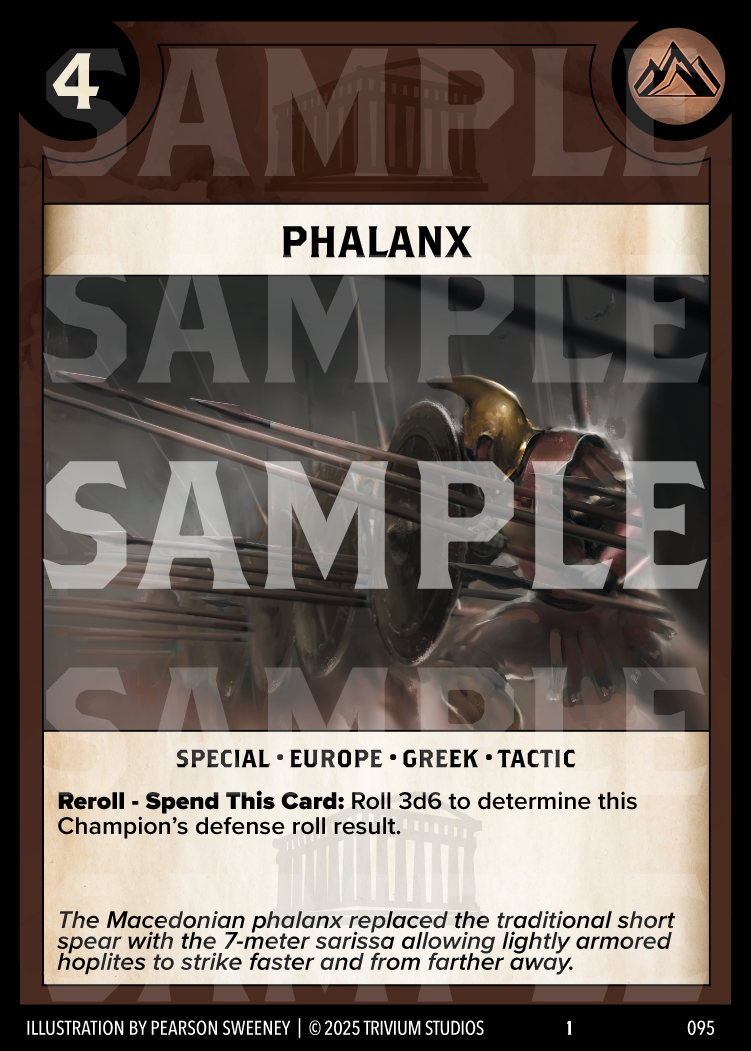
Special
Europe
Greek
Tactic
Reroll - Spend This Card: Roll 3d6 to determine this Champion's defense roll result.
The Macedonian phalanx replaced the traditional short spear with the 7-meter sarissa allowing lightly armored hoplites to strike faster and from farther away.

Philip II’s Macedonian phalanx was far more than a simple upgrade to the traditional Greek infantry; it functioned as a sophisticated weapon system. The core of this machine was the sarissa, a massive pike measuring between 4.5 and 6 meters (15 to 20 feet) in length. This weapon was so heavy it required both hands to wield, forcing Philip to revolutionize how soldiers were armored and organized. By turning his infantry into full-time professionals, he created a force that could march, wheel, and strike with the synchronized precision of a living engine.
On the march, the phalanx appeared as a dense, moving block of men. When they engaged the enemy, the first five ranks lowered their sarissas to the horizontal position, projecting a lethal forest of iron points that extended several meters beyond the front line. Because of the incredible reach of these weapons, an enemy soldier had to navigate five separate layers of sharp iron before they could even get close enough to swing a sword. At the Battle of Chaeronea in 338 BCE, the sheer physics of this formation proved decisive. The Macedonian pikes kept the legendary Greek hoplites at a distance, neutralizing their shorter 2.5-meter (8-foot) spears.
Operating this system was a grueling physical feat that required absolute trust. Archaeological finds of iron spearheads and weighted butt spikes—which helped balance the long shaft—show us that the sarissa was designed for stability and endurance. Success on the battlefield was not about individual glory, but about maintaining the integrity of the collective shield wall. Each man depended on the person to his right for protection. If the formation remained tight, it was a steamroller that flattened anything in its path; however, if the ranks became disorganized, the long pikes became a liability, and the formation could collapse under its own weight.
The rise of the phalanx signaled a permanent shift in the history of warfare. Philip’s genius lay in his understanding that a disciplined, standardized system could consistently defeat a collection of individual heroes. This "engine of pressure" became the foundation for the massive conquests of Alexander the Great, allowing him to dismantle empires across Asia. Even today, the phalanx is studied as the ultimate example of how organization and rigorous training can transform a group of people into a single, dominant force.