Encyclopedia Anachronistica

Standard
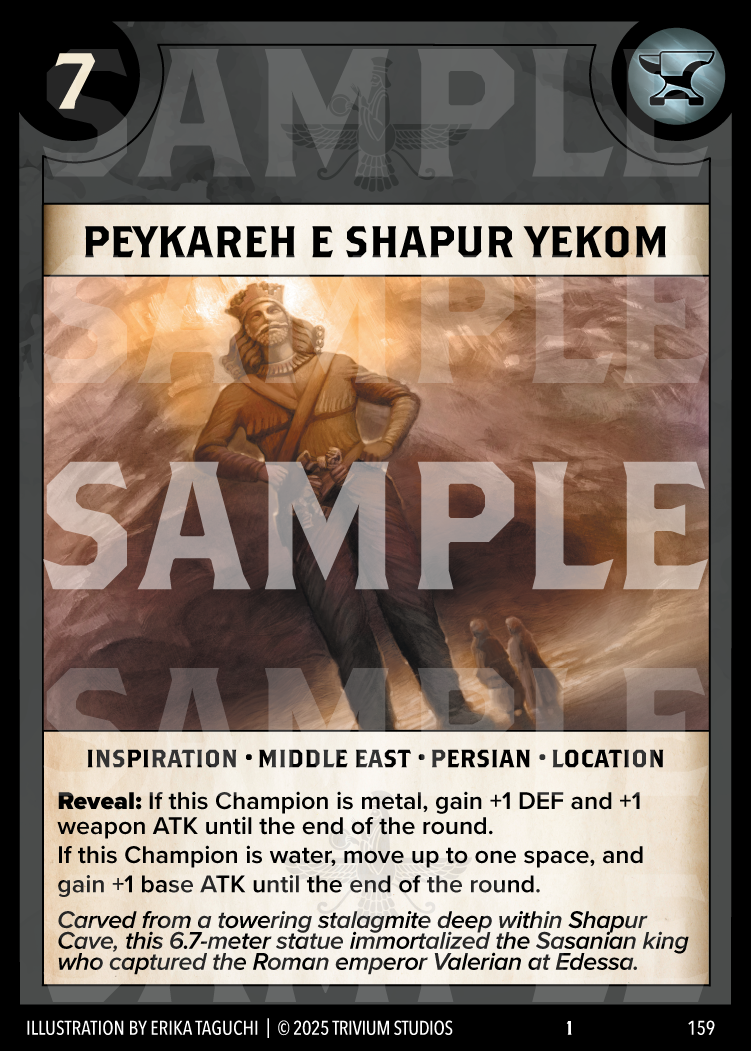
Inspiration
Middle East
Persian
Location
Reveal: If this Champion is metal, gain +1 DEF and +1 weapon ATK until the end of the round. If this Champion is water, move up to one space, and gain +1 base ATK until the end of the round.
Carved from a towering stalagmite deep within Shapur Cave, this 6.7-meter statue immortalized the Sasanian king who captured the Roman emperor Valerian at Edessa.
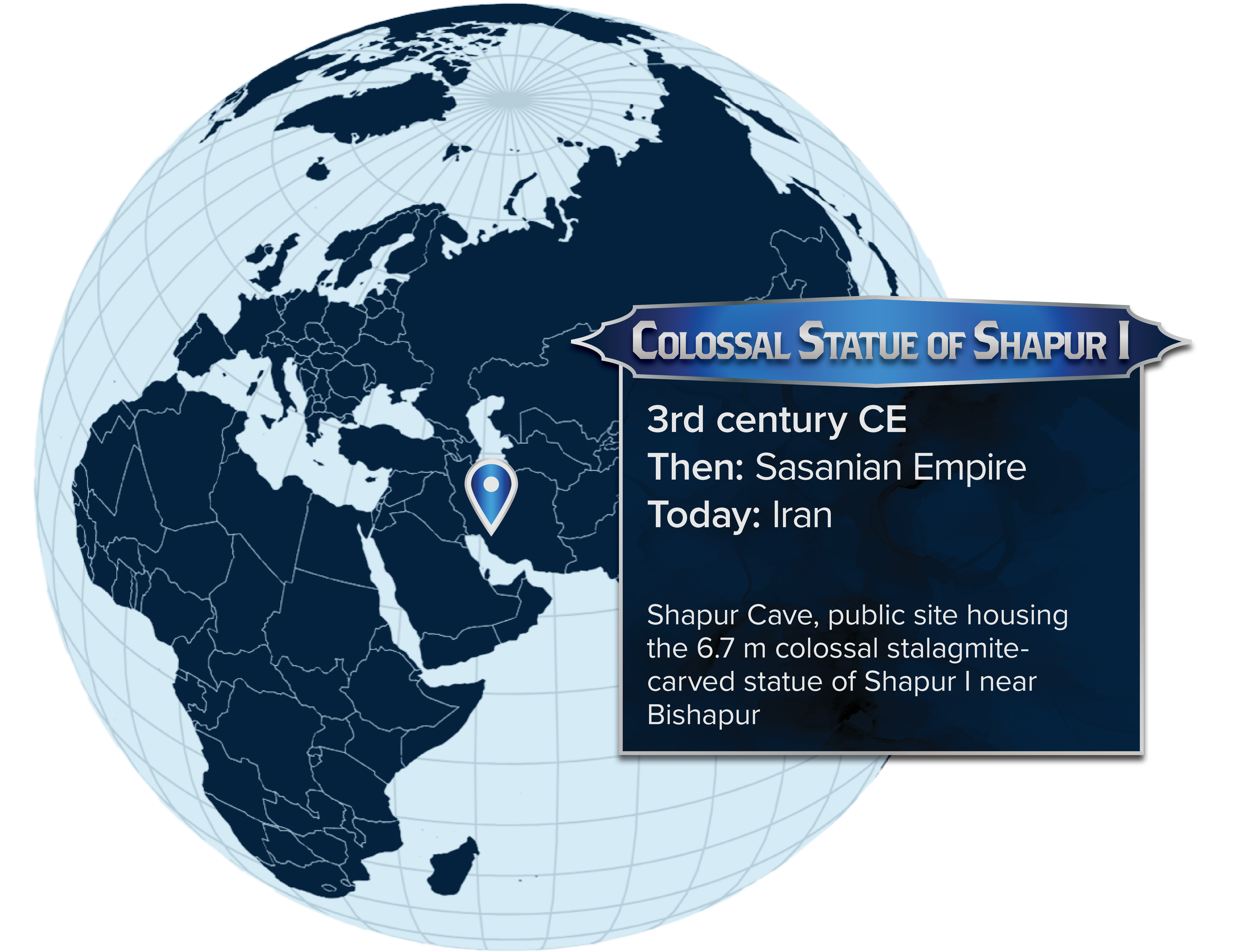
Deep inside the Shapur Cave, carved from the living rock of the Zagros Mountains, stands a giant that has watched over the valley for 1,700 years. This 7-meter-tall statue of Shapur I wasn’t hauled into the cave; it was sculpted directly from a single, massive stalagmite. The figure is an architectural marvel—shoulders broad, hair styled in the voluminous curls of the Sasanian royals, and a crown that once rose toward the cave’s ceiling. It is a hauntingly powerful depiction of the king who achieved the unthinkable: defeating three Roman emperors in a single lifetime.
The statue dates to the mid-3rd century CE, a golden age of Sasanian art where Iranian, Hellenistic, and local traditions fused into something entirely new. The craftsmanship is staggering; the king’s robes appear to fall in heavy, fluid folds of silk, and his belt and jewelry are rendered with the kind of precision usually reserved for small coins. Though an earthquake eventually toppled the giant, it was re-erected in the 20th century using internal supports, standing once again as a testament to the "King of Kings."
This colossal figure was a calculated political statement. Shapur I founded the nearby city of Bishapur using the labor of Roman prisoners—including engineers and architects—captured after his decisive victory over the Emperor Valerian. Placing this massive image in a cave, a space traditionally seen as sacred and eternal in Persian culture, added a layer of spiritual permanence to his military success. It told every visitor that Shapur’s authority wasn’t just a result of conquest, but a manifestation of divine favor that was literally part of the Persian earth.
Today, the statue remains the most impressive surviving work of Sasanian sculpture. Those who make the steep climb to the cave encounter a king who still seems to radiate a quiet, stony authority. It is a reminder that while the Sasanian Empire eventually fell, its artistic achievements were as monumental as its victories. Shapur’s giant stands as a bridge between the mortal world and the sacred mountain, capturing the moment when Persia reclaimed its status as a world superpower.