Encyclopedia Anachronistica

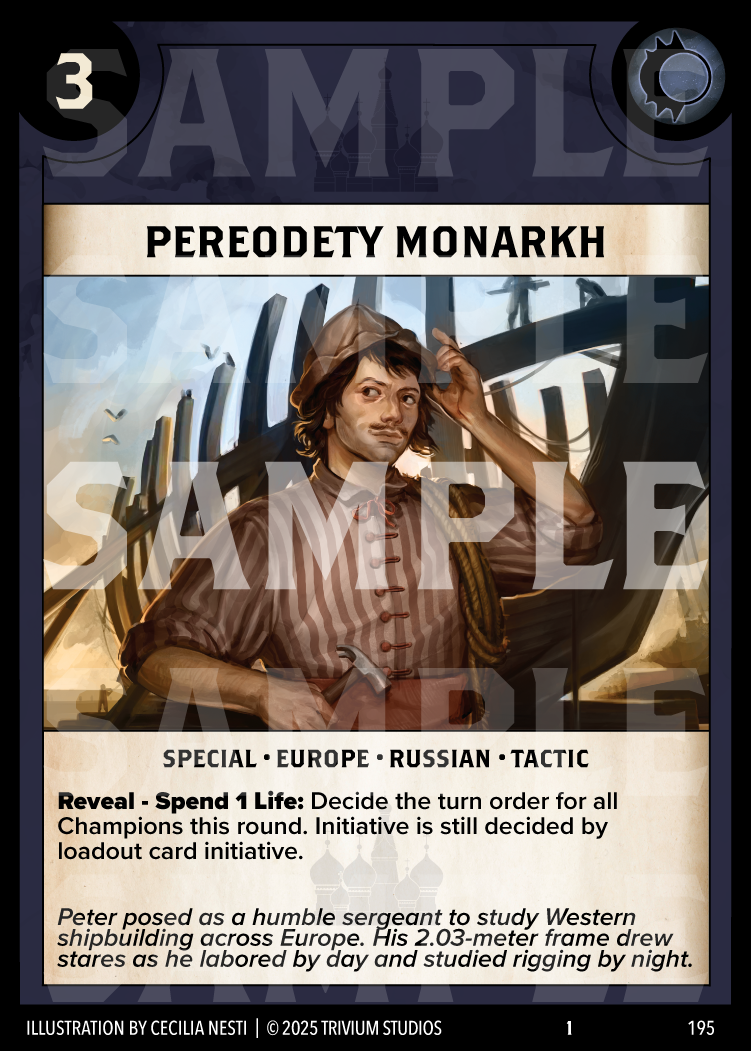
Standard
Special
Europe
Russian
Tactic
Reveal - Spend 1 Life: Decide the turn order for all Champions this round. Initiative is still decided by loadout card initiative.
Peter posed as a humble sergeant to study Western shipbuilding across Europe. His 2.03-meter frame drew stares as he labored by day and studied rigging by night.

In 1697, the most powerful man in Russia performed the ultimate disappearing act: he slipped out of his own country disguised as a common laborer. Peter the Great called this mission the "Grand Embassy," but the world remembers it as the "Disguised Monarch." To pull it off, Peter traveled under the alias Pyotr Mikhailov, pretending to be a simple carpenter. This episode—Pereodety Monarch, the “Disguised Monarch”—is one of the most remarkable moments in royal history. There was just one problem—Peter was over 2 meters tall (nearly seven feet)! In an era when the average person was much shorter, the Tsar’s "disguise" was about as effective as a giant trying to hide behind a blade of grass.
Peter wasn’t playing dress-up for fun; he was on a high-stakes mission of industrial espionage. He realized that if he wanted Russia to have a world-class navy, he needed to learn how to build one from the bottom up. In the Dutch Republic, he spent his days in the East India Company’s shipyards, swinging a mallet, hammering planks, and getting his hands covered in sawdust and tar. He worked alongside ordinary craftsmen, studying the skeleton of oceangoing vessels and learning the math behind navigation. While everyone knew he was really the Tsar, the disguise gave him a "social hall pass" to ask questions and do manual labor without the stifling ceremonies of a royal court.
This hands-on apprenticeship changed the map of the world. When Peter returned home, he didn't just tell people to build ships; he showed them how, using the very tools and blueprints he had mastered abroad. He built new shipyards that were mirrors of the Dutch ones and launched the Russian Navy, which would eventually dominate the Baltic Sea. His undercover journey became a legendary symbol of his "leadership by doing"—the idea that a ruler should understand the work they expect their subjects to perform.
Today, you can visit the "Czar Peter House" in Zaandam or museums in St. Petersburg to see the actual tools he used. These exhibits help us imagine a man who could have sat on a golden throne but chose to get blisters on his hands instead. Whether you see it as a brilliant publicity stunt or a moment of genuine humility, Peter’s time as a carpenter proves that, sometimes, to move a nation forward, a leader must be willing to pick up a hammer and get to work.