Encyclopedia Anachronistica

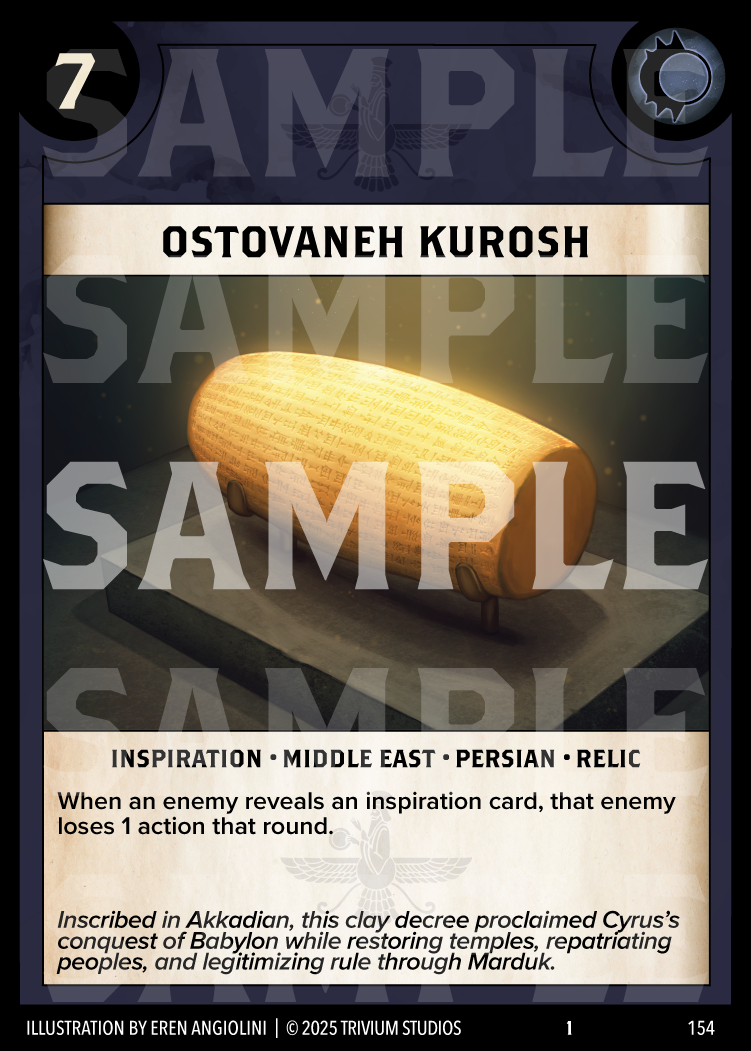
Standard
Inspiration
Middle East
Persian
Relic
When an enemy reveals an inspiration card, that enemy loses 1 action that round.
Inscribed in Akkadian, this clay decree proclaimed Cyrus's conquest of Babylon while restoring temples, repatriating peoples, and legitimizing rule through Marduk.

The Cyrus Cylinder is a small, clay barrel-shaped artifact covered in dense cuneiform script, but its historical weight is massive. Discovered in the ruins of Babylon in 1879, it commemorates Cyrus the Great’s conquest of the city in 539 BCE. Unlike the bloody victory boasts typical of many ancient conquerors, the Cylinder presents a different narrative: it depicts Cyrus as a liberator chosen by the Babylonian god Marduk to restore order and justice after the supposed "misrule" of the previous king, Nabonidus.
While modern fans often celebrate the Cylinder as the world’s first "charter of human rights," historians generally view it through a more pragmatic lens. It was a masterpiece of ancient public relations. Its primary goal was to legitimize Cyrus’s rule over a foreign superpower by speaking the language of their own traditions. However, the "PR" was backed by real action: the text confirms Cyrus’s policy of allowing displaced people to return to their homelands and rebuild their sacred temples. This included the Judean captives, whose return to Jerusalem is famously echoed in the biblical Book of Ezra.
For Cyrus, the Cylinder was a high-level diplomatic tool. He realized that a multi-ethnic empire could not be held together by the sword alone; it required the consent of the governed. By respecting local religions and customs, he turned potential rebels into loyal subjects. This policy of cultural tolerance wasn’t just "kindness,” it was brilliant statecraft. It allowed him to manage a territory that stretched from the Mediterranean to the Indus River with remarkably little internal resistance.
Today, the Cyrus Cylinder is one of the British Museum’s most prized treasures, remaining a focal point for discussions on leadership and how a ruler handles diversity. Its influence is so profound that a replica is prominently displayed at the United Nations Headquarters in New York City, where it is hailed as a symbol of the organization’s core values and an ancient parallel to the Universal Declaration of Human Rights. It was presented to the UN in 1971 by Princess Ashraf Pahlavi, the sister of the Shah of Iran, to commemorate the 2,500th anniversary of the founding of the Persian Empire. You can find it on the second floor of the Conference Building, in the corridor outside the Economic and Social Council Chamber. While we should be careful not to project modern legal concepts onto an ancient object—recognizing it first as a masterful piece of political messaging—the Cylinder still stands as a monumental shift in history. It marks the moment when a conqueror realized that the most durable empires are built not on the destruction of local cultures, but on their restoration. By acknowledging the dignity of his subjects and returning displaced peoples to their homes, Cyrus moved the needle of governance from raw conquest toward a more sustainable form of cultural tolerance that still resonates in the halls of international diplomacy today.