Encyclopedia Anachronistica


Chrono
Inspiration
Europe
Roman
Divinity
Parcea 1 of 3: Up to three Parcea cards may be used this game. Reveal: Gain 1 life.
Nona is one of the three Roman Fates (Parcae), alongside Decima and Morta. She spins life's thread at birth, invoked in the ninth month to guide each soul's arrival.
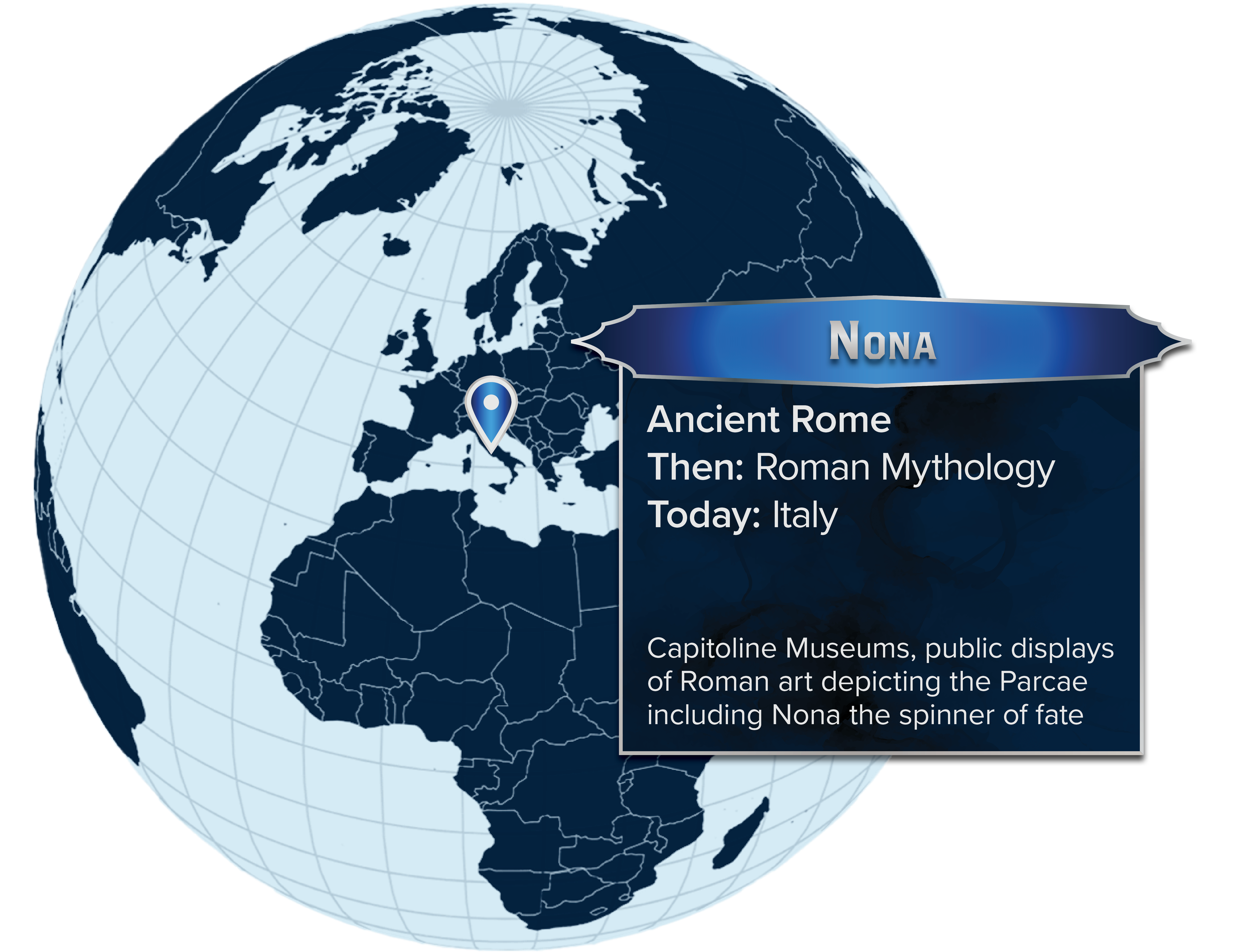
In the dangerous, uncertain world of ancient Rome, the first breath of a newborn was seen as a moment of profound divine intervention. At the center of this transition stood Nona, the first of the three Parcae, or Roman Fates. Her name literally translates to "Ninth," a direct and practical reference to the ninth month of pregnancy. While we often think of the Fates as distant, cosmic weavers, for a Roman family, Nona was a much more intimate figure—she was the guardian invoked by mothers and midwives to ensure that a child successfully crossed the threshold from the womb into the world.
Historically, Nona’s role was rooted in the realities of Roman domestic life. In a time when childbirth was one of the leading causes of death, Nona represented the hope for a safe delivery. She belonged to a trio alongside Decima (who measured the life) and Morta (who brought its end). While later Roman poets borrowed the Greek image of the Fates spinning a thread, the early Romans viewed Nona more as a celestial witness. She was the divine presence who marked the exact moment a child’s "fatum" (fate) began. To secure her favor, families would offer prayers and small gifts, treating her as a vital member of the household’s spiritual protection.
As the Roman Empire grew and absorbed Greek culture, Nona began to take on the characteristics of the Greek fate Clotho, and artists started depicting her with a spindle and wool. Yet, even in grand imperial art, she remained a symbol of the fragility of human existence. Inscriptions found on ancient altars show that she wasn't just a character in a story; she was a deity that real people—from weary soldiers to noble matrons—thanked when their children survived those first perilous days.
Today, Nona serves as a window into how the Romans personalized the vast concept of destiny. To them, fate wasn’t just an abstract law of the universe; it was something that arrived in the quiet of a nursery, woven into the very rhythms of birth and family survival. She reminds us that for the ancients, the "spinning" of a life was the most sacred craft of all.