Encyclopedia Anachronistica

Standard
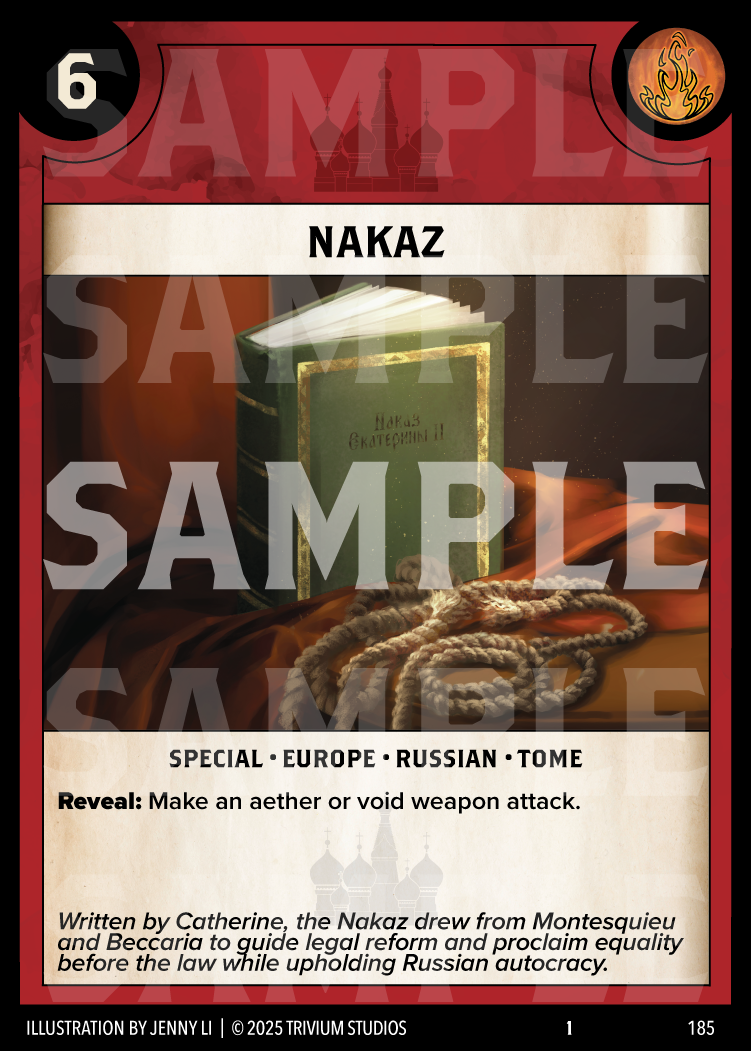
Special
Europe
Russian
Tome
Reveal: Make an aether or void weapon attack.
Written by Catherine, the Nakaz drew from Montesquieu and Beccaria to guide legal reform and proclaim equality before the law while upholding Russian autocracy.
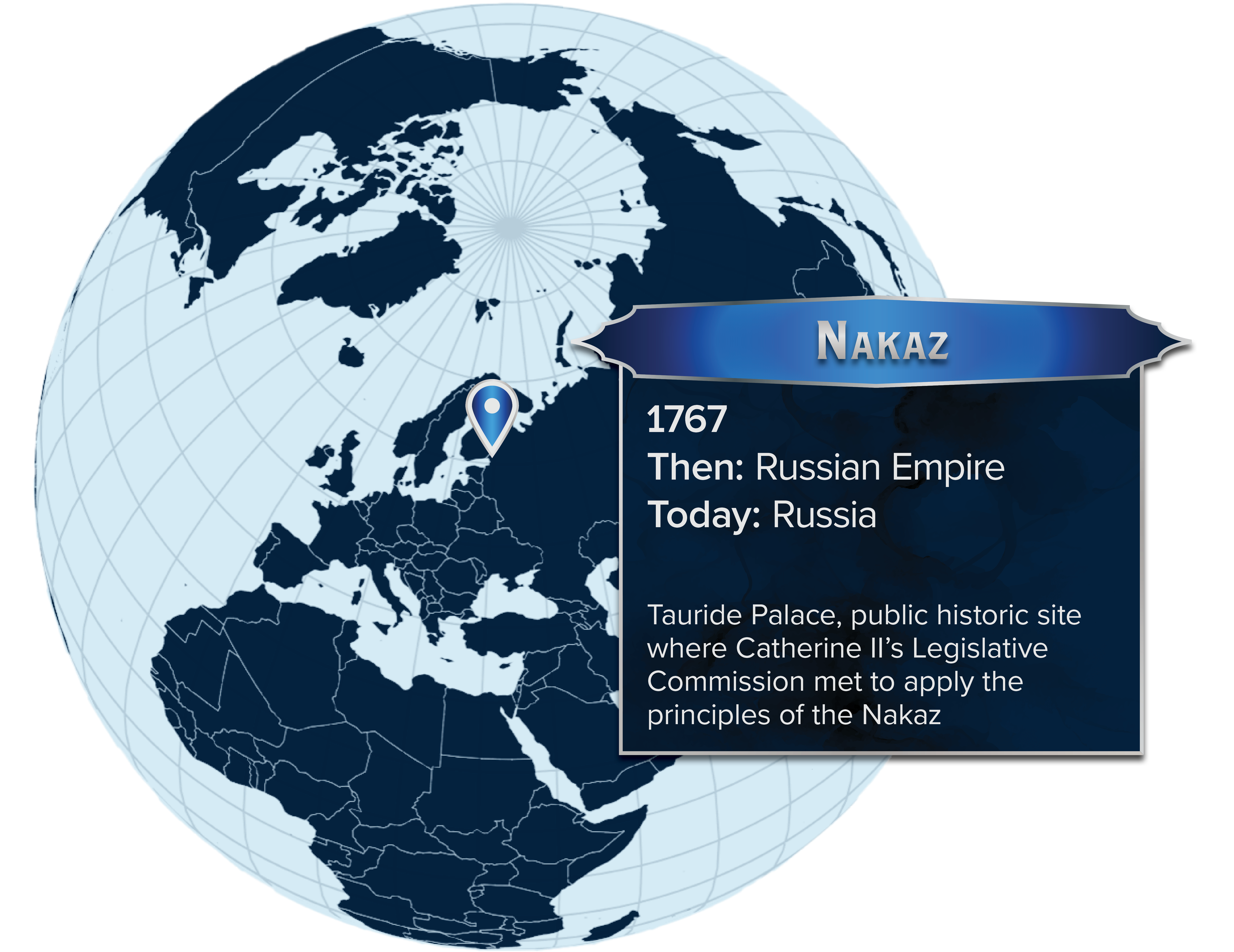
In 1767, Catherine the Great set out to rethink the laws of her vast empire. The result was the Nakaz (or “Instruction”), a long, carefully argued document that read like a visionary manifesto roadmap for a more rational and humane Russia. Instead of relying on tradition or inherited custom, Catherine drew directly from Enlightenment thinkers such as Montesquieu and Beccaria. She wrote that laws should be clear, predictable, and designed to protect people from cruelty rather than just punish them. She condemned torture, encouraged economic development, and insisted that the purpose of government was the welfare of its citizens — ideas that were bold in an empire still shaped by serfdom and autocracy.
The Nakaz wasn’t a law book itself, but rather an "instruction manual" for a massive brainstorm session. Catherine summoned a Legislative Commission—a diverse group of delegates from across her vast empire—to meet in Moscow and debate how to fix Russia’s aging legal system. Imagine a giant town hall meeting spanning half the globe. While the commission eventually fizzled out because the nobles weren't ready to give up their power and the empire was too diverse to agree on everything, the Nakaz became an international sensation. It circulated through the coffeehouses and courts of Europe, shocking readers who hadn't expected such "progressive" ideas to come from the Russian wilderness.
Legend has it that Catherine’s advisors were so terrified by her radical ideas that they begged her to burn the most daring parts of the draft. Whether she actually trimmed the text or not, the document succeeded in its most important job: branding Catherine as a philosopher-monarch who governed with reason as well as authority. She revised the document several times, adjusting its tone as political winds shifted, but its core message remained: a modern empire needed modern laws.
The Nakaz remains a fascinating glimpse into a moment when high-minded philosophy met the messy reality of running an empire. It captures a ruler trying to balance the desire for modern reform with the need for total control, proving that even centuries ago, the struggle for a "fair" system was a complicated, high-stakes game. Historians study it to understand how Enlightenment ideas spread beyond Western Europe and how rulers tried to balance reform with stability. Museums and archives preserve its manuscripts as evidence of one of the earliest attempts to apply Enlightenment principles to a multiethnic empire. Its debates about justice, cruelty, and the purpose of law still echo in modern discussions about human rights and legal reform.