Encyclopedia Anachronistica


Standard
Special
Europe
Greek
Motto
When this Champion deals damage to an enemy with O or lower DEF value, this Champion may rotate.
In Apophthegmata Laconica ("Sayings of Spartans"), Plutarch recorded Leonidas' answer to Xerxes' demand that the Greeks lay down their weapons- "Come and take them."
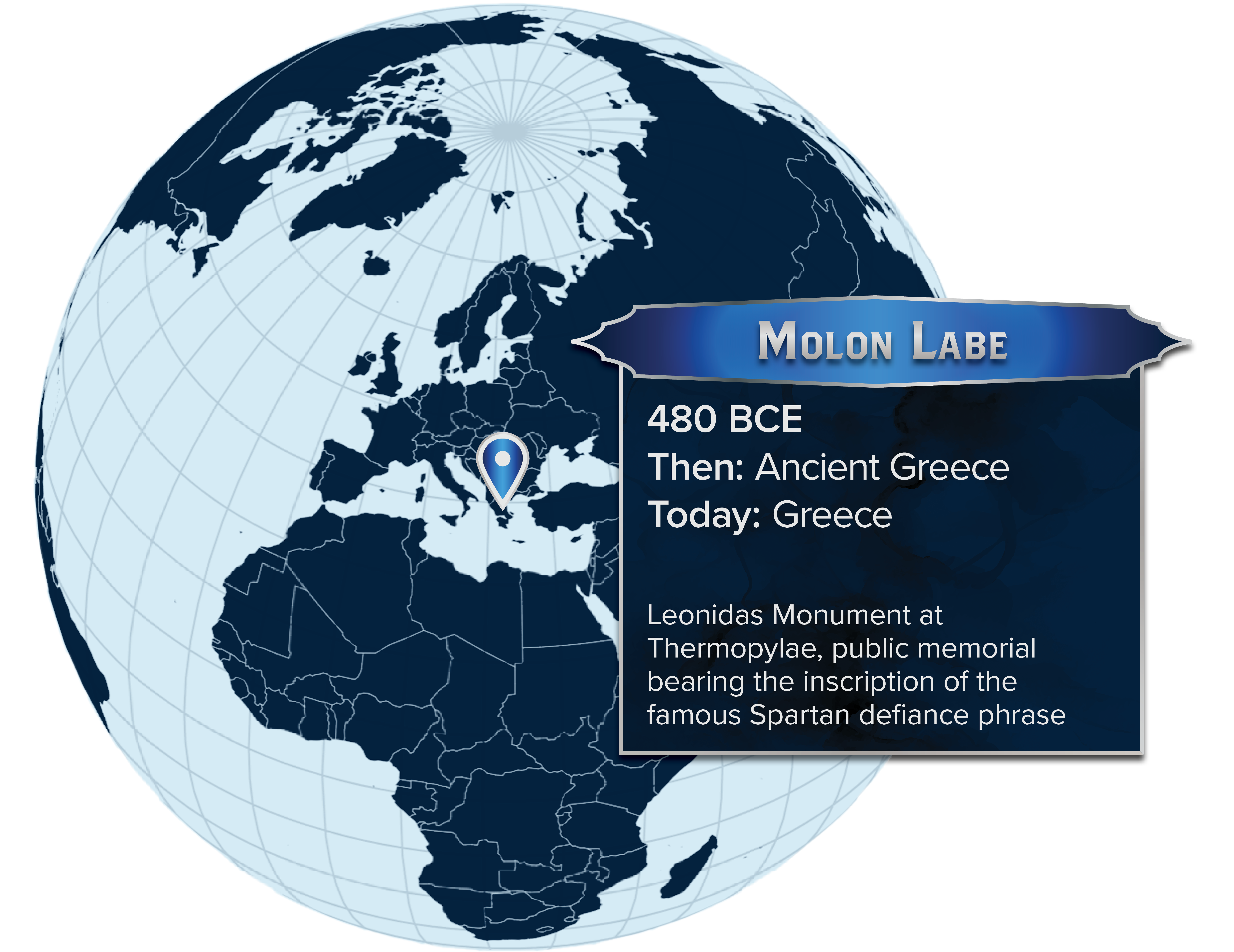
"Molōn labe" is perhaps the most famous "mic drop" in military history. Meaning "Come and take them," this three-word response was King Leonidas’s defiant answer when the Persian King Xerxes demanded that the Greeks hand over their weapons before the battle and surrender. While we cannot prove Leonidas whispered these exact words in the dust of the pass, the phrase perfectly captures the Spartan tradition of laconic speech—the art of being brief, cutting, and incredibly resolute. In Sparta, a man was judged not just by how he fought, but by how little he needed to say to make his point.
To the ancient Greeks, this wasn't just a tough-guy catchphrase; it was a profound statement of political identity. In their world, surrendering your shield and spear was the ultimate act of submission. To "hand over your arms" meant you were surrendering your autonomy and becoming a subject of a foreign king. By telling the Persians to "come and take them," Leonidas was telling the largest empire on Earth that the Spartans valued their freedom more than their lives. This verbal defiance acted as a backbone for the physical defense of the phalanx, transforming the battle into a fight for the very idea of independence.
Throughout the three-day struggle at Thermopylae, these words echoed in the actions of the soldiers. When the Persians rained down so many arrows that they "blotted out the sun," another Spartan famously joked that they would then "fight in the shade." This brand of dry, fearless humor—combined with the grit of "Molōn labe"—created a psychological edge that terrified their opponents. It framed the encounter as a clash between a massive force of conscripts and a small band of men who were there by choice, standing on a foundation of absolute resolve.
Today, students of history and rhetoric study "Molōn labe" to understand how language can be weaponized. It has moved far beyond the narrow pass of Thermopylae, appearing on military emblems and in modern literature whenever a small group chooses to stand its ground against impossible odds. Its power remains in its stark simplicity: it is a challenge that admits no negotiation, no compromise, and no retreat. It serves as a permanent reminder that, at Thermopylae, words and weapons carried the exact same meaning—a defiance that was spoken plainly and upheld until the very last man fell.