Encyclopedia Anachronistica

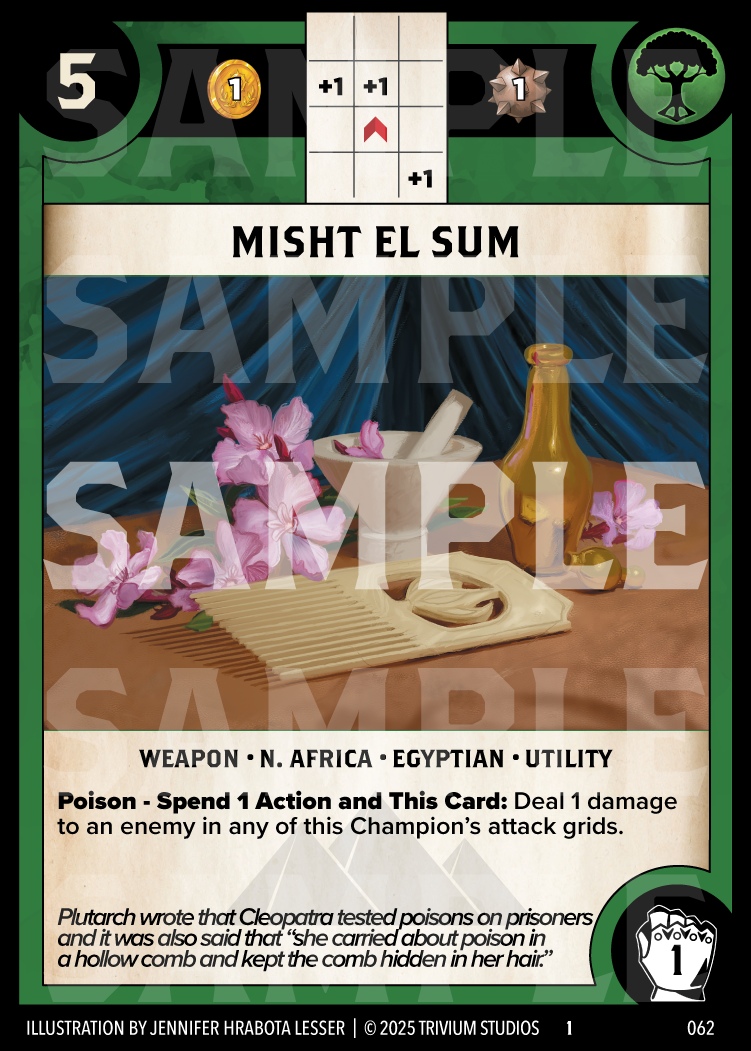
Standard
Weapon
N. Africa
Egyptian
Utility
Poison - Spend 1 Action and This Card: Deal 1 damage to an enemy in any of this Champion's attack grids.
Plutarch wrote that Cleopatra tested poisons on prisoners and it was also said that "she carried about poison in a hollow comb and kept the comb hidden in her hair."

Cleopatra VII lived in a palace that was basically a beautiful, high-end trap. The Ptolemaic family was famous for "removing" their own relatives to keep the throne, meaning Cleopatra grew up in a world where her closest friends and siblings were often her deadliest enemies. In this environment, even everyday objects like an ivory comb or a bronze hair pin weren't just about beauty—they were symbols of extreme trust.
Every morning, Cleopatra had to sit and let attendants handle sharp tools near her neck and face. This was a moment of total vulnerability. She had already survived a civil war against her own sister and had been forced into exile before clawing her way back to power. She knew that in Alexandria, danger didn't usually come from an invading army; it came from a whisper in a private hallway or a hand reaching out in a quiet room. To her, grooming was a daily exercise in security and political control.
Because she lived under constant threat, Cleopatra became a scientist of survival. She famously studied poisons, not because she was a "villain," but because she was a strategist. The historian Plutarch tells us she actually experimented with different toxins on prisoners to see which ones worked fastest and caused the least pain. She studied chemistry the way a general studies a map—she wanted a "Plan B" in case she was ever captured or humiliated by Rome. She wanted to control her own exit from the world if she couldn't control her throne.
Later legends grew wild with stories of "poisoned combs" or venomous hairpins. While we haven't found any "assassin's combs" in archaeology, the legend exists because it fits the reality of her life. In her world, beauty and danger were twins. Her perfectly arranged hair and scented oils weren't about vanity; they were part of her strategic armor. Every time she appeared in public looking flawless, she was telling her subjects and her Roman rivals that she was in total command of herself and her court.
Ultimately, Cleopatra’s story is about a woman who mastered the art of proximity. She understood that power wasn't just about who had the biggest army, but about who you allowed to stand close to you. The comb represents her incredible vigilance—it is a symbol of a queen who treated her own bedroom as a battlefield and her own appearance as a weapon of war.