Encyclopedia Anachronistica

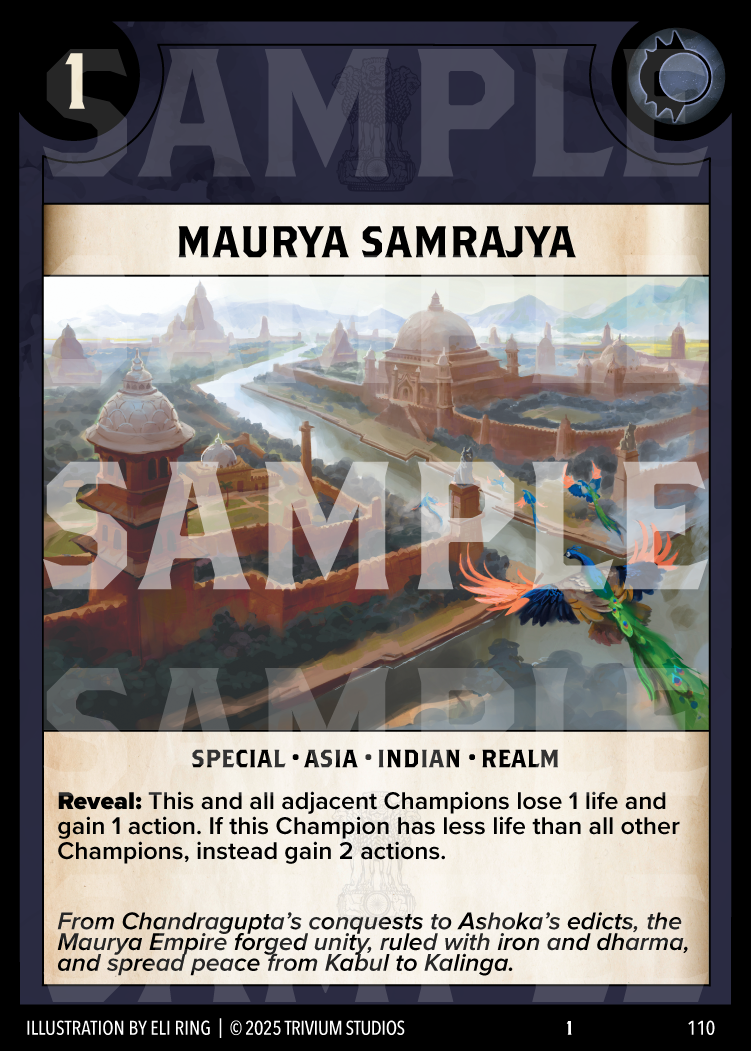
Standard
Special
Asia
Indian
Realm
Reveal: This and all adjacent Champions lose 1 life and gain 1 action. If this Champion has less life than all other Champions, instead gain 2 actions.
From Chandragupta's conquests to Ashoka's edicts, the Maurya Empire forged unity, ruled with iron and dharma, and spread peace from Kabul to Kalinga.
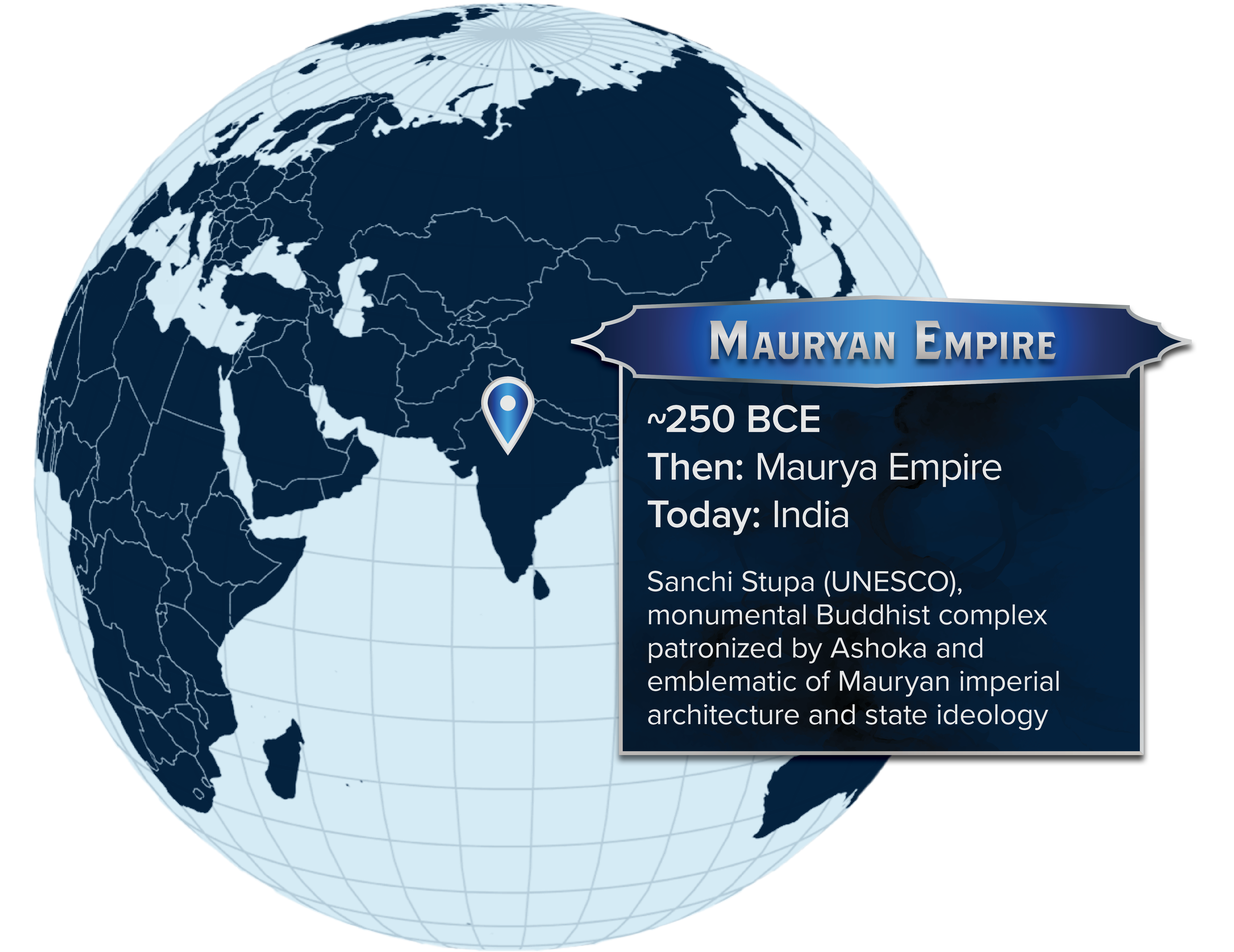
The Maurya Empire was far more than just a kingdom—it was a tectonic shift in history. When Chandragupta Maurya seized power around 321 BCE, northern India was a chaotic patchwork of rival states and warring tribes. Within a single generation, he forged them into one of the largest empires the ancient world had ever seen, stretching a massive web of authority from the mountains of Afghanistan to the lush deltas of Bengal. This empire is Chandragupta’s greatest invention: a colossal, living machine of governance that proved a single system could unite an entire subcontinent.
Life in the Mauryan state was defined by a level of organization that would make a modern city manager jealous. Roads acted as the empire’s arteries, linking distant provinces to the capital at Pataliputra. Greek ambassadors who visited were awestruck, describing a city protected by massive timber walls, sixty-four gates, and a deep moat that served as both a defense and a sewer system. Behind those walls, a vast bureaucracy tracked every harvest, every tax coin, and every trade route. This wasn’t just a military occupation; it was a sophisticated administration that managed everything from the quality of goods in the markets to the preservation of elephant-filled forests.
Chandragupta’s empire also turned India into a global superpower. After a high-stakes standoff with Seleucus I Nicator—one of Alexander the Great’s successor generals—the two rulers didn’t just walk away; they negotiated a landmark treaty. Chandragupta traded five hundred war elephants for vast territories and a diplomatic marriage, effectively placing his empire on the world stage alongside the great Hellenistic powers. This moment proved that the Mauryan state wasn’t just a local power, but a respected player in international politics and trade.
Today, the Mauryan legacy is etched into the very soil of India. Archaeological sites like the ruins of Pataliputra help us trace how this ancient "super-state" functioned day-to-day. Chandragupta’s creation set the blueprint for how a diverse region could be united under a single law, a standardized economy, and a shared vision of peace. It stands as a timeless reminder that true leadership isn’t just about winning a crown—it’s about building a system that can hold a world together long after the king is gone.