Encyclopedia Anachronistica

Standard
Special
Asia
Chinese
Tome
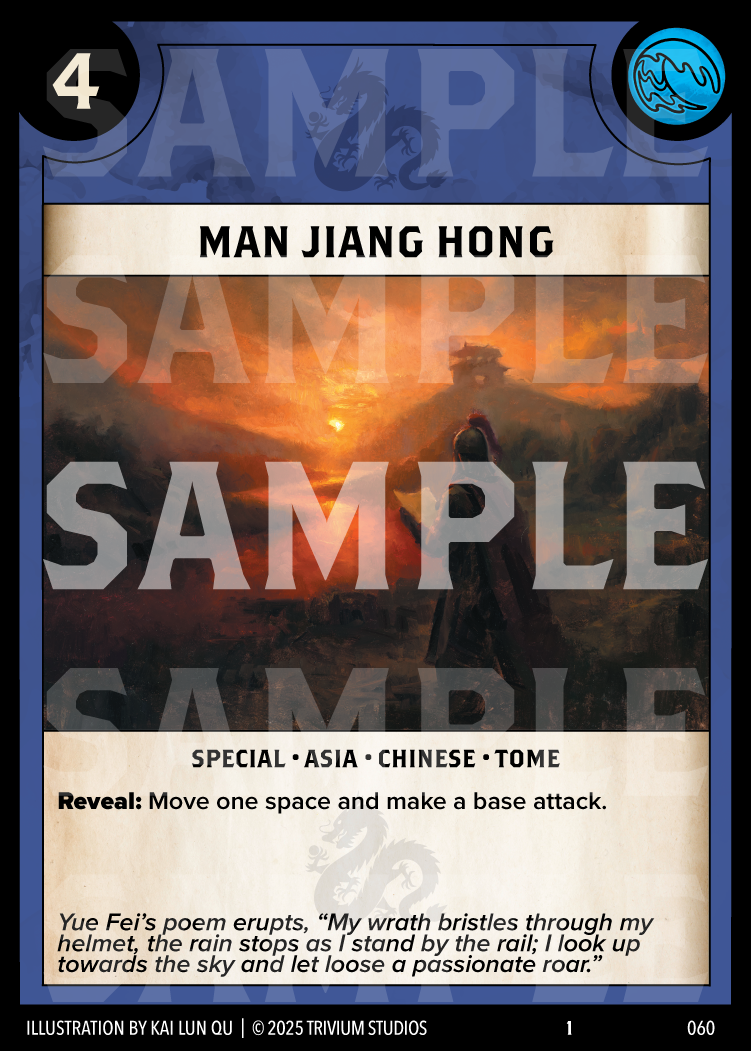
Reveal: Move one space and make a base attack.
Yue Fei's poem erupts, "My wrath bristles through my helmet, the rain stops as I stand by the rail; I look up towards the sky and let loose a passionate roar."

Man Jiang Hong (‘Full River Red’) is the name of the lyric tune pattern used for the poem most famously attributed to Yue Fei, though its authorship remains debated among scholars. The poem expresses fierce patriotism, grief over lost territory, and an unwavering resolve to reclaim the north from the Jin. Whether written by Yue Fei himself or composed later in his voice, Man Jiang Hong became one of the most influential patriotic texts in Chinese history, shaping the cultural memory of Yue Fei as the embodiment of loyal resistance.
The poem’s imagery is vivid and martial: cold armor, rising spirits, and the burning desire to “wash away humiliation.” Its emotional intensity reflects the Southern Song’s precarious position after the fall of Kaifeng and the capture of the emperors. Yue Fei’s campaigns briefly pushed deep into Jin-held territory, and the poem’s themes align with his documented frustration at political obstruction and his desire to continue the northern expeditions. Even if the poem was composed later, it captures the ethos associated with Yue Fei’s life and death.
During the Ming and Qing dynasties, Man Jiang Hong became a staple of patriotic education and popular performance. It appeared in operas, woodblock prints, and school primers, often recited at moments of national crisis. The poem’s association with Yue Fei reinforced his status as a martyr of loyalty, especially after his wrongful execution and posthumous rehabilitation. Its lines were invoked to inspire unity and resistance during foreign invasions and internal upheavals.
At the Yue Fei Temple in Hangzhou, a stone stele displays the full text of Man Jiang Hong, serving as a focal point for visitors. The poem’s presence in this memorial context underscores its role in shaping Yue Fei’s legacy. It is not merely a literary work but a cultural artifact that encapsulates centuries of patriotic sentiment.
Today, Man Jiang Hong remains widely taught and recited. Its themes of loyalty, perseverance, and national dignity continue to resonate in modern China. Whether or not Yue Fei penned the poem, it stands as a powerful expression of the ideals he came to represent — a testament to how literature and memory intertwine to define historical figures.