Encyclopedia Anachronistica

Standard
Armor
Europe
Roman
Medium
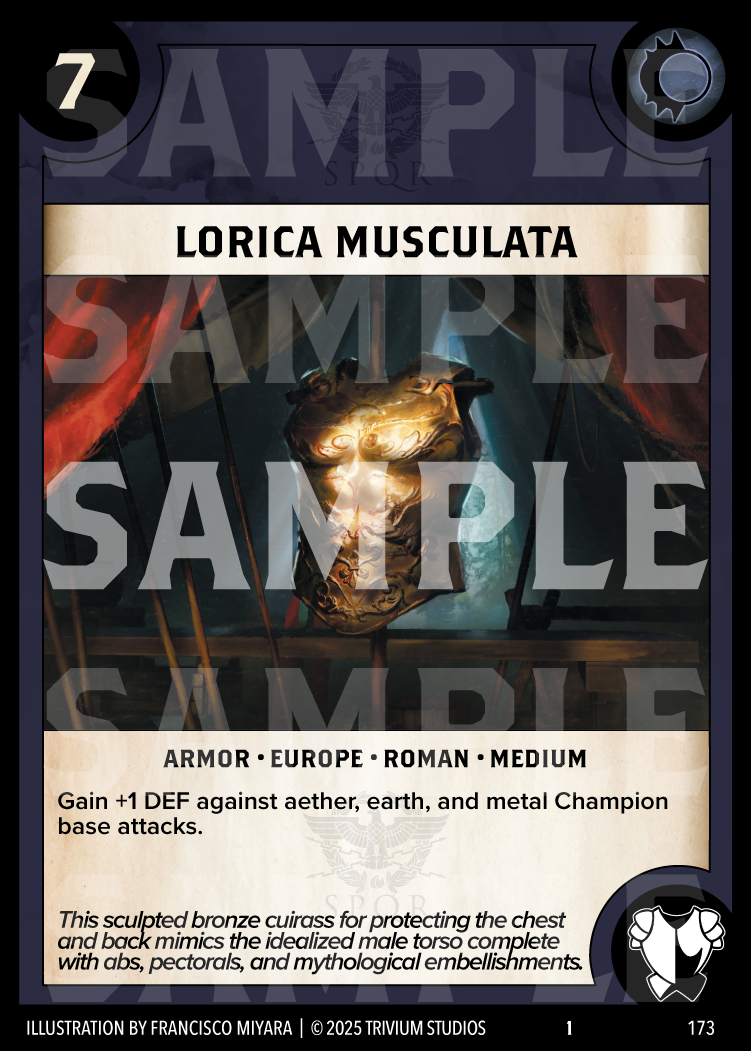
Gain +1 DEF against aether, earth, and metal Champion base attacks.
This sculpted bronze cuirass for protecting the chest and back mimics the idealized male torso complete with abs, pectorals, and mythological embellishments.

When we picture a Roman general like Julius Caesar leading a charge, we almost always see him in the lorica musculata, or muscle cuirass. This iconic armor, hammered from bronze or iron to resemble a perfectly ripped male torso, is the ultimate ancient "power suit." It wasn't just a piece of safety equipment; it was a high-definition billboard for a commander’s ego. Often decorated with carved images of soaring eagles, mythological heroes, or the terrifying face of Medusa, it was designed to make a general look less like a mere human and more like a living god on the battlefield.
Historically, this armor served as a sharp status symbol. While the average Roman legionary wore the famous lorica segmentata—those overlapping iron bands that look like a metal ribcage—the muscle cuirass was strictly "officers only." It was expensive, custom-fitted, and incredibly flashy. For a leader like Caesar, who famously obsessed over his public image, the muscle cuirass was essential branding. By wearing it, he was intentionally copying the look of Greek heroes like Alexander the Great and the gods of Olympus. It told his soldiers, "I am not just your general; I am a hero out of legend."
Despite its artistic look, the armor was surprisingly practical. It offered solid protection for the chest and back while leaving the arms completely free to signal troops or swing a sword. Underneath, a general would wear a padded garment called a subarmalis to keep the heavy metal from chafing and to absorb the shock of a blow. However, its most important job was "theatrical warfare." In the chaos of a dusty battle, a gleaming bronze torso reflecting the sun acted as a beacon, allowing soldiers to see exactly where their leader stood.
Today, surviving examples of these muscle cuirasses are prized exhibits in museums across Europe, from the Louvre to the British Museum. Seeing them in person helps us realize that Caesar’s political success depended not only on his strategy and speeches but also on how he presented himself to the world. We see the legacy of this armor every time a superhero puts on a suit with molded muscles or a modern brand uses a "tough" aesthetic to sell an image. Caesar understood a truth that still rules our world today: if you want people to believe you are a hero, you must look the part.