Encyclopedia Anachronistica


Chrono
Weapon
Europe
Spanish
Sword
Whenever this purple, silver, or white Champion hits with this weapon, the defender loses 1 action.
Lobera ("Wolf-Slayer") was the ceremonial sword of Ferdinand Ill of Castile, embodying divine authority and royal virtue, later to be passed down to his son Manuel.
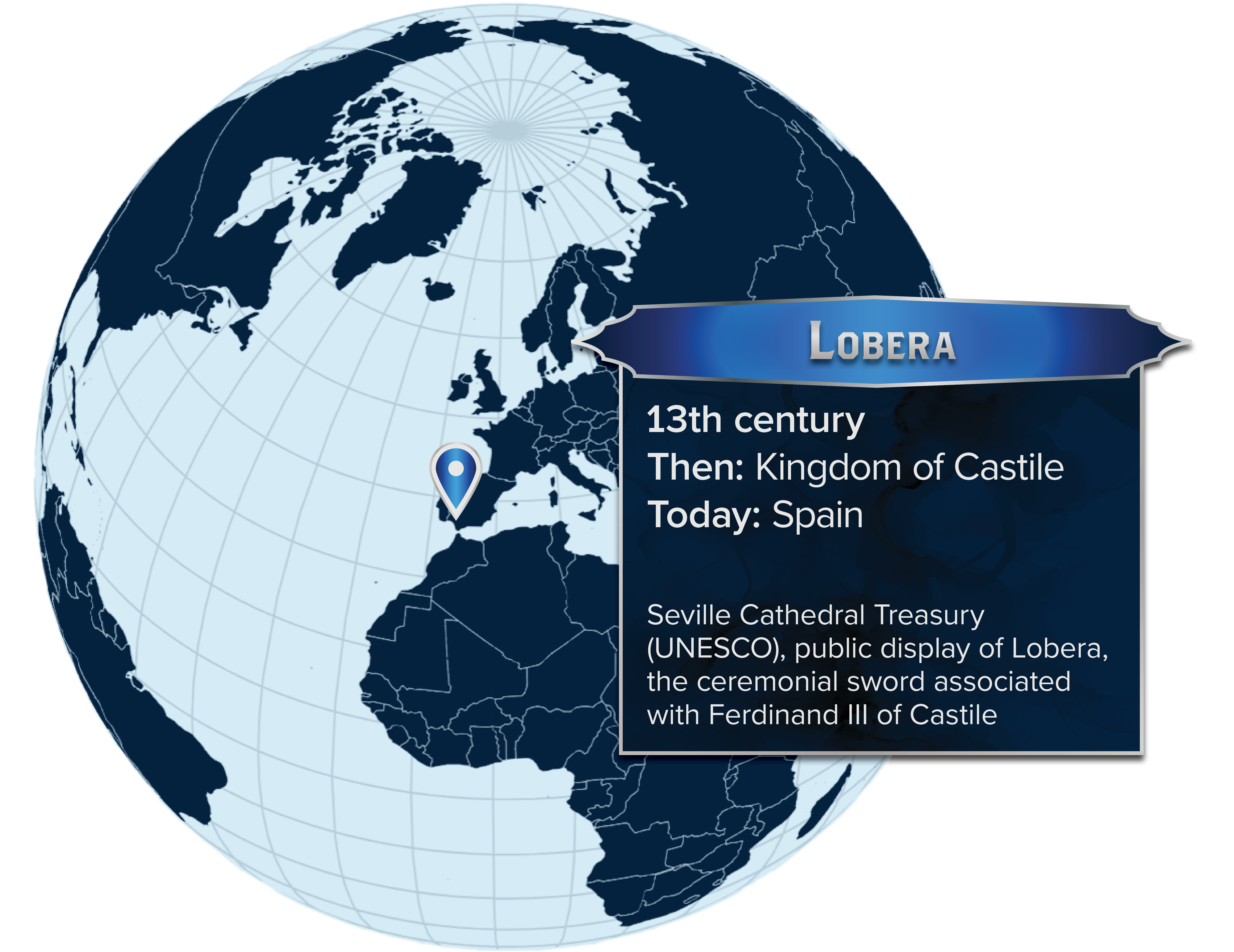
In the treasury of the Cathedral of Seville lies a blade that helped forge the identity of a nation: Lobera. Often translated as the "Wolf-Slayer," this straight, double-edged sword was the prized possession of King Ferdinand III of Castile, a 13th-century ruler who reshaped the map of medieval Spain. While its name sounds like something out of a fantasy novel, Lobera is a very real historical artifact that has survived for over 700 years, serving as a silent witness to the rise of the Spanish monarchy.
Historically, Lobera wasn’t a weapon meant for the mud and blood of the front lines. Instead, it was a "sword of state"—a ceremonial masterpiece used to signify royal authority and justice. In the Middle Ages, a king didn't just rule through laws; he ruled through symbols. Lobera would have been carried upright in grand processions or held during solemn oaths to show that the king had the divine right to lead. When Ferdinand captured major cities like Córdoba and Seville, Lobera was there, representing the law and order he brought to the newly conquered territories.
The sword’s most famous moment came at the end of Ferdinand’s life. According to 14th-century chronicles, the dying king handed Lobera to his son, Alfonso X, as a way of passing on his power and legitimacy. It was a medieval version of a baton pass in a relay race; by holding his father’s sword, the new king proved he was the true heir. Over time, the sword became so legendary that people began to believe it had miraculous powers or had been blessed by a saint. While these legends are more folklore than fact, they show how much the people of Castile admired Ferdinand’s leadership.
Today, Lobera is treated as both a royal treasure and a sacred relic. After Ferdinand was declared a saint in 1671, the sword became a centerpiece of religious festivals in Seville, where it is still carried through the streets to this day. Visitors can see the original blade, which still fits the style of 13th-century craftsmanship, sitting alongside the king's other crown jewels. Lobera remains a powerful symbol of a time when a single object could represent the honor of a king, the strength of a kingdom, and the long, complex history of the Spanish frontier.