Encyclopedia Anachronistica

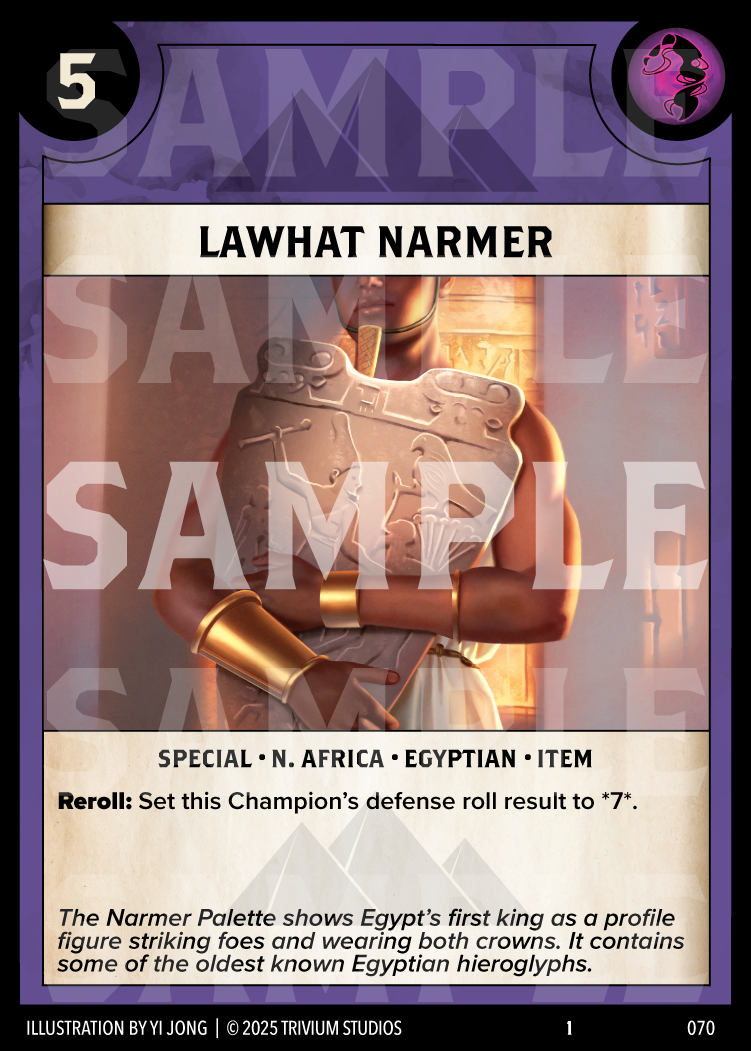
Standard
Special
N. Africa
Egyptian
Item
Reroll: Set this Champion's defense roll result to *7 *.
The Narmer Palette shows Egypt's first king as a profile figure striking foes and wearing both crowns. It contains some of the oldest known Egyptian hieroglyphs.
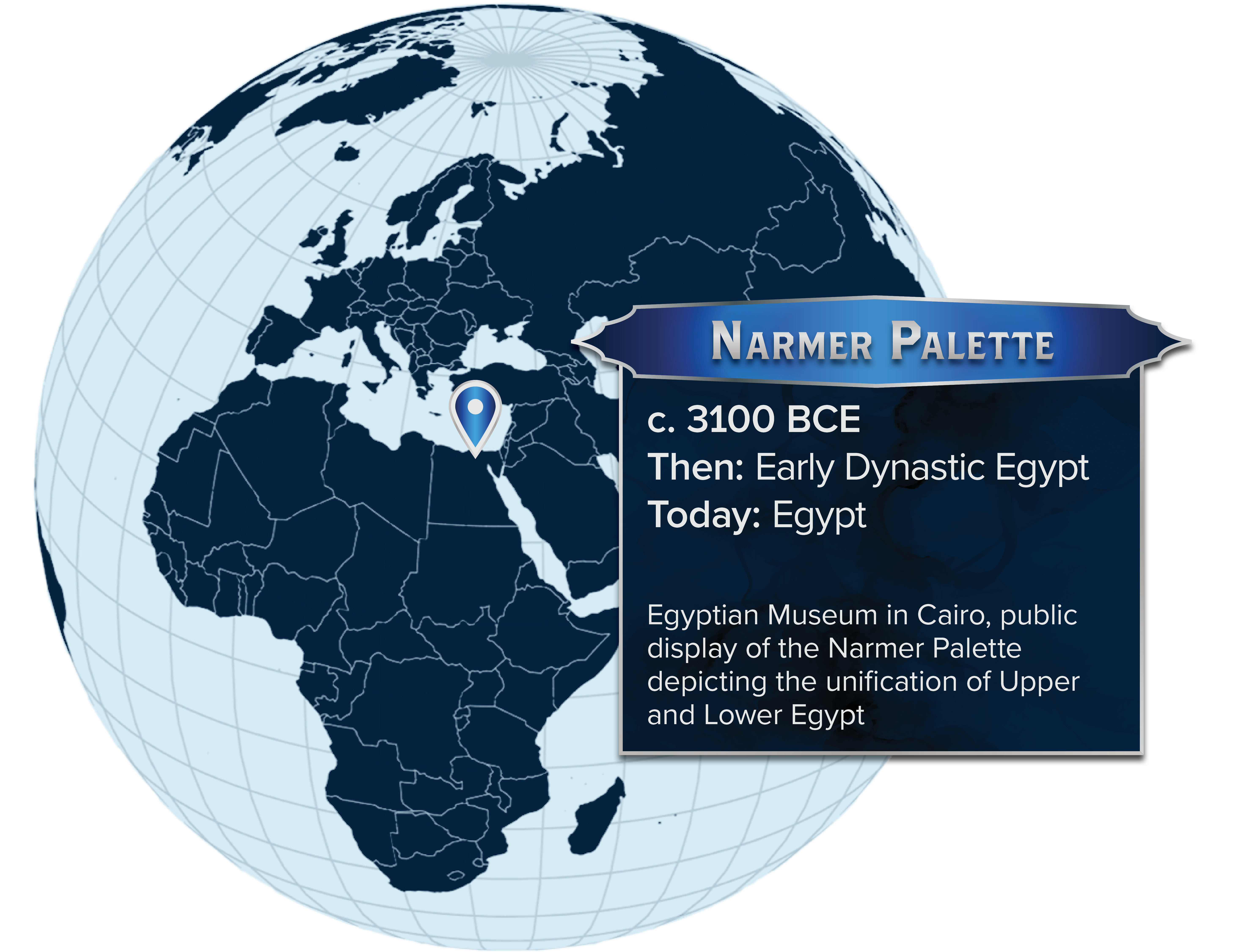
The Narmer Palette is often called the "First Political Document" in human history. Discovered in the "Main Deposit" at Hierakonpolis in 1897-98, alongside the Narmer Macehead, this 60 cm (two-foot) tall slab of dark siltstone is the ultimate record of Egypt’s birth. It is famous for being the earliest artifact to show a single king wearing the crowns of both the North and the South, effectively announcing to the world that the "Two Lands" had finally become one.
The most striking image on the palette is the "Smiting Pose." Narmer is shown standing in a powerful profile, his arm raised and ready to strike a kneeling enemy with a mace. To modern eyes, it might look like a scene of simple violence, but to the ancient Egyptians, it was a sacred duty. The king wasn't just a soldier; he was the "Champion of Order." By subduing his enemies, he was pushing back the forces of chaos and protecting the harmony of the universe (Ma’at). This specific pose was so effective that Egyptian pharaohs continued to use it in their art for the next 3,000 years.
The palette is packed with "visual codes" that tell a complex story. On one side, you see two mythical beasts with long, serpentine necks (serpopards) being held on leashes by attendants. Their necks intertwine to form a circle—the spot where cosmetics would normally be ground. This symbol represents the "taming" of wild energy and the unification of opposites. Above them, Narmer marches in a victory procession, preceded by standard-bearers carrying the symbols of the different regions of Egypt, showing that the entire country was now marching to his beat.
While small palettes were used by everyday people to grind eye makeup, this one is far too large and heavy for a makeup bag. It was a ritual object, likely used in a temple to prepare cosmetics for the statues of the gods. It was a way for Narmer to "sign" his name to history. Whether he unified Egypt in one big battle or over many years of clever politics, the palette tells the story he wanted people to remember: that he was the conqueror, the unifier, and the chosen leader of the gods.
Today, the Narmer Palette is a treasure of the Egyptian Museum in Cairo. It’s a foundational piece for students because it shows exactly how art, writing, and politics first came together to create a national identity. It reminds us that whoever controls the narrative—and the symbols—controls history itself.