Encyclopedia Anachronistica

Standard
Armor
Europe
Greek
Medium
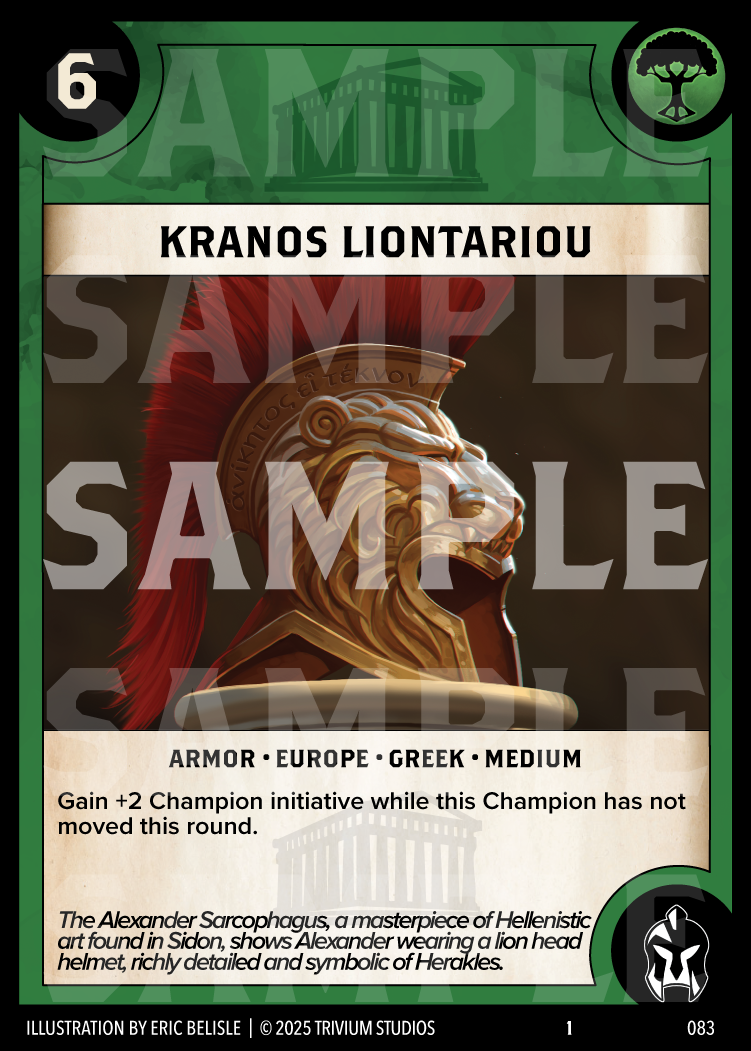
Gain +2 Champion initiative while this Champion has not moved this round.
The Alexander Sarcophagus, a masterpiece of Hellenistic art found in Sidon, shows Alexander wearing a lion head helmet, richly detailed and symbolic of Herakles.

The lion-headed helmet is one of the most iconic images of Alexander the Great, yet it exists almost entirely in the world of art rather than archaeology. Its most famous appearance is on the Alexander Sarcophagus, a massive stone coffin found in Sidon. In the carvings, Alexander is shown charging into battle wearing a helmet crafted to look like a lion’s head, with the animal’s jaws framing his face. This wasn’t just a fashion choice; it was a high-stakes claim to power, signaling to the world that he was a hero on the same level as the gods.
In ancient Greece and Macedonia, the lion was the symbol of Heracles (Hercules), the legendary hero who supposedly killed the Nemean Lion and wore its skin as armor. Because Alexander’s family, the Argead dynasty, claimed they were direct descendants of Heracles, wearing a lion-themed helmet was like wearing a family crest. It told his followers and his enemies that he possessed "divine favor" and the superhuman strength of his ancestors.
While we have found many amazing Macedonian helmets made of bronze and iron, we have never found a physical lion-headed helmet. This suggests it was likely a piece of ceremonial armor—something worn for royal parades, special portraits, or religious festivals—rather than a piece used for the gritty, daily business of a 1,600-kilometer (1,000-mile) march. Even if it wasn't worn in every mud-soaked trench, the image was incredibly effective. It worked so well that for hundreds of years after his death, Hellenistic kings and even Roman emperors used lion imagery on their own armor to try and "borrow" some of Alexander’s legendary charisma.
Today, the lion helmet is a favorite for museum reconstructions and historical movies because it perfectly blends the world of myth with the world of war. It reminds us that Alexander wasn't just a general; he was a master of branding. He knew that by wearing the face of a lion, he was transforming himself from a human king into a timeless legend.