Encyclopedia Anachronistica

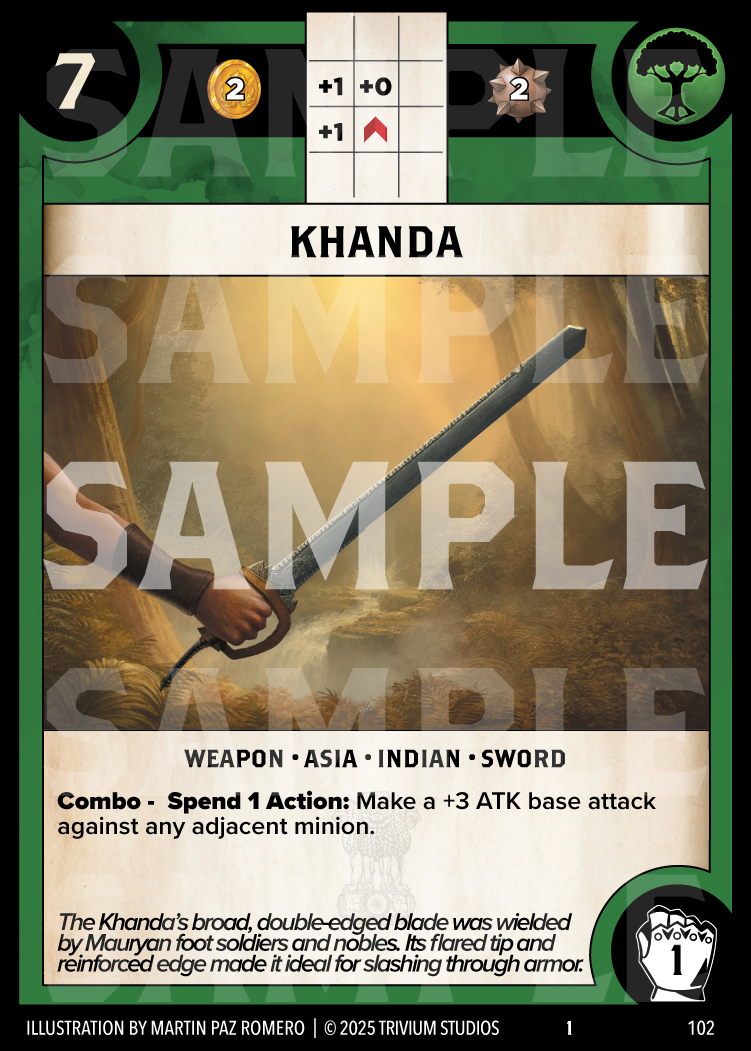
Standard
Weapon
Asia
Indian
Sword
Combo - Spend 1 Action: Make a +3 ATK base attack against any adjacent minion.
The Khanda's broad, double edged blade was wielded by Mauryan foot soldiers and nobles. Its flared tip and reinforced edge made it ideal for slashing through armor.
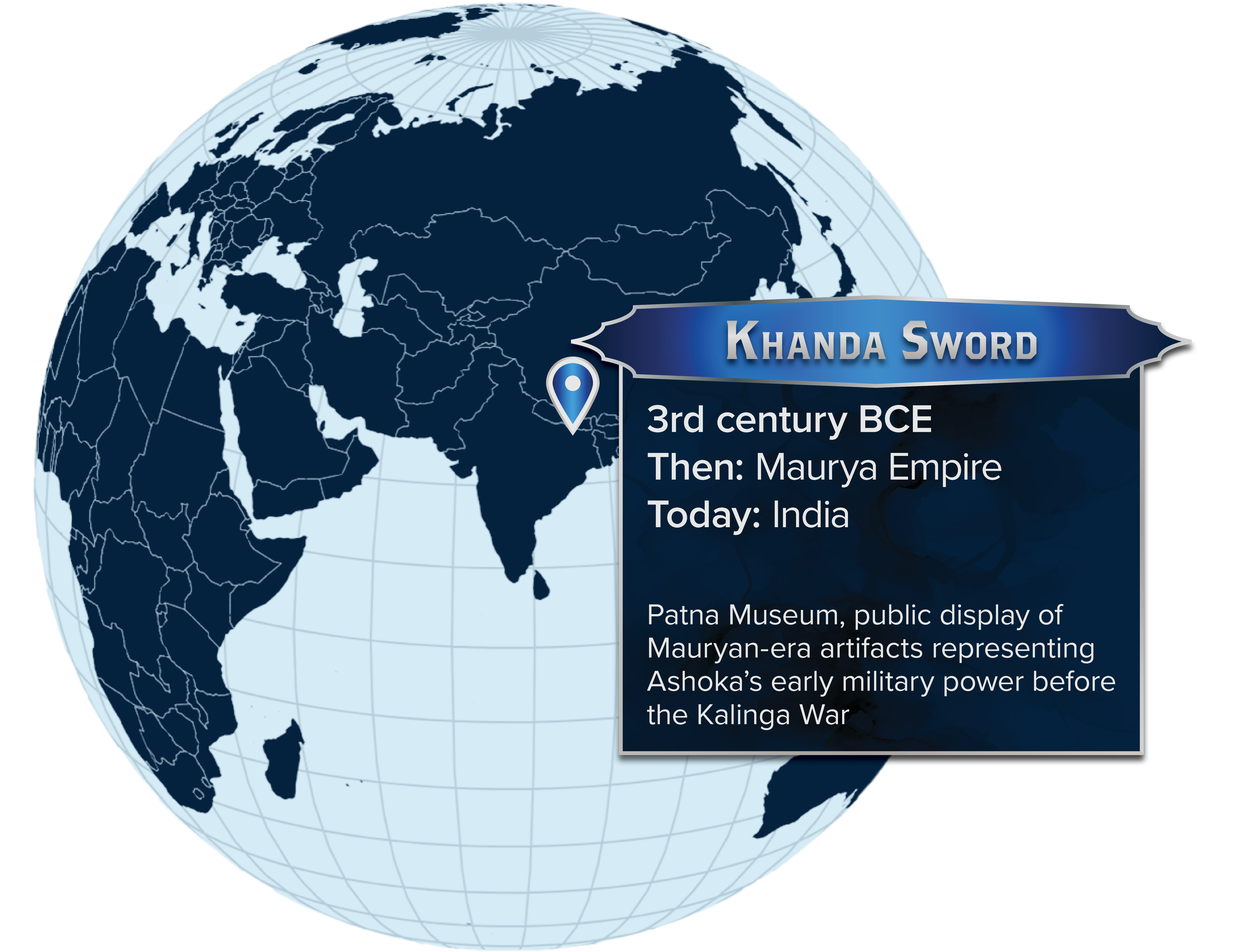
Forget the elegant, curved sabers often seen in movies; the khanda was the heavy metal of the ancient world. A Mauryan warrior gripped this straight, double-edged blade not for delicate fencing, but for devastating, bone-crushing force. Unlike modern kitchen knives that taper to a thin point, the khanda featured a broad, blunt tip and a reinforced spine, making it less like a needle and more like a weighted cleaver. This design meant that every ounce of a soldier's strength was funneled into a chopping strike powerful enough to cleave through thick leather armor or wooden shields. It was a weapon built for the grit and noise of a front-line formation, where space was tight and every swing had to count.
By the time Ashoka took the throne in 268 BCE, Indian ironworkers were already masters of their craft. Archaeological finds from ancient cities like Taxila reveal that these straight iron blades were the backbone of a military machine that included massive war elephants and thundering chariots. When you see a khanda today, you are looking at the "hardware" that allowed the Mauryan Empire to swallow up nearly the entire subcontinent. It represents a time of iron and expansion, a period when Ashoka’s power was measured by how many thousands of these blades stood ready at his command. The sword wasn't just a tool; it was the physical manifestation of the Emperor’s early, unstoppable will.
However, the khanda also tells the story of a great "what if." After the bloodshed at Kalinga, these heavy blades didn't just disappear, but the intent behind them changed. Ashoka didn't order his soldiers to break their swords; instead, he ordered them to keep them sheathed in favor of the "armor of dhamma." The khanda stands as a silent witness to this massive cultural pivot—a reminder of the raw military might that Ashoka was brave enough to restrain. Today, these swords are preserved in museums across India, serving as a heavy, iron link to a time when a single king decided that his empire’s greatest strength shouldn't be found in the edge of a blade, but in the peace that followed it.