Encyclopedia Anachronistica


Standard
Inspiration
Middle East
Caliphates
Ideology
All enemies' aether and void weapon damage is reduced by 1 [to a minimum of 1].
After many who had memorized the Qur'an died in battle, Abu Bakr ordered a written codex to preserve the revelations, gathering fragments into a unified text.
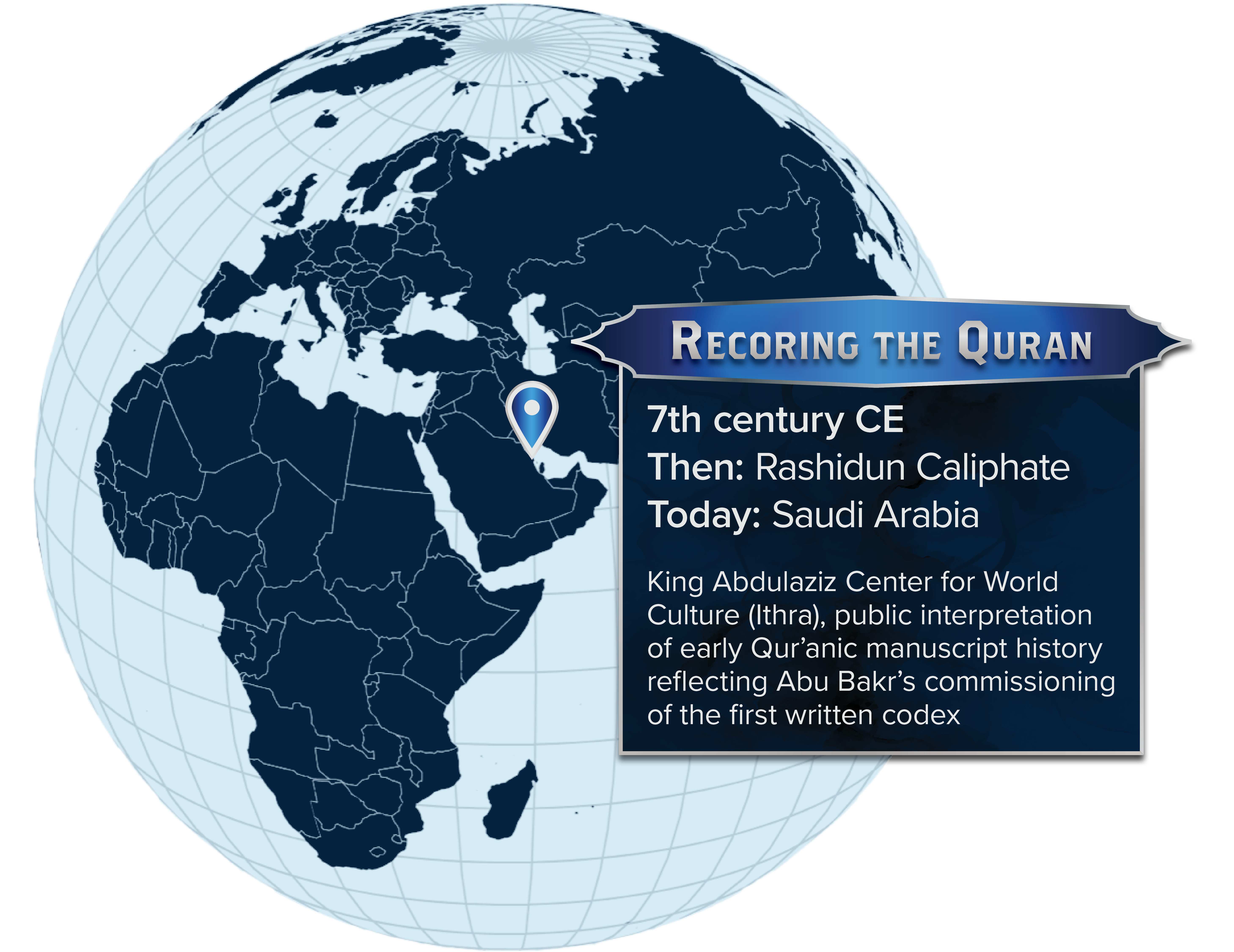
When the Battle of Yamama ended in 632, the early Muslim community faced a crisis that threatened their very foundation. Many of the huffaz—the people who had memorized the entire Qur’an—had fallen in battle. With them went the living voices that carried the recitations. Abu Bakr, the first caliph, realized that the community could not risk losing the words that shaped their faith to the passage of time or the edge of a sword. He ordered a massive, methodical rescue mission to gather every verse from "palm stalks, thin white stones, and the hearts of men."
This wasn’t just a simple writing project; it was more like a high-stakes forensic investigation. The work was led by Zayd ibn Thabit, a young scribe who had been one of the Prophet Muhammad’s personal secretaries. Zayd famously said that the task was harder than "moving a mountain." Every single verse had to be cross-checked with multiple eyewitnesses before it was allowed into the official collection. If a verse was found written on a piece of parchment or a sun-bleached shoulder blade of a camel, Zayd required two witnesses to swear they had heard the Prophet recite it. This extreme caution reflected how seriously the community treated the accuracy of their sacred text.
The result was the first compiled manuscript of the Qur’an, a stable collection created at a moment when relying on memory alone was no longer safe. This "master copy" was kept with Abu Bakr, then passed to the next leader, Umar, and eventually to Hafsa, one of the Prophet’s widows, where it served as the ultimate reference for the future. While legendary accounts sometimes focus on the miraculous nature of the text, historians and archaeologists focus on the physical evidence—the angular Kufic script found on early fragments that shows the intense care scribes took with every letter.
Abu Bakr’s decision to commit the oral recitations to writing is one of the most significant preservation efforts in world history. It represents a turning point where a community facing an uncertain future used technology—the written word—to protect their identity. These early manuscripts remind us that great texts don't just appear; they are often saved by leaders who have the foresight to act before a living memory fades away forever.