Encyclopedia Anachronistica

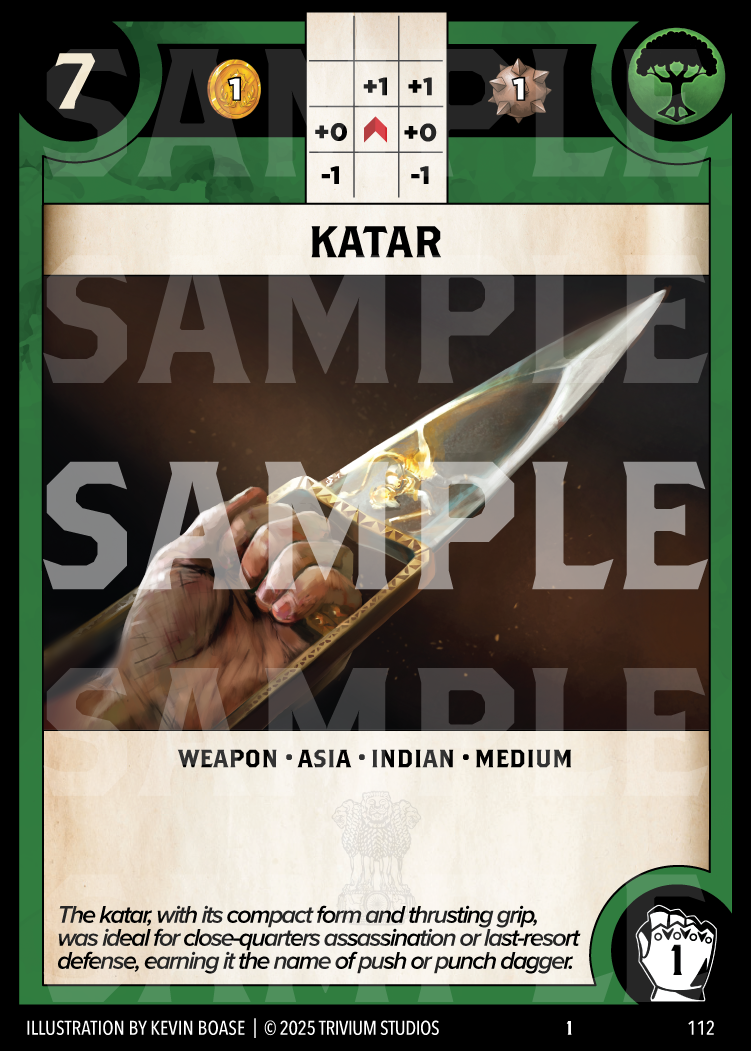
Standard
Weapon
Asia
Indian
Medium
The katar, with its compact form and thrusting grip, was ideal for close-quarters assassination or last-resort defense, earning it the name of push or punch dagger.
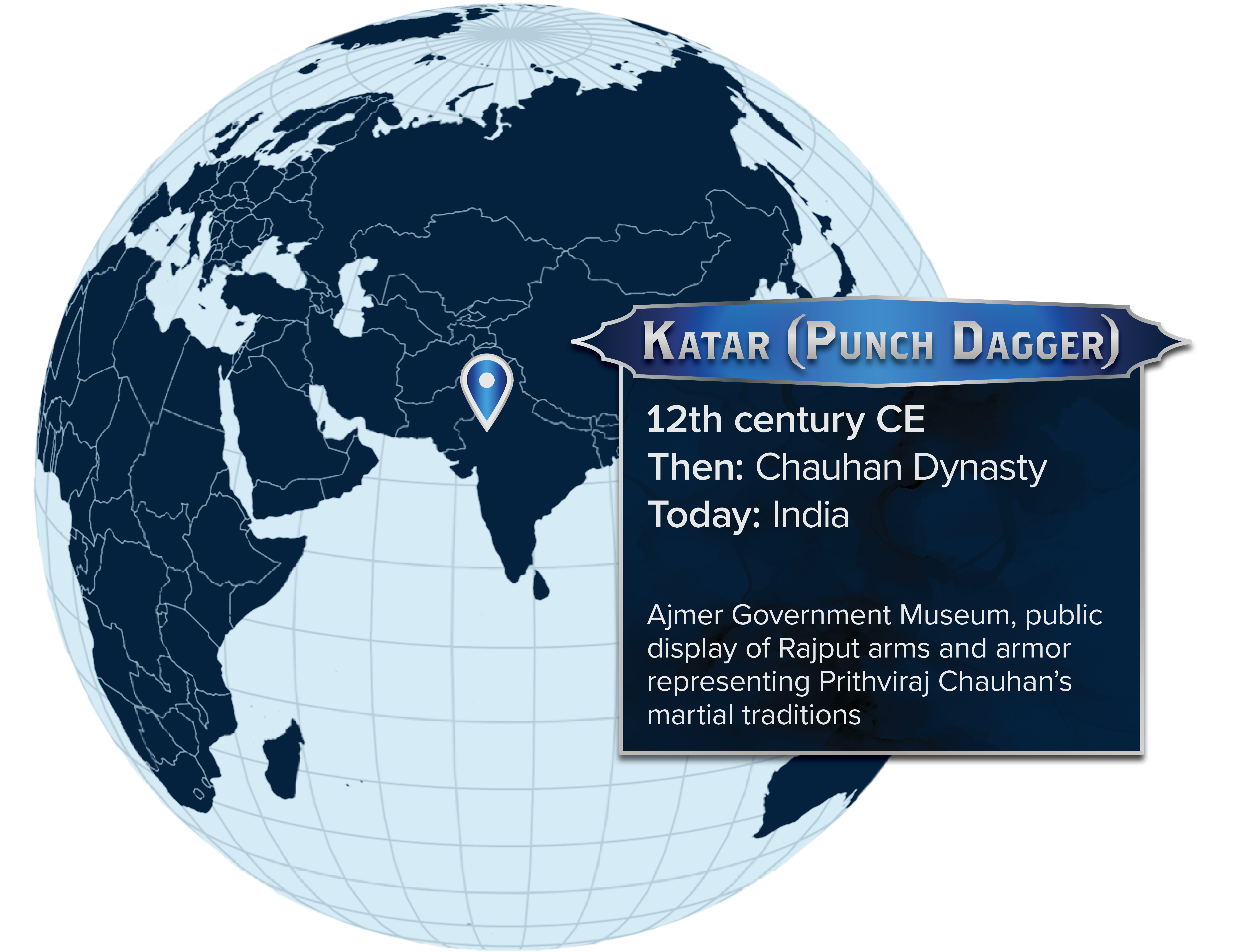
Hold a katar in your hand, and you feel its purpose immediately. Unlike a traditional knife with a handle you wrap your fingers around, the katar features an H-shaped grip that sits deep within your palm. Two parallel bars protect your wrist, and the heavy, triangular blade juts straight out from your knuckles like a natural extension of your skeleton. It is a "punch dagger," designed so that the full force of a shoulder-thrust is concentrated into a single, armor-piercing point. In the frantic, face-to-face chaos of a 12th-century melee, this was the ultimate weapon for finding a gap in a suit of mail or punching through a thick, quilted tunic. This distinctive weapon, developed in the Indian subcontinent, was prized for its speed, power, and compact size.
By the time of Prithviraj Chauhan, the battlefields of northern India were a testing ground for innovative steel. While warriors primarily reached for long spears and broadswords, the katar was beginning its journey toward becoming the iconic sidearm of the Rajput warrior. Its reinforced, thick blade was specifically engineered to survive the impact of hitting metal without snapping. A skilled fighter didn’t just stab with a katar; they used it to deflect incoming slashes with the sidebars before delivering a decisive, bone-splitting counterpunch. It was a weapon of high-speed geometry, perfect for tight formations where there was no room to swing a long sword.
Beyond its utility, the katar was a badge of courage. Because you had to be within arm’s reach of an enemy to use it, carrying one signaled that you were a warrior who didn’t shy away from the most dangerous part of the fight. In later centuries, these daggers became incredibly ornate, with gold-inlaid blades and hilts carved into the shapes of lions or tigers. Even as the technology evolved, it stayed true to the martial culture of Prithviraj’s world—a culture that valued personal honor and the cold, hard precision of a direct strike.
Today, katars are among the most popular items in Indian armories and world museums because of their unique, "sci-fi" appearance. Their clever engineering continues to impress modern weapons specialists, proving that medieval Indian blacksmiths were master physicists. The katar stands as a reminder that the world Prithviraj inhabited was one of constant innovation, where the difference between victory and defeat often rested on the strength of a handful of steel and the courage to use it.