Encyclopedia Anachronistica

Standard
Armor
Asia
Indian
Medium
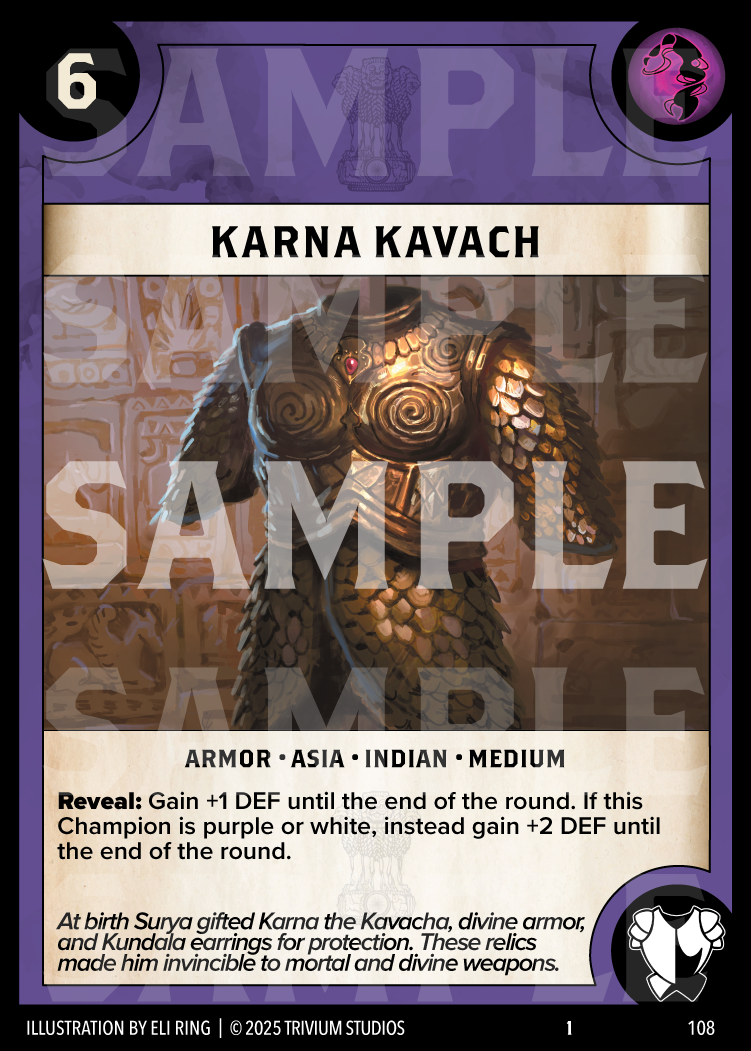
Reveal: Gain +1 DEF until the end of the round. If this Champion is purple or white, instead gain +2 DEF until the end of the round.
At birth Surya gifted Karna the Kavacha, divine armor, and Kundala earrings for protection. These relics made him invincible to mortal and divine weapons.

The stories of ancient India are filled with heroes whose armor shone like the sun. Chandragupta Maurya never wore the legendary Karna Kavacha—no ruler could—but the idea of it shaped how his world understood power and divine protection. In the Mahabharata, the warrior Karna is born with celestial armor fused to his skin, a gift said to make him nearly invincible. Even though this armor belongs to epic tradition rather than Chandragupta’s lifetime, its symbolism mattered deeply in the early Mauryan age. It represented the ideal of a ruler shielded by righteousness, destiny, and cosmic order.
Real Mauryan armor looked nothing like the glowing plates of legend. Soldiers in Chandragupta’s armies used quilted cotton jackets, leather, and sometimes bronze or iron scales. Yet the epic image of Karna’s armor influenced how people imagined kingship: a ruler protected not only by soldiers and walls, but by dharma—moral duty and just rule. Chandragupta’s rise from a young exile to the founder of a vast empire made this connection even stronger. To many, his success looked like the work of fate, the kind of destiny that epic heroes carried on their shoulders.
The Karna Kavacha card stands for that idea: the belief that a ruler’s protection comes from more than metal. Chandragupta’s real “armor” was the system he built—alliances, reforms, and the guidance of his advisor Chanakya. But the legendary armor reminds us how ancient societies blended myth and statecraft. Epic stories shaped expectations for real kings, influencing how people judged their strength and legitimacy.
Today, the Karna Kavacha remains a powerful symbol in South Asian culture. It appears in art, theater, and modern retellings of the Mahabharata, reminding audiences how myth can shape political imagination. For historians, it offers a window into how early India understood leadership: not just through armies and laws, but through stories that carried moral weight.