Encyclopedia Anachronistica


Standard
Inspiration
Middle East
Caliphates
Event
React: When an enemy makes a weapon attack against this Champion, the attacker loses -2 DEF until the end of the round.
Khalid crossed the deadly Syrian desert by sealing camels' mouths to store water, then slaughtering them to quench his men's thirst when supplies ran dry.
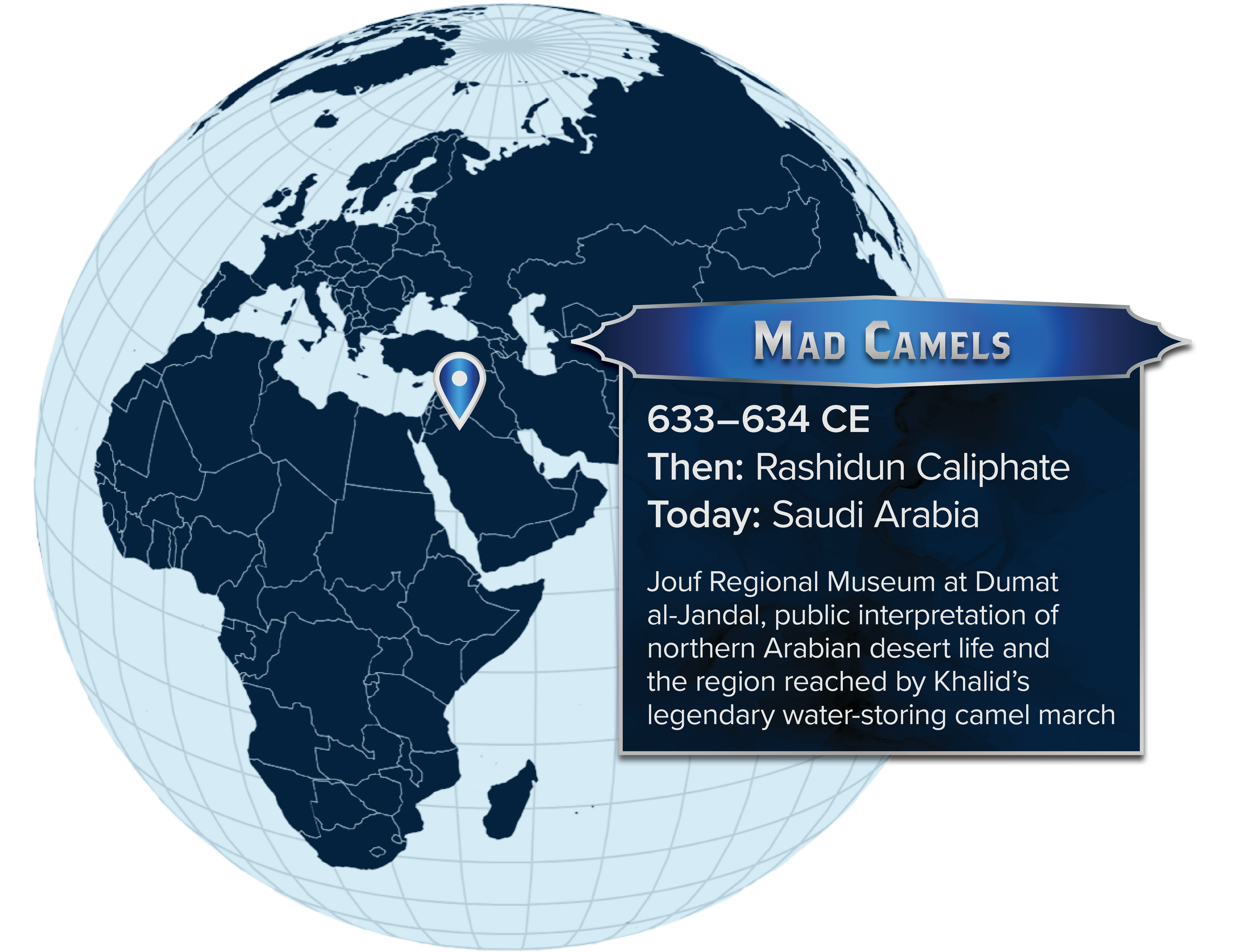
In 634 CE, Khalid ibn al-Walid faced a tactical puzzle that seemed impossible: he needed to move his army from Iraq to Syria across the "Desert of Samāwah," a waterless, sun-scorched void that the Byzantine Empire considered a natural fortress. Most commanders would have seen a death trap, but Khalid saw a chance to pull off the ultimate "stealth" maneuver. The march that followed was a masterpiece of desert logistics, proving that his deep knowledge of the environment was just as sharp as his blade.
The secret to this gamble was the camel, an animal Khalid treated as a biological supply chain. Arabian armies knew that camels could store massive amounts of water in their stomachs, but Khalid pushed this reality to an extraordinary extreme. According to early historians like al-Baladhuri and al-Tabari, he ordered his camels to be watered until they could hold no more, then reportedly had their mouths tied or sealed so they wouldn't waste the liquid. As the army trekked through the most brutal, well-less stretches of the desert, they slaughtered the camels one by one, using the water stored inside the animals to keep the soldiers alive. It was a gritty, high-stakes system of "living canteens" that allowed his men to survive a journey that should have been a death sentence.
By taking this unexpected route, Khalid appeared in Syria like a ghost, arriving far earlier than the Byzantines ever anticipated. He had turned the "impossible" desert into a shortcut, bypassing enemy lookouts and catching the imperial forces completely off guard. While some later storytellers added dramatic flourishes to the scale of the march, the core historical impact is undeniable: Khalid used his expertise in desert survival to outmaneuver a global superpower.
Today, this march is remembered as one of history's greatest lessons in environmental mastery. Artifacts of desert travel in regional museums—from simple leather water skins to camel gear—help us visualize the harsh reality of the 7th-century desert. Khalid’s crossing remains a powerful reminder that ingenuity can turn the deadliest landscapes into a winning advantage, cementing his reputation as a commander who could conquer the earth itself to reach the battlefield.