Encyclopedia Anachronistica

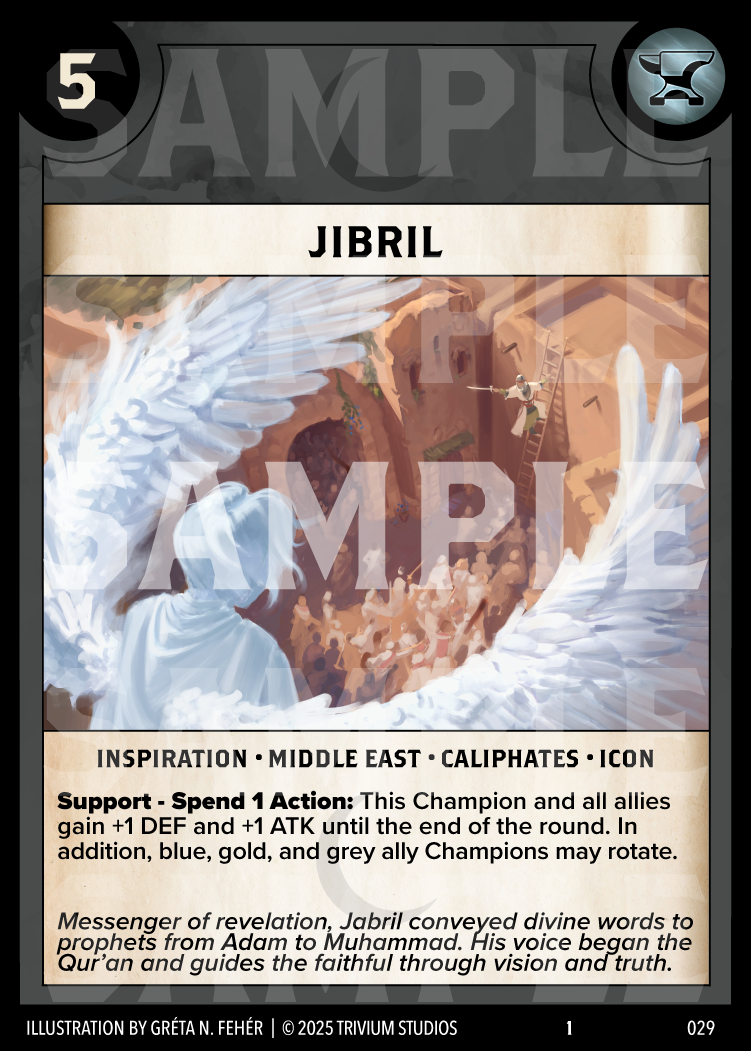
Standard
Inspiration
Middle East
Caliphates
Icon
Support - Spend 1 Action: This Champion and all allies gain +1 DEF and +1 ATK until the end of the round. In addition, blue, gold, and grey ally Champions may rotate.
Messenger of revelation, Jabril conveyed divine words to prophets from Adam to Muhammad. His voice began the Qur'an and guides the faithful through vision and truth.

In early Islamic belief, Jibril—known in English as the archangel Gabriel—is the ultimate messenger. For 7th-century Muslims, Jibril wasn’t just a metaphor; he was the vital link between the divine and the human, the one who delivered the Qur’an to Muhammad over 23 years. Understanding Jibril is the key to understanding how the first believers viewed the world: they believed they were living in a moment where the "heavens were open," and spiritual guidance was literally being whispered into their reality.
The relationship between Jibril and Ali ibn Abi Talib is a fascinating example of how history and devotion weave together. In the earliest historical records, like the chronicles of Ibn Ishaq, Jibril is primarily focused on supporting Muhammad. During the Battle of Badr, for instance, these texts describe the angel strengthening the entire Muslim force. Ali is present in these accounts as a superstar warrior—frequently the first to charge and the last to leave the field—but the early historians focus on Jibril’s support for the Prophet’s mission.
As the centuries passed, however, the stories linking Jibril directly to Ali began to grow. Medieval storytellers and historians recorded traditions where Jibril’s voice was heard on the battlefield, famously shouting, "There is no hero like Ali, and no sword like Zulfiqar!" While modern historians classify these specific moments as legendary or symbolic rather than eyewitness history, they reveal something powerful about Ali’s legacy. He became so admired that later generations couldn't imagine his greatest victories happening without the direct applause of the angels.
For students, this evolution shows how a historical figure can transform into a cultural icon. Ali wasn't just a soldier; he became a symbol of justice and courage so profound that he was seen as "standing shoulder-to-shoulder" with the celestial world. Jibril’s presence in these later stories acts as a divine "seal of approval" on Ali’s character, highlighting the values—truthfulness and bravery—that the community wanted to preserve forever.
Today, Jibril remains a central figure in Islamic belief, and his role in revelation is studied in classrooms and mosques worldwide. By looking at both the early chronicles and the later legends, we get a clearer picture of how faith and storytelling shaped Ali's enduring memory. It reminds us that history isn't just about what happened on the ground, it's also about what people believed was happening in the skies above them.