Encyclopedia Anachronistica


Chrono
Weapon
Asia
Chinese
Sword
When this brown or cyan Champion hits with this weapon, reduce the defender's weapon damage by 1 [to a minimum of 1] until the end of the round.
Forged in bronze or steel, the jian's straight, double edged blade thrusts and slashes with precision, a sign of honor and prestige in the hands of nobles and sages.
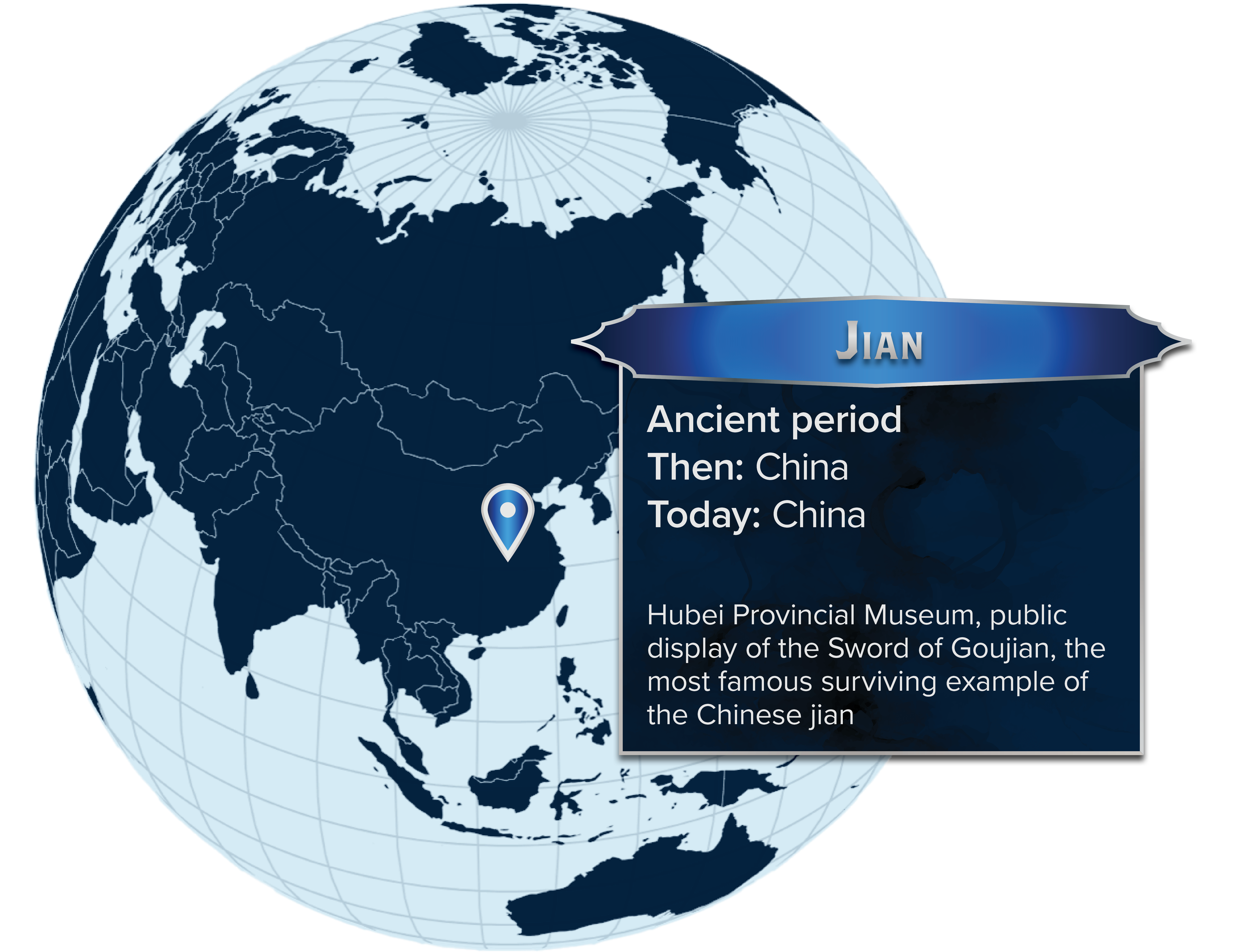
Often called the “gentleman of weapons,” the jian is a double-edged straight sword that has served as a symbol of skill and status in China for over 2,500 years. It first emerged during the Bronze Age, appearing in the archaeological record during the late Shang and early Zhou dynasties. Unlike heavy, curved sabers designed for hacking through shields, the jian was a weapon of surgical precision. Its symmetrical, narrow blade was perfectly balanced for swift thrusts and controlled cuts, requiring the wielder to rely on agility and timing rather than brute strength.
As metallurgy advanced from bronze to steel during the Warring States period (475–221 BCE), the jian became a masterpiece of ancient engineering. One of history’s most stunning examples is the Sword of Goujian; discovered in a damp tomb after two millennia, it was still sharp enough to slice through twenty layers of silk and featured an intricate, rust-resistant pattern that still baffles modern scientists. While spears and halberds were the primary tools for soldiers in large-scale warfare, the jian became the preferred sidearm of officers, scholars, and the elite. Because it was notoriously difficult to master, carrying one signaled that the owner possessed the patience and intelligence to perfect a complex art.
By the medieval era, the jian transitioned from the battlefield into the heart of martial philosophy. It was featured in Ming and Qing dynasty manuals that blended practical self-defense with elegant, fluid movement. It also became a staple of folklore, associated with wandering heroes and legendary scholars who used their wits as much as their steel. These stories transformed the sword into a cultural icon of justice, representing the "gentleman" who is dangerous but disciplined.
Today, the jian remains the crown jewel of traditional Chinese martial arts. Its movements are practiced in parks and schools worldwide to develop balance, coordination, and mental focus. It survives not just as a museum piece, but as a living connection to centuries of craftsmanship and the enduring idea that true power is found in precision.