Encyclopedia Anachronistica

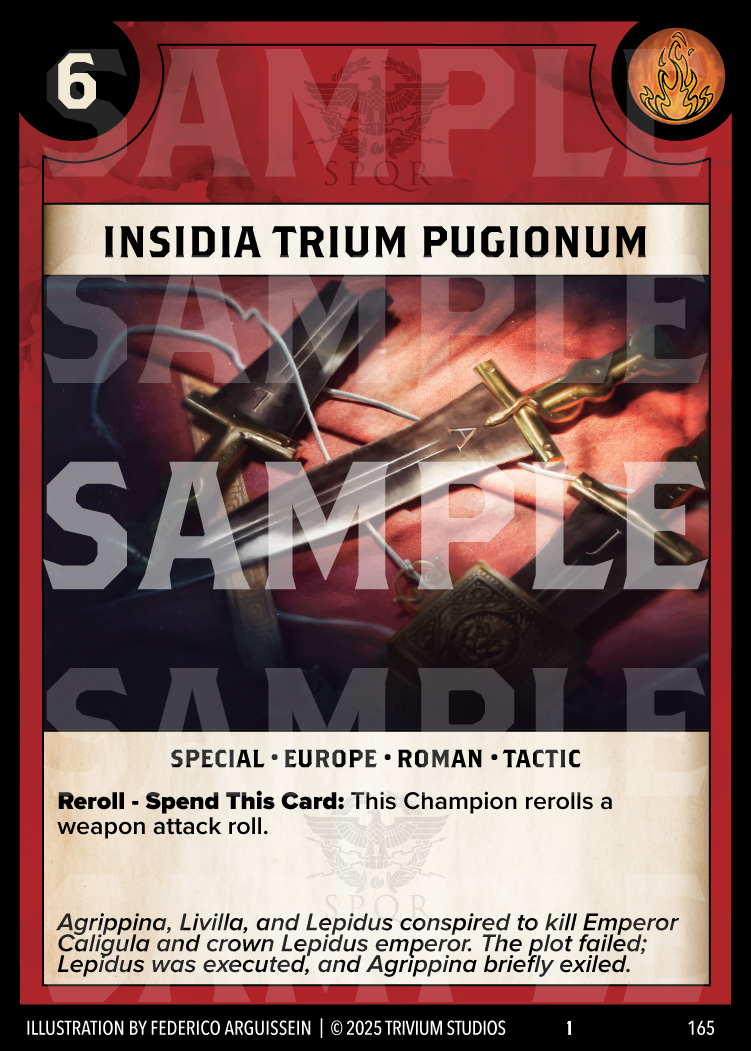
Standard
Special
Europe
Roman
Tactic
Reroll - Spend This Card: This Champion rerolls a weapon attack roll.
Agrippina, Livilla, and Lepidus conspired to kill Emperor Caligula and crown Lepidus emperor. The plot failed; Lepidus was executed, and Agrippina briefly exiled.
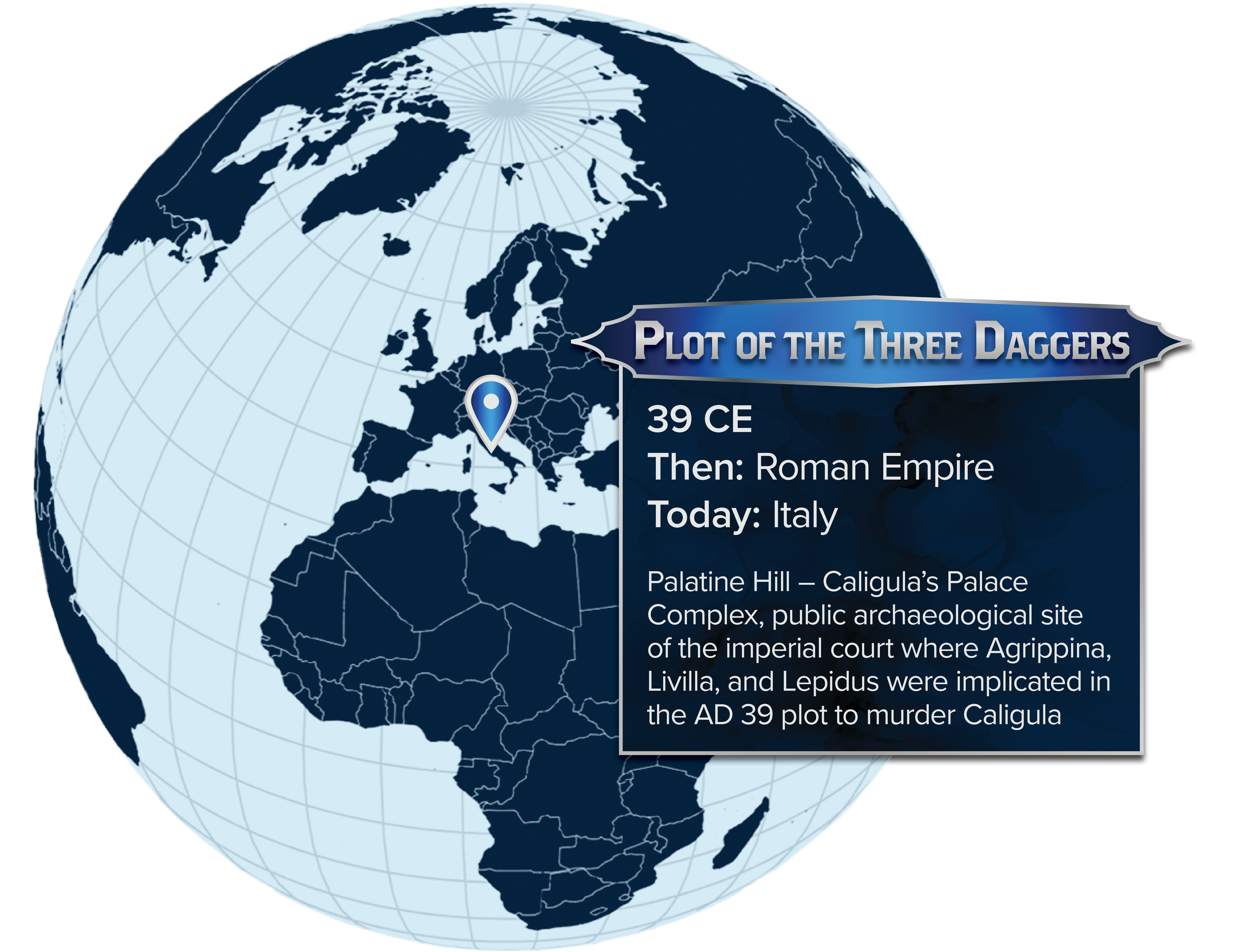
In the heart of Caligula’s palace, where a whisper could be as lethal as a blade, a shadow fell over the Julio-Claudian dynasty. The year was 39 CE, and three sharp daggers were about to become the symbols of a conspiracy that nearly toppled an emperor. At the center of the storm were Agrippina the Younger, her sister Livilla, and their cousin Lepidus—a man who had once been Caligula's closest confidant. While the exact details of their late-night meetings remain shrouded in mystery, the "Plot of the Three Daggers" (in Latin, Insidia Trium Pugionum) suggests a desperate plan: to assassinate the increasingly unstable Caligula and seize the throne. Whether the plot was a genuine attempt at revolution or a paranoid fabrication by a volatile emperor, the consequences were devastatingly real.
To ensure no one missed the message, Caligula turned his "survival" into a theatrical display of power. He didn't just punish the conspirators; he dedicated three ceremonial daggers in the Temple of Mars Ultor—the temple of "Mars the Avenger." Imagine the scene: Roman citizens and senators walking past these gleaming blades, each one a silent, metallic warning that the Emperor’s eyes were everywhere and his vengeance was absolute. For a student of history, these daggers represent more than just metal; they were a public branding of Agrippina and her siblings as traitors to the state.
Agrippina’s personal involvement remains one of Rome’s great "cold cases." Ancient historians, who loved a scandal, claimed she was Lepidus’s lover and co-conspirator. Caligula even produced intercepted letters—which may have been forged—to "prove" her guilt. The punishment was designed to strip Agrippina of her dignity: while Lepidus was executed, Agrippina was forced to carry his ashes back to Rome in a funeral urn, a grim and public walk of shame before being banished to a barren island. Caligula didn't just want her gone; he wanted her broken.
Yet, for Agrippina, the Plot of the Three Daggers was not the end—it was her origin story. She survived the exile, outlasted her brother’s bloody reign, and returned to Rome to become the most powerful woman in the empire. These daggers serve as a window into the "kill or be killed" reality of Roman politics, where the line between the royal family and the executioner’s blade was razor-thin. Today, while the physical blades have long since rusted away, the story survives as a masterclass in how emperors used fear and public spectacle to keep a grip on a fragile empire. It reminds us that behind the grand marble statues of Rome lay a world of rumor, high-stakes gambles, and a woman who refused to stay defeated.