Encyclopedia Anachronistica

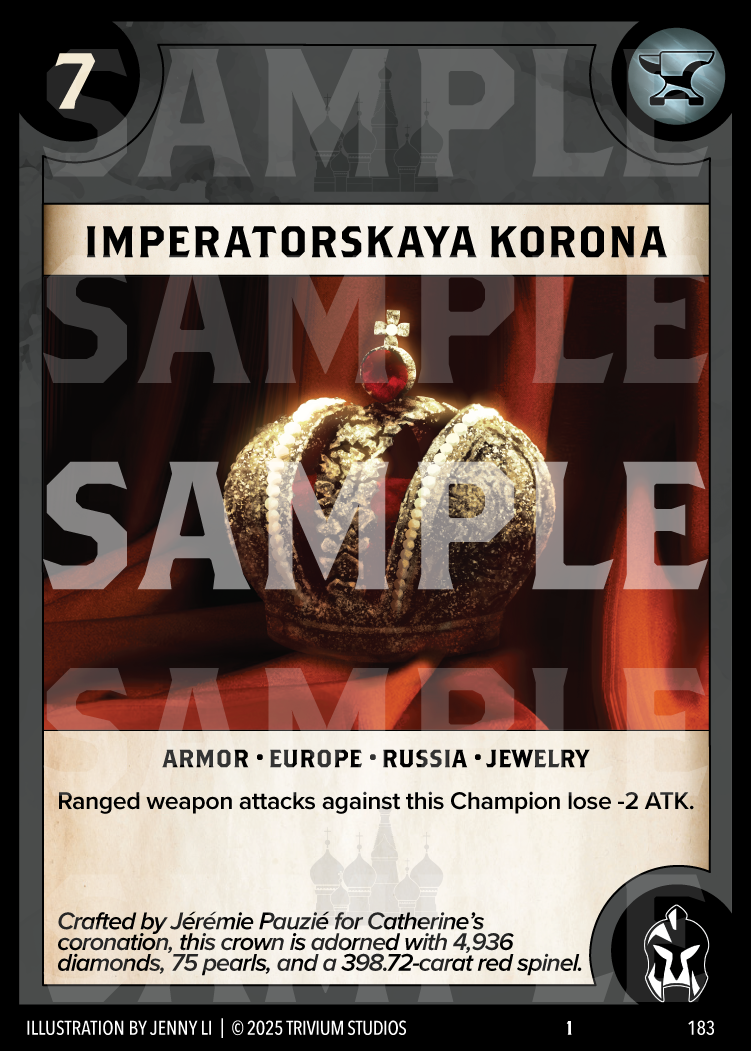
Standard
Armor
Europe
Russian
Jewelry
Ranged weapon attacks against this Champion lose -2 ATK.
Crafted by Jérémie Pauzié for Catherine's coronation, this crown is adorned with 4,936 diamonds, 75 pearls, and a 398.72-carat red spinel.
The Imperial Crown of Russia was built to overwhelm the eye. When Catherine the Great walked into the Dormition Cathedral for her 1762 coronation, the crown’s surface flashed with nearly five thousand diamonds arranged in tight, shimmering patterns. Two silver domes rose from the base, a design borrowed from Byzantine imperial regalia, symbolizing the unity of East and West within the Russian Empire and signaling that it was the true successor to the Roman Empire. At the very top sat a single enormous red spinel, polished smooth and glowing like a hot coal. Even in a room lit only by candles, the crown looked electric.
Catherine needed a crown that could do political work. She had taken the throne after a palace coup, and every detail of her coronation had to convince nobles, clergy, and foreign ambassadors that she was the rightful ruler. The crown’s design blended Russian tradition with Western European fashion, sending a message that Catherine would modernize the empire without breaking its historical identity. The jeweler Jérémie Pauzié, a Swiss craftsman working in St. Petersburg, oversaw its creation using diamonds from the imperial treasury and metalwork from Russian artisans.
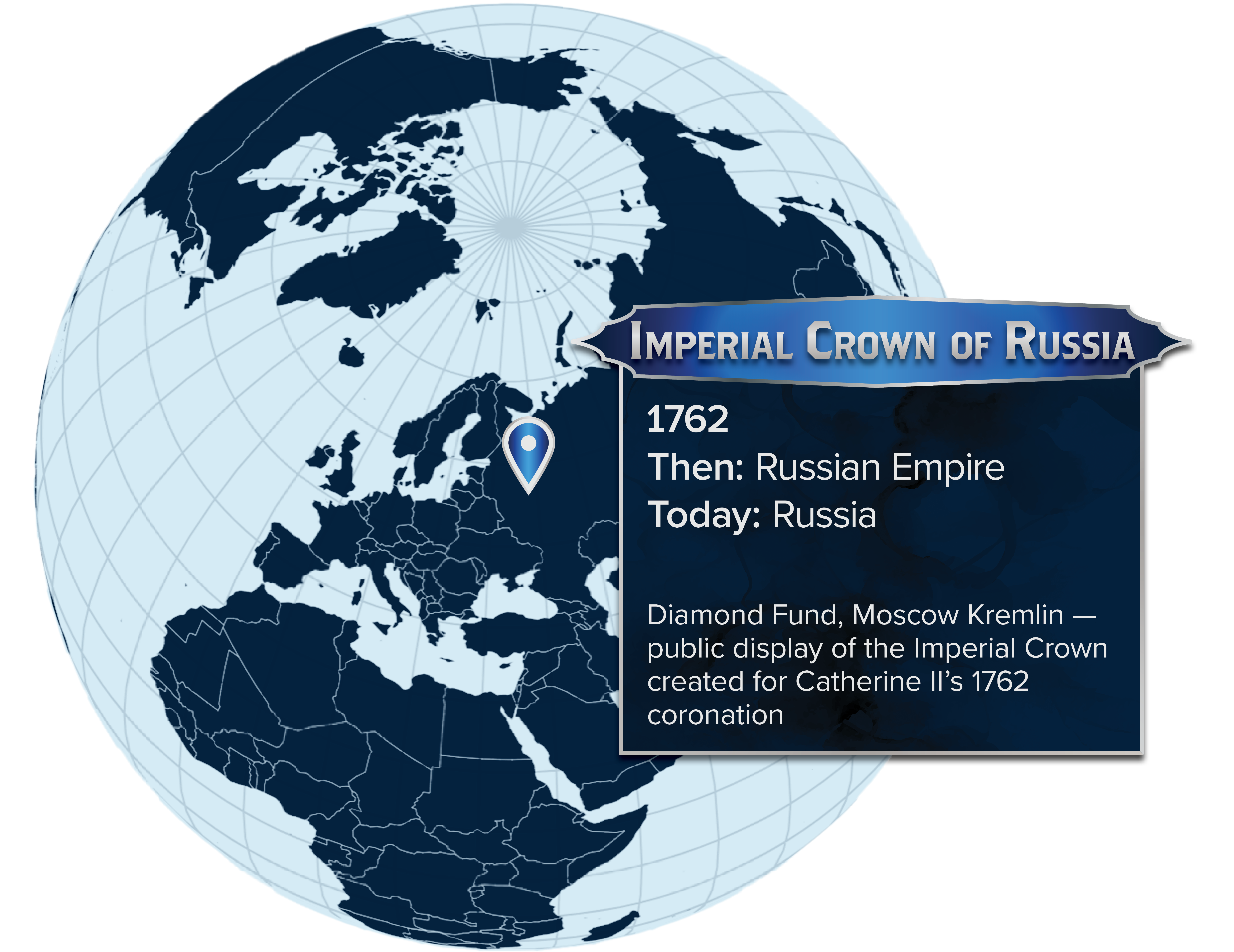
The crown was not just a personal symbol. It became the ultimate emblem of the Romanov dynasty. Every tsar after Catherine used it in their coronation ceremonies, and it appeared on state seals, coins, and official portraits. Its survival through revolutions, wars, and regime changes makes it one of the most recognizable objects in Russian history. Today it is preserved in the Kremlin Armoury, where visitors can see the extraordinary craftsmanship up close — the delicate latticework of silver, the precise diamond settings, and the massive spinel that anchors the entire structure.
The Imperial Crown matters today because it captures the intersection of art, politics, and identity at a turning point in Russian history. Museums use it to teach how rulers crafted public images long before photography or mass media. Historians study it to understand the symbolism of monarchy and the ways material culture helped stabilize governments during uncertain transitions. Long before social media or television, Catherine used this shimmering heavy-hitter to craft a public image of absolute stability, proving that a well-placed diamond could be just as effective as a battalion of soldiers.