Encyclopedia Anachronistica

Standard
Armor
Asia
Chinese
Light
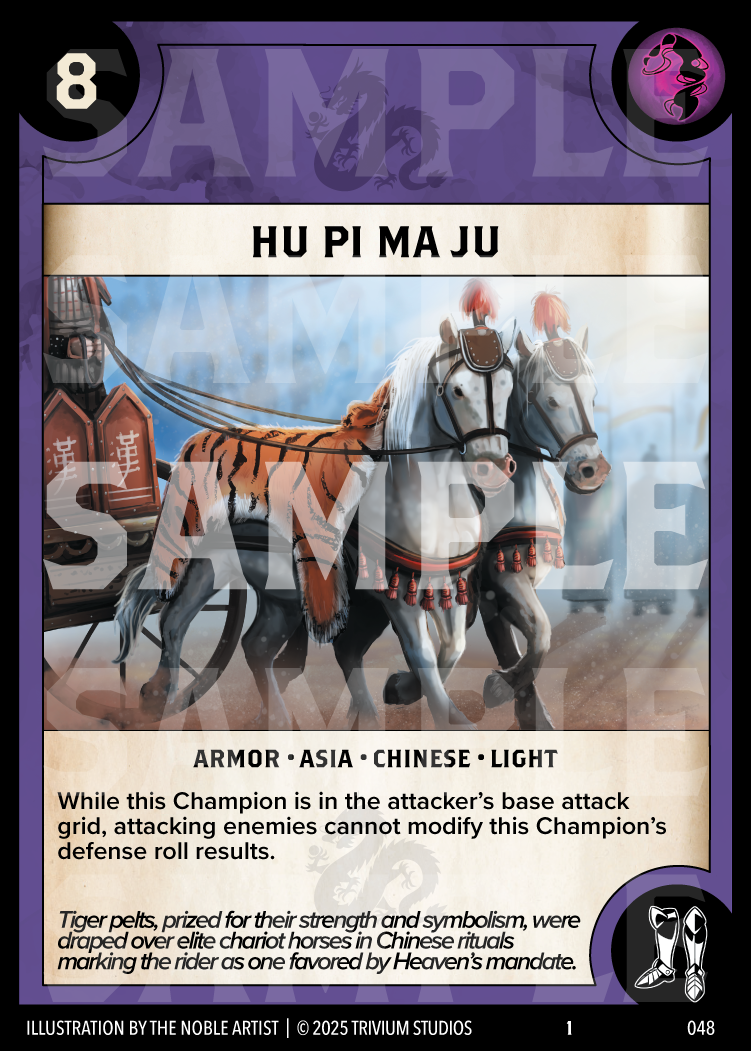
While this Champion is in the attacker's base attack grid, attacking enemies cannot modify this Champion's defense roll results.
Tiger pelts, prized for their strength and symbolism, were draped over elite chariot horses in Chinese rituals marking the rider as one favored by Heaven's mandate.

“Tiger’s Harness” is a modern descriptive term for elite chariot and cavalry display gear adorned with tiger pelts or tiger-patterned textiles in late Qin and early Han China. While full horse armor was rare in this era, symbolic coverings — especially tiger skins — were used to signal ferocity, command, and divine favor. The tiger, long associated with martial power in Chinese cosmology, became a visual shorthand for imperial authority and battlefield dominance.
Under Liu Bang, tiger symbolism adopted a new meaning. As a former minor official turned rebel commander, Liu Bang relied on charismatic leadership and symbolic gestures to rally support. Accounts from the Chu–Han Contention emphasize the use of banners, drums, and animal symbolism to project authority and martial legitimacy. While direct evidence of tiger-skin harnesses in Liu Bang’s army is limited, the broader tradition of tiger symbolism was well established in Qin elite cavalry and continued into Han ceremonial regalia. The Terracotta Army, associated with the First Qin Emperor, includes chariot horses with elaborate harnesses that helped shape later Han visual conventions for elite horse equipment.
Tiger pelts were also used in imperial processions and funerary rites, where they represented courage and protection. Han tombs contain bronze fittings and animal-motif decorations, including tiger imagery, suggesting that such iconography was reserved for high-ranking military and ceremonial contexts. These artifacts reflect both the practical and symbolic dimensions of military display in early imperial China.
Today, tiger harness traditions survive in stylized forms — from opera costumes to martial arts iconography. Museums such as the Mausoleum of the First Qin Emperor interpret horse gear as part of China’s evolving cavalry culture. The tiger remains a central figure in Chinese martial symbolism, and its use in harness design continues to evoke the power and prestige of ancient commanders.