Encyclopedia Anachronistica

Chrono
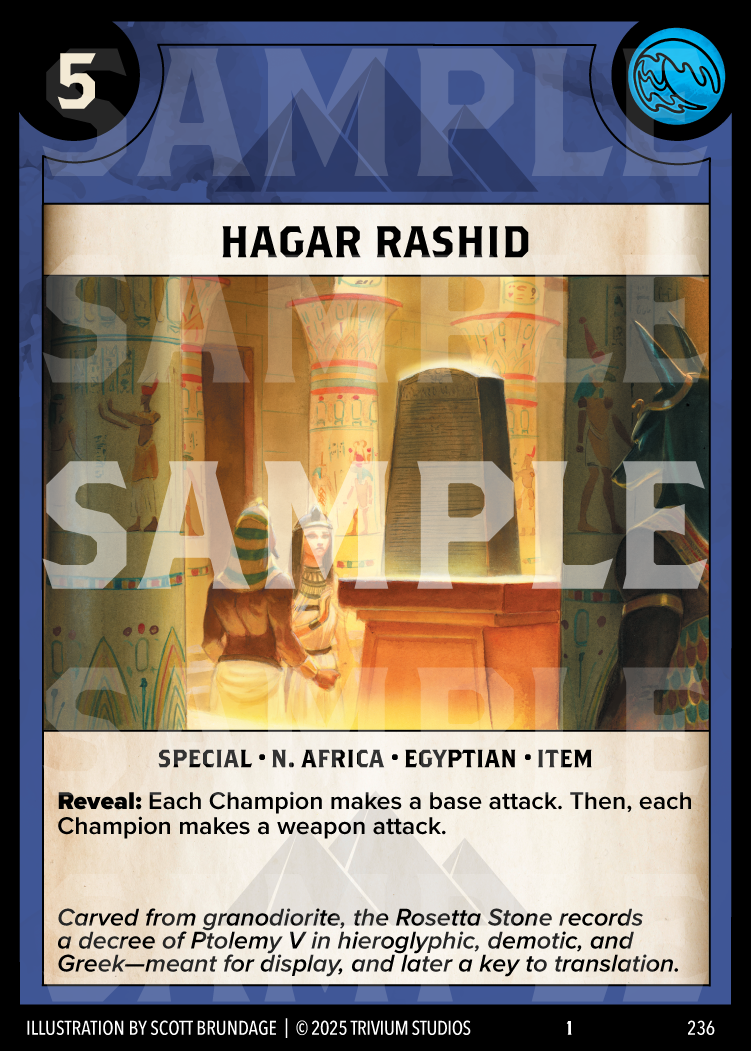
Special
N. Africa
Egyptian
Item
Reveal: Each Champion makes a base attack. Then, each Champion makes a weapon attack.
Carved from granodiorite, the Rosetta Stone records a decree of Ptolemy V in hieroglyphic, demotic, and Greek-meant for display, and later a key to translation.
In 1799, a group of French soldiers was busy repairing an old fort near the Egyptian town of Rashid (Rosetta) when they struck something hard in the dirt: a broken slab of dark, heavy stone covered in mysterious writing. They didn’t know it yet, but they had just found the "key" to an entire civilization. For nearly 1,400 years, the beautiful pictures known as hieroglyphs found on Egyptian tombs and temples had been a total mystery—a silent language that no living person could read.
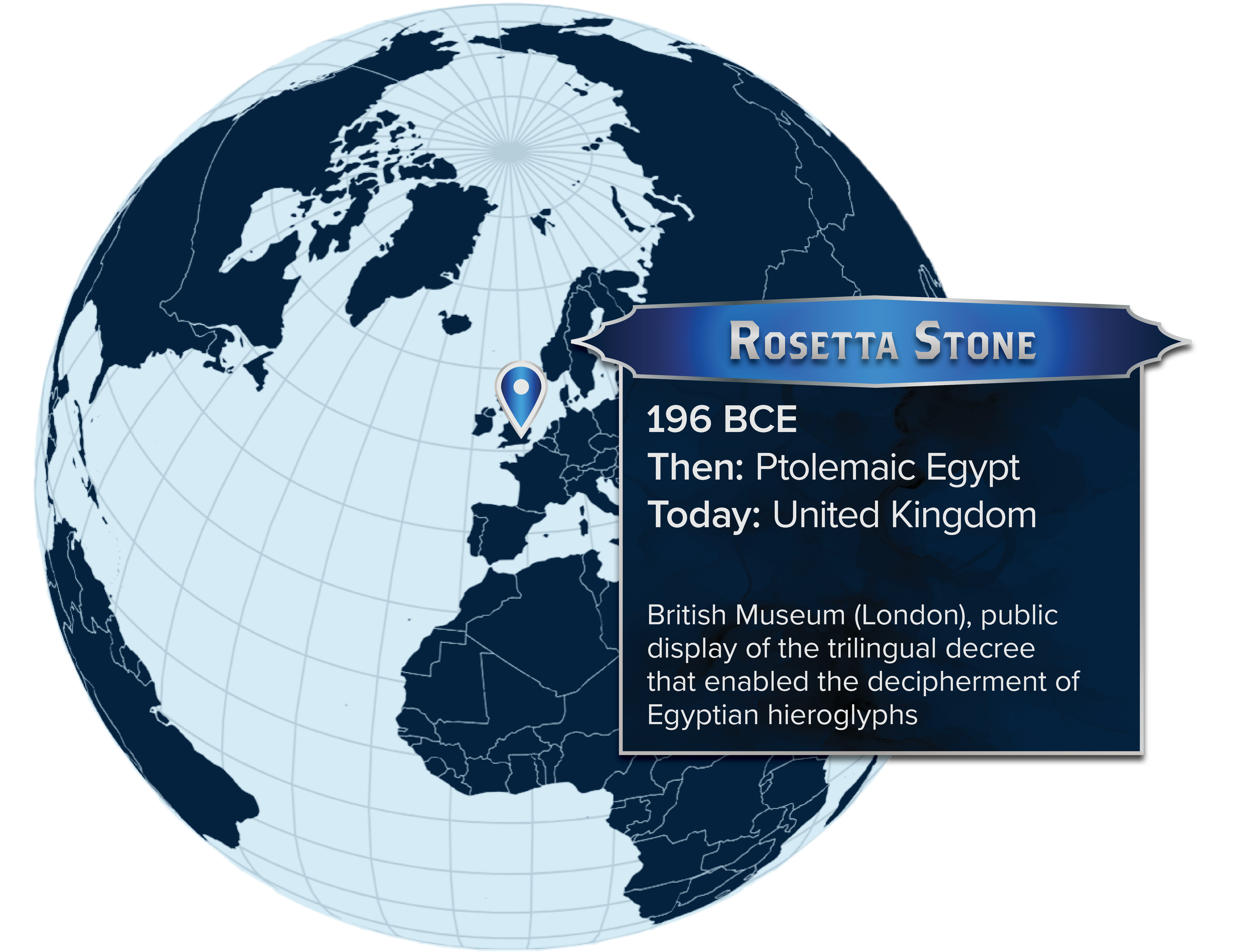
The stone, now famous as the Rosetta Stone, was essentially a 2,000-year-old press release. It was carved in 196 BCE to announce a decree from the young King Ptolemy V. Because Egypt was a multicultural place at the time, the government wanted to make sure everyone got the message. They carved the same text three times: once in hieroglyphs (the sacred script for priests), once in Demotic (the everyday script for Egyptians), and once in Ancient Greek (the language of the ruling government). This trilingual format was the ultimate "cheat sheet" for future historians.
The real breakthrough came in 1822, thanks to a French linguist named Jean-François Champollion. While other scholars thought hieroglyphs were just symbols or pictures of ideas, Champollion used the Greek names on the stone to prove that the symbols actually represented sounds, much like our alphabet. It was like finally finding the password to a locked hard drive. Suddenly, the silent walls of the Great Pyramids and the Valley of the Kings began to "speak," revealing the names of pharaohs, the details of ancient battles, and even personal letters between friends.
Today, the Rosetta Stone is the most visited object in the British Museum. It’s more than just a piece of rock; it’s a symbol of how language can bridge the gap between different cultures. Before its discovery, ancient Egypt was a land of ghosts and guesses; after the stone was decoded, it became a vivid, living history. It remains a powerful reminder that sometimes, the most important thing a civilization leaves behind isn’t its gold or its weapons, but its words.