Encyclopedia Anachronistica


Chrono
Special
Europe
Roman
Terrain
Deploy: Place this card in an unoccupied wall space in the Arena. Champions must spend an additional action to move through this space as if it were unoccupied, but cannot end a turn or the round in this space.
Roman legions built Hadrian's Wall spanning 117 kilometers across Britain fortified with milecastles, ditches, and towers to define and defend Rome's northern frontier.
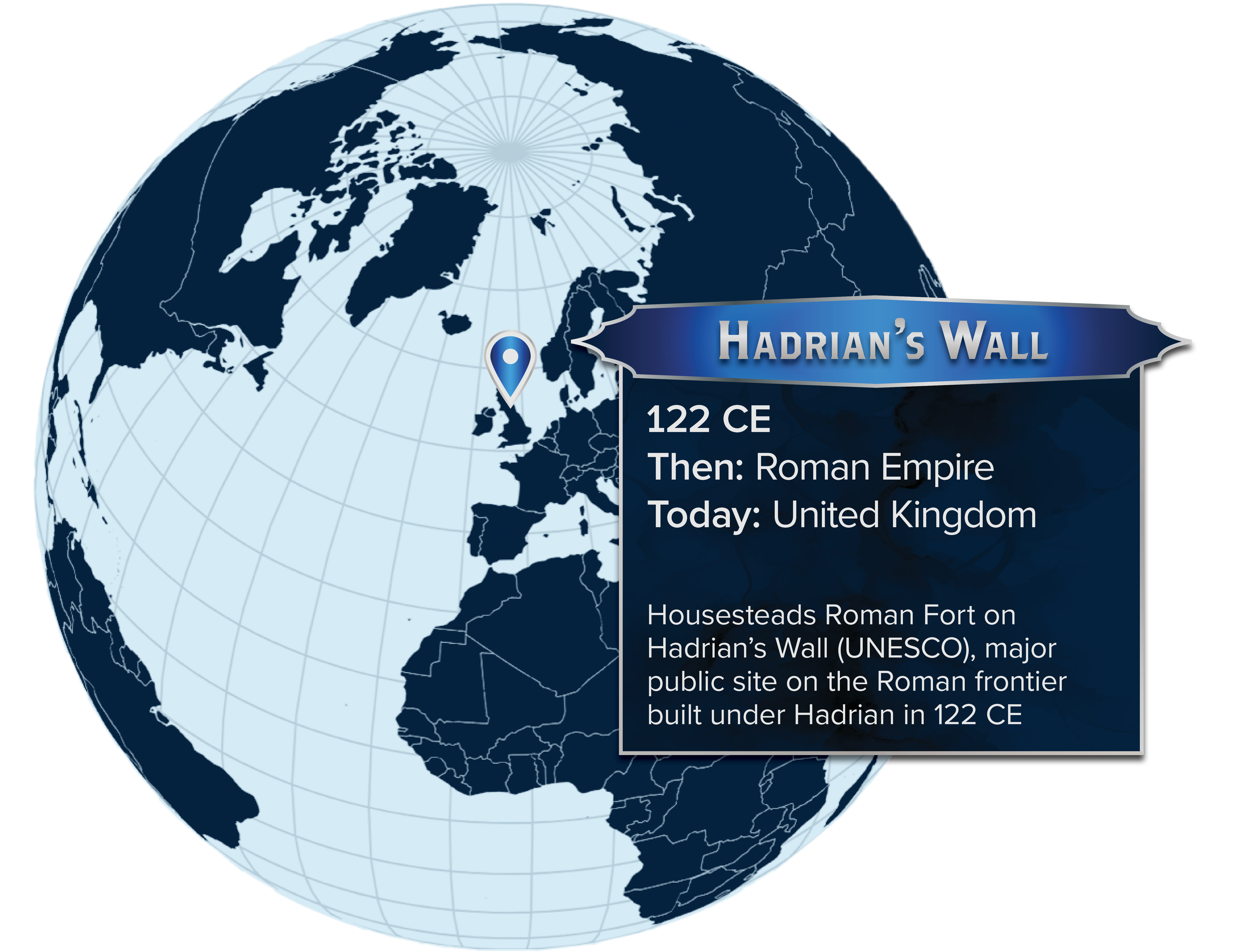
Stretching across the rugged hills of northern Britain, Hadrian’s Wall stands as one of the most ambitious construction projects in the history of the Roman Empire. Built starting in 122 CE under the emperor Hadrian, this massive fortification marked the empire’s northernmost boundary. It signaled a monumental shift in Roman strategy: the era of endless conquest was over, and the era of consolidation had begun. Instead of chasing the northern tribes into the mist, Hadrian decided to draw a line in the stone, creating a physical and psychological edge to the Roman world.
The wall was an engineering marvel, snaking 73 miles from the River Tyne to the Solway Firth. In some places, it rose as a formidable stone rampart nearly fifteen feet high; in others, it was a massive earthen mound topped with turf. This wasn’t just a fence, but a high-tech military zone. Roman engineers placed "milecastles" every mile, with smaller turrets in between and massive forts that housed thousands of troops. Parallel to the wall ran the Vallum, a deep ditch that made it clear to anyone approaching: you are now entering Roman territory.
Despite its appearance, the wall was not a sealed barrier intended to shut the world out. It functioned more like a modern border crossing or a busy airport terminal. It regulated trade, allowed officials to collect taxes, and monitored the movement of people. Archaeological finds at forts like Vindolanda reveal that the people living here were a true melting pot. Soldiers from Spain, Syria, North Africa, and the Balkans lived side-by-side, leaving behind leather shoes, wooden writing tablets, and even invitations to birthday parties. This frontier was a vibrant, multicultural community where Roman discipline met the wild energy of the north.
When Rome eventually withdrew from Britain in the 5th century, the wall was abandoned. Local farmers used its stones to build cottages and barns, yet its shadow never left the landscape. Today, it is a UNESCO World Heritage Site where visitors can still walk along the same stones where Syrian archers and Spanish cavalry once stood watch. Hadrian’s Wall endures as a powerful reminder that borders are more than just lines on a map—they are the places where different worlds meet, trade, and leave behind a legacy that lasts for thousands of years.