Encyclopedia Anachronistica


Chrono
Weapon
Asia
Chinese
Polearm
When this blue or grey Champion spends an action to move, gain +1 ATK for each action spent to move before attacking with this weapon until the end of the round.
Revered as one of the four foundational weapons in Chinese martial arts, the gun is a Chinese staff prized for its versatility, speed, and deceptive simplicity.
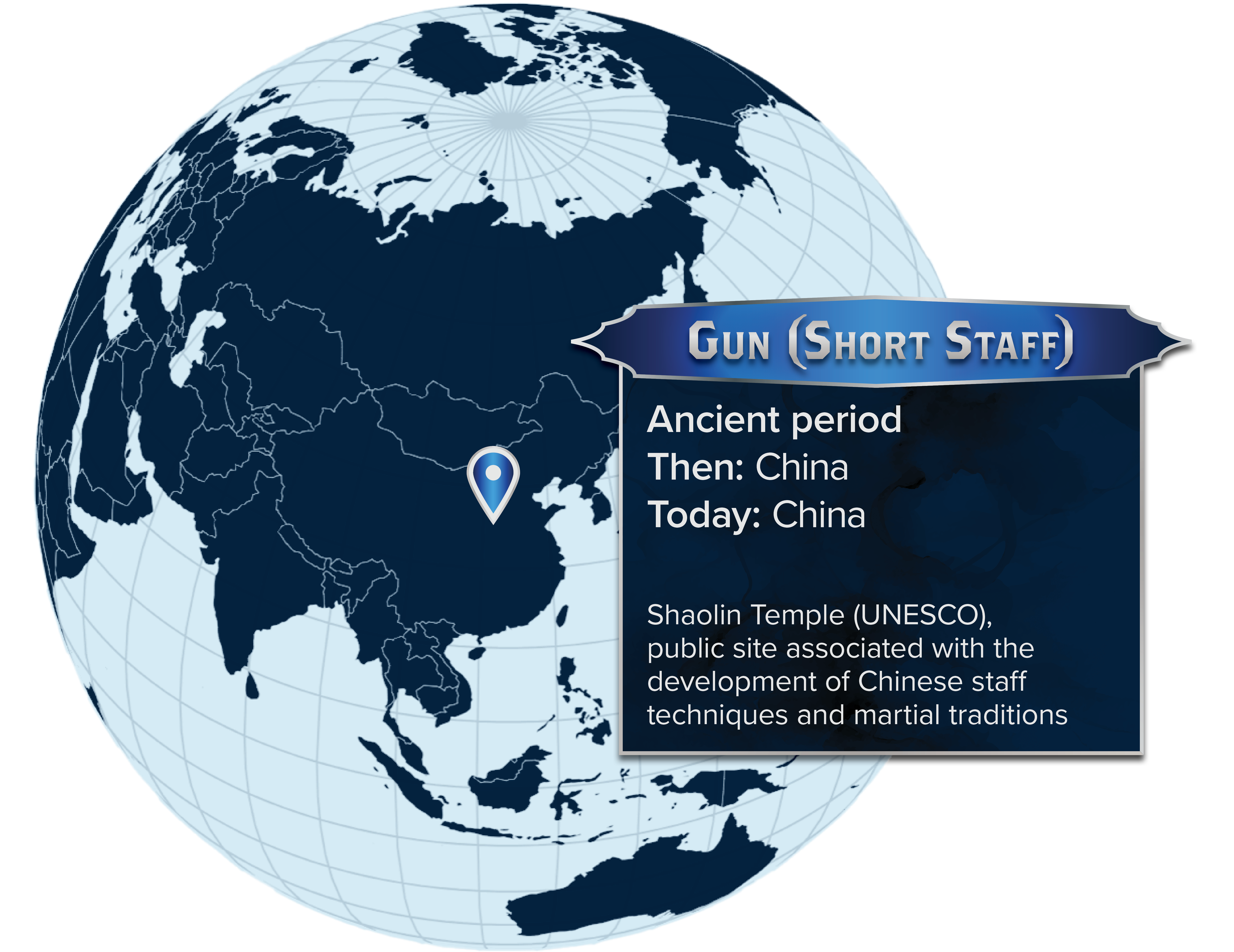
A simple wooden staff might not look like a masterpiece of military technology, but in the hands of a trained practitioner, the gun became one of the most feared and versatile weapons in Chinese history. Long before it was the star of temple legends, the staff was a humble tool of survival: a walking stick for a traveler, a herding pole for a farmer, or a yoke for carrying heavy loads. Because it was inexpensive and didn’t look like a weapon of war, it became the "people’s blade," carried by everyone from merchants on the Silk Road to guards protecting remote villages.
Archaeological evidence shows staff-like weapons in China as far back as the Neolithic period, but they became a true military staple during the Han Dynasty. Measuring roughly six to seven feet long, the gun gave a fighter "reach"—the ability to strike an opponent or an animal before they could get close. Military manuals from the Ming Dynasty, like those written by the famous general Qi Jiguang, reveal that the staff was the "grandfather" of all weapons. Recruits were trained with the staff first because its movements—sweeping strikes, lightning-fast thrusts, and solid stances—formed the foundation for every other weapon in the imperial arsenal.
The gun is most famously linked to the Shaolin Monastery. Starting as early as the Tang Dynasty, monks were known to use the staff to defend their lands and escort travelers. Unlike the sharp, metal weapons used by soldiers, the wooden staff was seen as a more compassionate tool for a monk, capable of subduing an attacker without necessarily being lethal. Over centuries, these monks refined staff-fighting into a high art, turning a simple piece of wood into a spinning blur of defensive power. Their techniques were so effective that they influenced martial arts across all of Asia.
Despite its simplicity, the gun played a massive role in community life. In times of war, villagers armed with staffs became a formidable militia; in times of peace, those same movements were performed in operas and festivals to celebrate Chinese heritage. Today, the gun remains the "mother of all weapons" in martial arts training. It teaches balance, coordination, and how to use the entire body’s strength through a single point of contact. It stands as a reminder that in history, the most enduring tools are often the simplest ones, turning a common branch into a symbol of discipline and survival.