Encyclopedia Anachronistica

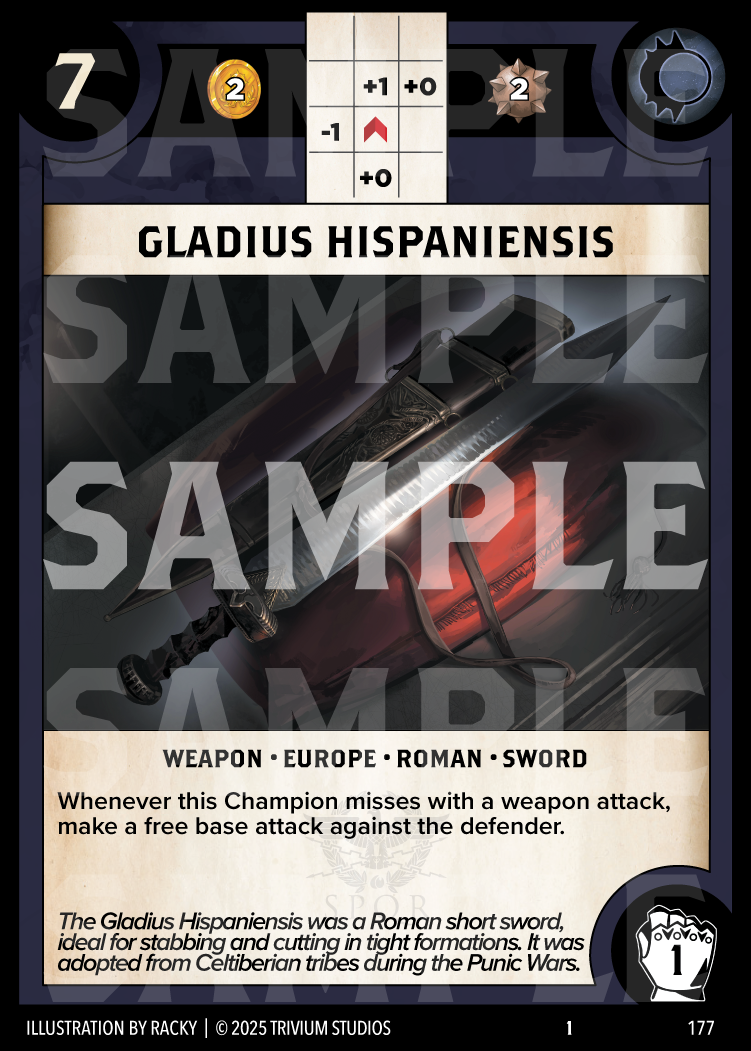
Standard
Weapon
Europe
Roman
Sword
Whenever this Champion misses with a weapon attack, make a free base attack against the defender.
The Gladius Hispaniensis was a Roman short sword, ideal for stabbing and cutting in tight formations. It was adopted from Celtiberian tribes during the Punic Wars.
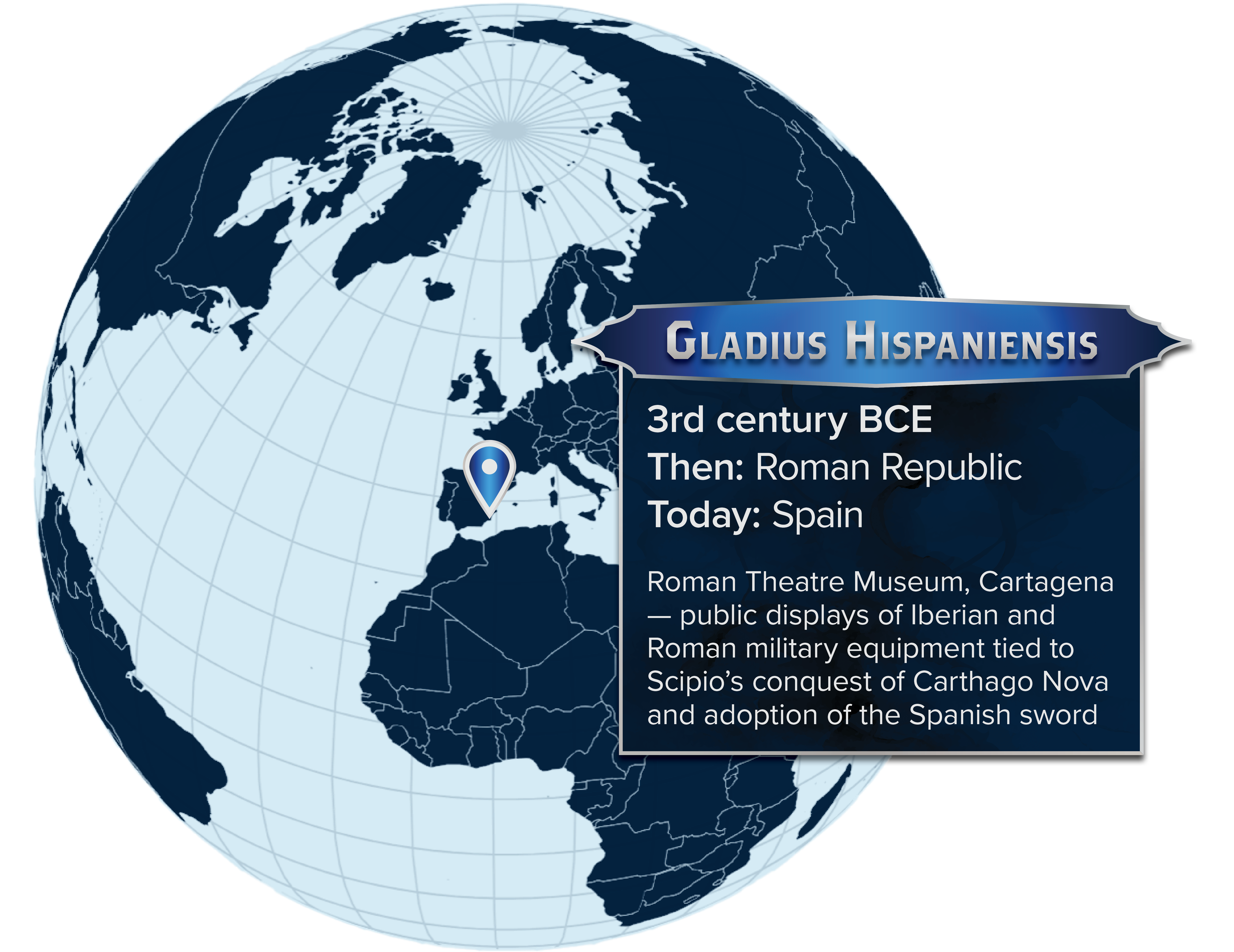
When Roman soldiers marched into battle under the legendary Scipio Africanus, they carried a weapon that was a piece of stolen technology. This was the gladius Hispaniensis, or the "Spanish sword." Before it was a Roman icon, it was the preferred weapon of the fierce tribal warriors in ancient Spain (Iberia). During the bloody wars in the Spanish wilderness, Roman commanders realized that their own long, flimsy swords were no match for these short, terrifyingly efficient Iberian blades. Showing the Roman talent for "borrowing" a good idea when they saw one, they adopted the design and turned it into the most successful killing machine of the ancient world.
The gladius was roughly two feet long and looked deceptively simple, but it was perfectly engineered for the "meat grinder" of ancient combat. In the chaos of a battle, there was rarely room to swing a long sword without hitting your own friends. The gladius solved this by being a "stabbing" weapon. A Roman legionary would crouch behind his massive plywood shield, wait for an opening, and deliver a quick, punch-like thrust. Because it was double-edged and had a reinforced point, it could punch through leather armor and chainmail with ease. Scipio Africanus, one of Rome's greatest tactical geniuses, saw this potential firsthand. He didn't just give his men the sword; he trained them to use it with surgical discipline, transforming the Roman army from a group of brawlers into a wall of blades.
At massive clashes like the Battle of Zama, where Scipio faced off against the brilliant Hannibal, the gladius was the "X-factor." While Hannibal’s war elephants and cavalry grabbed the headlines, it was the steady, rhythmic advance of the Roman infantry—each man armed with a gladius—that eventually broke the Carthaginian line. It wasn't about flashy heroics; it was about a tool that worked perfectly in a system. The gladius turned the Roman legion into a "buzzsaw" that simply didn't stop until the enemy was gone.
Today, you can find the rusted, battle-worn remains of these swords in museums across the globe, often sitting right next to the Spanish originals that inspired them. They serve as a powerful lesson in how the Roman Empire actually worked: they didn't just conquer other cultures; they absorbed their best ideas. For students today, the gladius is a reminder that being the best doesn't always mean being the first to invent something—it means being the best at recognizing a great idea and making it part of your own success. It is the ultimate example of "work smarter, not harder," proving that a two-foot piece of steel could change the course of history more than a dozen war elephants ever could.