Encyclopedia Anachronistica


Chrono
Special
Europe
Roman
Tome
Reveal: Each Champion moves up to two spaces and must end this movement in a starting row.
In his book, Germania, historian Tacitus described Germanic tribes beyond Roman control-praising their simplicity and virtue while subtly critiquing Roman decadence.
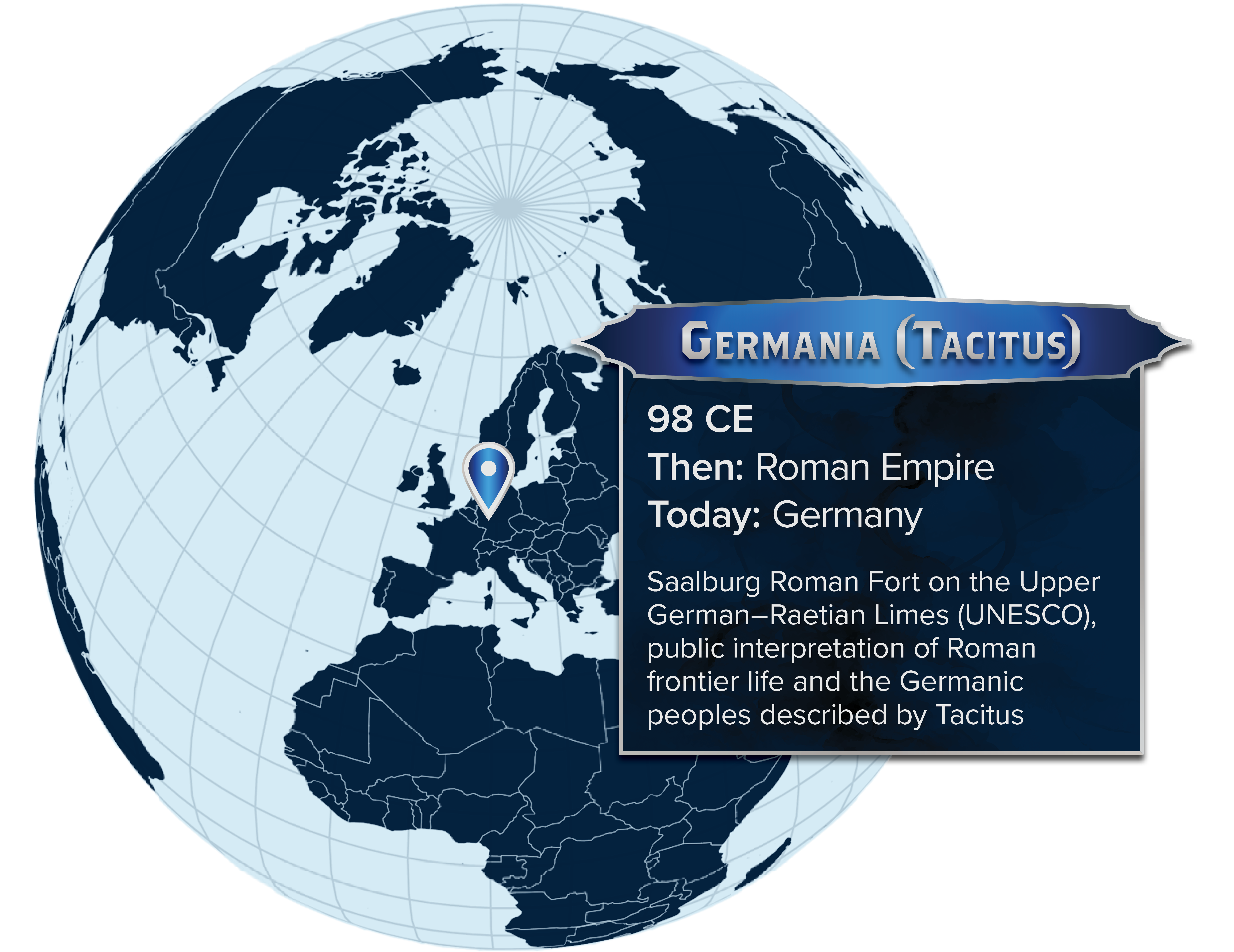
In the year 98 CE, the Roman senator and historian Tacitus sat down to write a book that would become one of the most controversial studies of all time: Germania. Formally titled On the Origin and Geography of the Germans, this was not a book of battle plans or a simple diary of his travels. In fact, Tacitus likely never stepped foot in the lands he described. Instead, he functioned like an investigative journalist, gathering stories from weary soldiers, traveling merchants, and dusty archives to paint a portrait of the "barbarian" tribes living beyond the Rhine and Danube rivers.
At the time, Rome was obsessed with the northern frontier. For centuries, the dense, misty forests of northern Europe had been a source of both mystery and terror for Roman citizens, especially after the memory of the Teutoburg Forest—where three entire Roman legions were wiped out by Germanic warriors—still hung over the empire like a ghost. Tacitus used his writing to explore this world, detailing tribal assemblies where leaders were chosen by merit and warrior bands that prioritized loyalty to their chief above their own lives. He described a people who lived in simple wooden settlements, governed not by complex Roman laws, but by deep-seated tradition and kinship.
However, Germania was more than just a history book; it was a mirror. Tacitus used the "noble" and "simple" lifestyle of the Germanic tribes to criticize what he saw as the rot of Roman society. He praised the warriors for their discipline and courage, subtly shaming his Roman readers for their love of luxury, corruption, and political games. To Tacitus, the Germanic people represented a raw, untamed strength that Rome—in its golden age of excess—was beginning to lose. While archaeological finds often back up his descriptions of their houses and armor, historians know that Tacitus was framing the facts to make a point about Roman morality.
Throughout the centuries, the text took on a life of its own, rediscovered during the Renaissance and later used—and often dangerously misused—to fuel nationalist agendas. Today, Germania remains a vital but cautious window into the ancient world. It captures the exact moment when the Roman and Germanic worlds stood in uneasy contact, peering at each other across the river borders. It reminds us that history is often written by outsiders, and that the way we describe our neighbors usually says just as much about who we are as it does about them.