Encyclopedia Anachronistica

Standard
Special
Asia
Chinese
Item
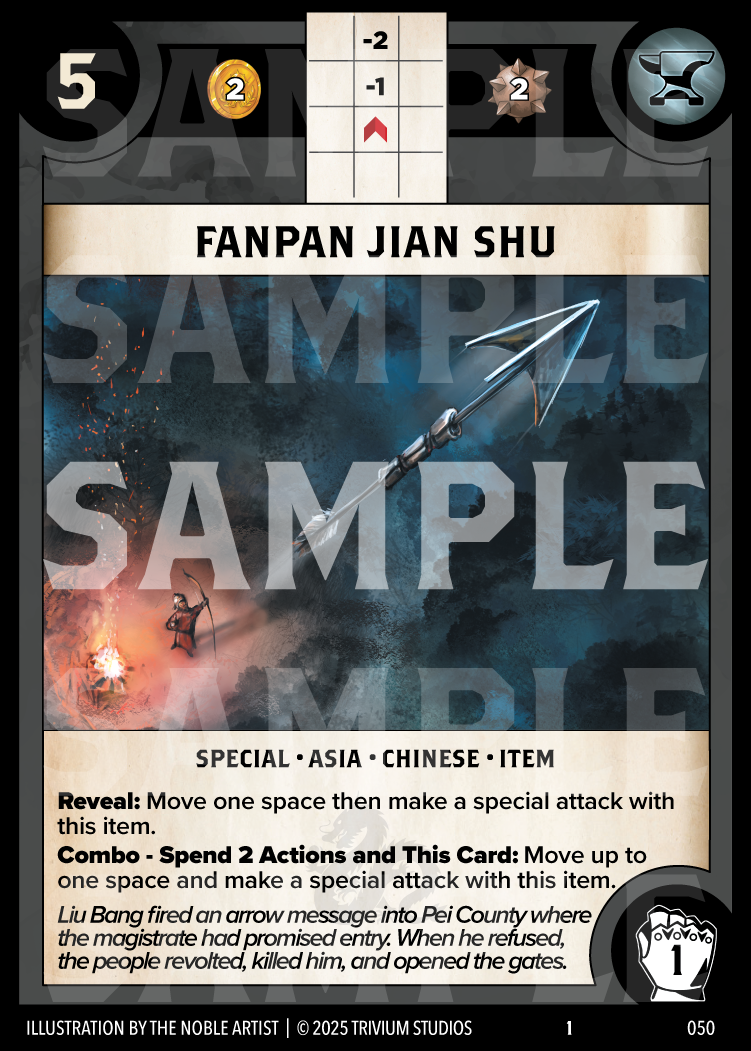
Reveal: Move one space then make a special attack with this item. Combo - Spend 2 Actions and This Card: Move up to one space and make a special attack with this item.
Liu Bang fired an arrow message into Pei County where the magistrate had promised entry. When he refused, the people revolted, killed him, and opened the gates.

Message of Rebellion refers to the use of arrow messages — written declarations or commands tied to arrows and shot into enemy camps or cities — during the early Han period. This technique, used for psychological warfare and covert communication, allowed commanders to deliver threats, rally support, or issue surrender terms without direct contact. The arrow message combined military precision with symbolic force: it pierced defenses both physically and rhetorically.
During the Chu–Han Contention, Liu Bang’s forces reportedly employed arrow messages to communicate with besieged allies and pressure wavering officials. The Shiji records an episode in which a local official had secretly agreed to open a city’s gates for Liu Bang, only to lose his nerve at the last moment. In response, Liu Bang shot an arrow bearing a written message into the city, publicly calling out the broken promise and forcing the official to choose between exposure and compliance. The act transformed a private negotiation into a visible test of loyalty, using shame and resolve as weapons.
While surviving examples are sparse, the practice is alluded to in early historical narratives and later military writings. Messages could be written on silk or bamboo slips and tied beneath the fletching or wrapped around the shaft. The arrow’s flight carried not just information but intent — a declaration that the sender had both reach and the will to act.
Arrow messaging also had ritual and moral dimensions. In Chinese tradition, the arrow was a tool of both war and justice. Shooting a message into a city invoked Heaven’s judgment, framing rebellion as morally sanctioned rather than merely violent. For Liu Bang, who styled himself as a liberator from Qin tyranny, such gestures reinforced his claim to legitimacy and rallied support among uncertain populations.
Today, the concept of arrow messaging survives in literature, film, and martial arts storytelling as a symbol of bold defiance and strategic cunning. Museums and historical parks interpret the practice as part of early Han military technique, and replicas of arrow messages appear in educational exhibits. The technique reflects the fusion of warfare, symbolism, and moral theater that defined Liu Bang’s rise — a rebellion fought not only with armies, but with messages that forced decisions.